[
This is the first in our series of three articles on the
Hindu Trinity of Brahma, Vishnu and Shiva. As we add the
next in the series, we will send out a newsletter informing
you of the same. To subscribe to our newsletter please become
a member for free - click
here. ]
The Hindu Trinity
Aum
Bhur Bhuva Swaha
Tat Savitur Varenyam
Bhargo Devasya Dheemahi
Dhiyo Yo Nah Prachodayat
The protector who is the basis of
the whole universe and who is self existent and who is
free from all pains and whose contact frees the soul
from all troubles exists in different forms in this universe
and sustains all. He is the creator and energizer of
the whole universe, the giver of all happiness, worthy
of acceptance, pure and purifier. That very God let us
embrace, so that God may direct our mind and thoughts.
- Gayatri Mantra, a popular Hindu
Mantra or Hymn
|
Eka Mai Jugat ViyaeeTin
Chele Parvan
Ik Sansari Ik Bhandari Ik Lae Diban
Jiv Tis Bhave Tivey Chalavey Jiv Hove Phurman
Ohu Vekhe Ona Nadar Na Avey Bahuta Ehu Vidan
The Supreme spirit manifested Maya
Who conceived and delivered the Holy Triad
The Creator, the Sustainer and the Destroyer
Yet He ordains as pleases Him for the Triad to act
Even they see Him not Who Sees All
This remains the greatest wonder of all
- Rajender Krishan
|
The plethora of deistic traditions under the
umbrella of the Hindu religion, are united through the concept
of the Trimurti or trinity. One finds depictions of this concept
in beautiful art works or religious texts and ritualistic verses
in Hinduism. However, in practice it is more of a philosophical
symbol which depicts the three aspects of the Supreme Being,
all of which need to concur for the creation, preservation and
eventual destruction of all that exists in the Universe.
The Trimurti (literally indicating three forms
or trinity), is the representation of the three projections
of the Supreme Reality, each with a specific cosmic function.
These
manifestations are that of Brahma (serving the cosmic function
of creation), Vishnu (serving the cosmic function of renewal
and preservation), and Shiva (serving the cosmic function of
dissolution or destruction that precedes re-creation) – the
three popular Hindu gods. Our daily existence reflects these
three cosmic functions as birth, life and death. A somewhat
similar symbolization exists in the Christian trinity of God
as the Father,
Son and Holy Ghost. However the interpretation and philosophy
behind the Christian and Hindu concepts of the trinity differ.
The trinity is interpreted in various forms
in Hindu philosophy. A widely accepted belief is that it represents
earth, water, and fire. The earth, or Brahma, is seen as the
originator of all life and hence is regarded as the Creator.
Water is the sustainer of life and hence is the Preserver and
is represented as Vishnu. Fire destructs life and hence is the
Destroyer and is represented as Shiva.

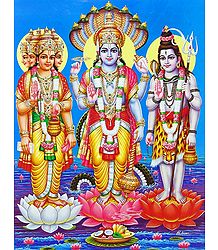
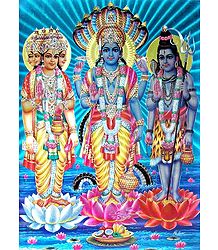
Buy
this painting |
TRIMURTI
- BRAHMA (LEFT)
VISHNU (CENTER) SHIVA (RIGHT)
Courtesy Exotic India |
The trinity also represents the three fundamental
gunas or qualities, as described in the Bhagavad-Gita - the
sacred Hindu philosophical text. These qualities are the quality
of
passion or desire (rajas – as represented by Brahma, because
passion or desire results in procreation), the quality of mercy
(satva – as represented by Vishnu, because mercy preserves
life), and the quality of darkness and wrath (tamas – as
represented by Shiva, because darkness equates with the annihilated
state of the universe).
The Trinity represents three individual forms
on the different planes of Consciousness. On the Physical plane,
the psychic element is represented by Brahma, the mental element
by Vishnu, and the physical element by Shiva. On the mental plane,
Brahma is the intuitive and creative thought, Vishnu is intelligence
and Shiva stands for emotions and feelings. The Sky as Brahma,
the Sun as Vishnu and the Moon as Shiva form the earthly plane.
Various phases of an individual’s life
are said to be represented by the Trinity. The first of these
phases, that of celibacy and studentship, (Brahmacharya Ashram) – is
represented by Brahma. During this phase, knowledge is the individual’s
constant companion. Knowledge of course is represented by Goddess
Saraswati, who is said to be the consort of Brahma.

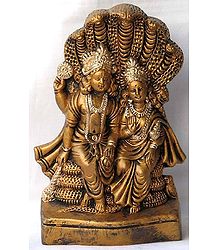
Buy
this sculpture |
VISHNU
- GOD OF PRESERVATION
AND HIS CONSORT LAKSHMI
Courtesy Exotic India |
The second phase of adulthood and household
(Grihastha Ashram) is represented by Vishnu. During this phase,
the individual fulfils all religious and family obligations by
involving oneself in generating wealth, which one uses to sustain
oneself and one’s family. During this phase wealth is the
individual’s companion and is represented by Vishnu’s
consort, Goddess Lakshmi.
The third phase is that of old age (Vanaprastha
Ashram) and is represented by Shiva. This phase marks the renunciation
of one’s worldly life for a life void of material pleasures,
dedicated to the pursuit of true knowledge. In ancient days,
this typically marked the time when a householder, along with
his wife, left their worldly belongings to spend their life in
a forest, just like Lord Shiva leads a homeless life with only
the essential belongings.
The final phase (Sanayasa Ashram) the individual
seeks to merge oneself with the Supreme power (Ishwara). One
completes the process of renunciation and he along with his wife
lead a life completely untouched by any attachments. The only
occupation becomes deep meditation, leading to the individual
becoming Ishwara Himself, with his wife as Ishwara’s consort
becoming the Universal Mother.
The three phases of life, represented by the
Trinity thus culminates into One underlining the fact that the
three are in reality one and the same Ishwara.
An interesting legend illustrates this concept
beautifully. Once, Brahma, Vishnu and Shiva were boasting about
their great powers. All of a sudden, a young boy came forth,
and asked Brahma as to what he creates. Brahma quickly replied
with pride, “Everything”. When he asked Vishnu and
Shiva as to what they sustain and destroy respectively, he got
the same reply from both Gods – “Everything”.
Showing Brahma a small straw, the young boy asked him if he could
create a straw just like the one he was holding. However, even
after a great deal of effort, Brahma was unable to do so. The
child then turned upon Vishnu and asked him whether he could
preserve the dissolving form of the straw but Vishnu looked on
helplessly. The child finally asked Shiva to destroy the small
straw but despite Shiva’s best efforts, the straw still
remained as it was. Then the boy turned again towards Brahma
and asked him whether he was the child’s creator. Even
after great thought Brahma could not remember having created
this bright child. The child then suddenly vanished, and the
three Gods then remembered that there always is the Supreme God
behind their amazing powers.
Each of the Gods in the Trinity has
a consort and each God is inseparable from his female part,
or Shakti (cosmic
power or cosmic force). Saraswati, the goddess of knowledge
is the consort of Brahma. Lakshmi, the goddess of wealth, love,
beauty and delight is Vishnu’s consort. Shiva has Parvati
as his consort, the Goddess of power, destruction and transformation.
Just as the Trinity, Saraswati, Lakshmi and Parvati are the three
main goddesses in Hindu religion. The three Goddesses are often
worshipped individually, as also as spouses of the Trinity Gods.
The Puranas say that the Trimurti (Trinity)
originated from Adi Shakti – or the Supreme cosmic Energy – as
symbolized by a female form – the universal Mother. The
Trimurti was originally worshipped as a single deity, as a representation
of the Brahman or the Supreme Being. However later, each God
was separated from the single form and now the unified form is
not worshipped anymore. Of the three Gods forming the Trimurti,
Brahma is not worshipped except at a very few places while Vishnu
and Shiva both have huge followings.
Brahma, the Creator
Hindu mythology addresses Brahma – the
omniscient, the source of all that exists, the causation of all
forms and events - by various names. He is the single syllable “Om” – the
eka aksharam (single letter). As the self-born uncreated creator,
he is Swayambhu. As the first manifestation of one’s existence
he is Ahankara. As the embryo from which the universe originates,
he is Hiranya Garbha (golden embryo), the ball of fire. As all
creatures are his progeny, he is Prajapati (king of kings). He
is also Pitamaha (patriarch), Vidhi (ordinator), Lokesha (master
of the universe) and Viswakarma (architect of the world).
Some Hindu texts say that Brahma emerged from
Brahman, the Supreme Being – the Consciousness. Brahman
wanted to create the universe. To this end, he first created
water, into which he deposited his seed. This seed became a
golden egg, and from this egg, he was born as Brahma or Hiranyagarbha,
born from the golden egg. Since he was born in water, he is
also
known as Kanja (water born).

Buy
this painting |
BRAHMA
EMERGING ON A LOTUS
SPRUNG OUT OF VISHNU'S NAVEL
Courtesy Exotic India |
The Mahabharata gives a separate version of
Brahma’s origin in which, Brahma arose from a lotus (Kamala)
with thousand petals that grew out of Vishnu's navel (Nabhi).
This legend explains his name Nabhija (navel born).
According to the Puranas, Brahma is said
to be the son of the Supreme Being and his female energy, Maya – the
cosmic illusion which keeps all life under a veil of separation
from the Supreme One.
It is said that Brahma creates and recreates
the universe time and again. One creation of his lasts one Brahma-day
which is equivalent to a period of 4,320,000,000 human years
in terms of the Hindu calendar. Each Brahma-day (Kalpa) comprises
a thousand Mahayugas each of which comprises the four Yugas or
Ages.
1. KRITA (OR SATYA)-YUGA
2. TRETA-YUGA
3. DWAPARA-YUGA
4. KALI-YUGA
TOTAL
|
432,000 x 4 = 1,728,000 years
432,000 x 3 = 1,296,000 years
432,000 x 2 = 864,000 years
432,000 x 1 = 432,000 years
4,320,000 years
|
It is said that each Yuga's length decreases
progressively in relation to increasing moral and physical decadence
in each age. As a result, in Krita Yuga, virtue prevails while
evil is unknown while in Kaliyuga, evil takes a strong grip.
When Brahma goes to sleep at night after the
end of his day, all of his creations get dissolved into the universe.
The night again lasts for the same period as the day. The dissolution
of the universe during the Brahma-night is called the Pralaya.
When he awakes he again restores the whole creation for the next
Kalpa.
Brahma is said to have a life of hundred
Brahma-years, each year comprising 720 Kalpas (360 each Brahma-days
and Brahma-nights). This process of creation and dissolution
goes on till the hundred years of Brahma's life are completed.
At the end of these hundred Brahma years, all that exists, including
Brahma and all other Gods – the whole universe - dissolves
into its constituent elements.
At the beginning of the process of creation,
Brahma created ten Prajapatis, who are believed to be the fathers
of the human race. The Manusmriti enumerates them as Marichi,
Atri, Angirasa, Pulastya, Pulaha, Kratu, Vasishtha, Prachetas
or Daksha, Bhrigu, and Narada. He is also said to have created
the seven great sages or the Saptarishi to help him create the
universe. However since all these sons of his were born out of
his mind rather than body, they are called Manas Putras or mind-sons.
The depiction of Brahma in Hindu art and
religious texts is replete with interesting legends and interpretations.
In addition to being the creator of the universe,
Brahma delegates various duties to all creatures, and based on
these he decides the incarnations to be bestowed on each creature.
To be fully aware of the deeds of all creatures at all times
is therefore indispensable and hence Lord Brahma is shown with
four heads, to look in all four directions.
The four heads of Brahma has earned him the
name Chatur Mukha (the one with four heads). The heads represent
the four Vedas – holy Hindu text (Rigveda, Yajurveda, Samaveda
and Atharvaveda). They also symbolize the four Yugas – epochs
of time (Krita Yuga, Treta Yuga, Dwapara Yuga and Kali Yuga)
as well as the four castes or Varnas (Brahmana, Kshatriya, Vaishya
and Shudra). The four castes are believed to have originated
from the various body parts of Brahma: the Brahmanas from his
head, the Kshatriyas from his arms, the Vaishyas from his thighs,
and the Shudras from his feet.
Even though Brahma is typically shown as
having four heads looking in the four directions, legend holds
it that at one time he had five heads, the fifth looking upwards.
However originally he is said to have possessed just one head.
At that time the cosmos did not exist and Brahma was self-contained
and self-content. However he eventually started longing for company.
At this time, he split himself to form a female form, called
Satarupa (the one with a hundred beautiful forms). As he laid
his gaze upon Satarupa, Brahma immediately felt attracted towards
her. To avoid Brahma’s gaze, Satarupa tried to slip off
in various directions but was unsuccessful as Brahma developed
a head in each direction. Finding no other way, Satarupa start
ascending upwards but then too, Brahma developed a head that
looked upwards. Shiva noticed all that was happening. Since Satarupa
originated out of Brahma, Shiva felt Satarupa was a daughter
of Brahma and hence it was improper of Brahma to be obsessed
with her. Shiva therefore cut off the head of Brahma that looked
upwards so she could escape him. As an additional punishment
for this unholy behavior of Brahma, Shiva cast a curse on him
and directed that there be no proper worship of Brahma. Ever
since, only Vishnu and Shiva out of the three Gods comprising
the Trinity are worshipped while Brahma is almost totally ignored.
It is also said that since then Brahma has been trying to redeem
himself of his sins by continuously reciting the four Vedas.
According to Shiva Purana, the incestuous union of Brahma and
Satarupa resulted in the birth of Swyambhu Manu, who eventually
turned out to be the progenitor of Man.
There exists another version of the cutting
off of Brahma’s fifth head. According to the Puranas, Brahma
and Vishnu once had an argument over who was the Supreme God.
The Vedas however declared Shiva as the Supreme Being. Having
discovered this, Brahma started speaking insultingly about Shiva.
To teach Brahma a lesson, Shiva cut off the head which had spoken,
and therefore Brahma was left with four heads.
In spite of being one among the three gods
forming the Trinity, worshipping of Brahma worship is not as
widespread as worshipping of Shiva or Vishnu. In India, there
are only two temples dedicated to Brahma, as against thousands
dedicated to Shiva and Vishnu. One of these two temples is at
Pushkar near Ajmer in Rajasthan. The other is at Khedabrahma
in Kerala. It is believed that once Lord Shiva stood in the form
of a great linga with no end under the ground or in the sky.
Brahma and Vishnu threw each other a challenge of superiority
in which one of the ends had to be reached. Brahma took the form
of a swan and flew upwards while Vishnu turned into a boar and
started digging into the ground. However, even after a lot of
efforts, neither of the two found the end of the linga. However
to exert his superiority, Brahma came back and lied to Vishnu
about having found the top of the linga. Shiva flew
into a rage as soon as Brahma uttered the lie and took his own
form from the linga and cast a curse on Brahma and declared that
he would never be worshipped. Further, since the Ketaki flower
stood witness to Brahma’s blatant lie, Shiva cursed the
flower as well and since then the Ketaki flower is not used in
religious rituals.
Since Brahma is the creator of all life and
hence our ancestor, and his existence has been for ages beyond
our comprehension – since in a day of Brahma’s life
eons pass, his appearance is made to match the near eternal nature
of his existence by depiction of a white beard on all the four
faces and eyes closed in meditation.
Brahma is typically shown without any form
of weapons. Since he is also called the lord of sacrifices, he
is shown holding a scepter in the form of a spoon, which is associated
with the pouring of holy ghee or oil into a sacrificial pyre.
Some depictions of Brahma however do show him holding a bow,
which is said to be the weapon of Brahma. Lord Brahma is depicted
as holding a coconut shell bowl filled with water, in one of
his hands. The significance of the water is that initial all
encompassing ether in which the first element of creation evolved.
In another hand of Brahmas are held the Vedas, which are considered
to be the primeval text of creation – containing all the
knowledge there was, is and will ever be. It is said that even
the Pralayas could not destroy the Vedas since Brahma himself
took incarnations to save the Vedas during the deluges. The Vedas
have neither origin nor end and reminds Brahma of his previous
Kalpa. The indestructible nature of the Vedas signifies the fact
that all except truth – the Supreme Consciousness - is
destructible. A Rosary adorns another hand of Lord Brahma. The
rosary signifies the importance of reminding oneself of the almighty,
the Supreme God, by reciting His name through the mundane passage
of each day in one’s life. Lord Brahma’s hand postures
(mudras) are those of Abhaya (protector) and Varada (giver of
boons). Both the postures have the palms facing outward, with
the former being that of the fingers of the palm facing upwards
while the latter has the fingers facing downward.
Brahma resides in what is known as Brahmaloka.
His abode is said to contain all the splendors of earth and of
the heavens of the other gods. He is typically shown in one of
the two forms of a standing or sitting position on a lotus or
of a sitting position on a Hamsa (swan). The lotus is known to
grow in muck. The seat of Lord Brahma as the lotus signifies
that one should try to attain freedom from the shackles of influences
of one’s origin in passion and illusion.
A divine white swan or goose is depicted as
the vehicle of Brahma. This divine bird is bestowed with a virtue
called Neera-Ksheera Viveka or the ability to separate milk and
water from a mixture of the two. The significance of this is
that justice should be dispensed to all creatures, however entwined
it might be in a situation. Also, this virtue indicates that
one should learn to separate the good from the evil and then
accept that which is valuable and discard that which is worthless
or evil.
|
|

Buy
this painting |
BRAHMA
SITTING
ATOP THE WHITE SWAN
HIS DIVINE VEHICLE
Courtesy Exotic India |
|

Buy
this doll |
GODDESS
SARASWATI
AS DEPICTED THROUGH
THE BHARATNATYAM
DANCE FORM |
Goddess Saraswati is Brahma's consort and
feminine counterpart. She is the Goddess of wisdom and knowledge.
Her name comprises two Sanksrit terms – Sara or essence
and Swa or self, which indicates a connotation of the Essence
of the Self. Literally, however, the word Saraswati means “the
one which flows”. The Rigveda mentions Saraswati in the
form of a divine river and hence gets associated with fertility
and purification. She has some other designations too – Sarada
- the giver of essence; Vageshvari – the mistress of speech;
Brahmi - the wife of Brahma; and Mahavidya – the supreme
knowledge.
Brahma’s creative force is represented
by Saraswati, who is the master of the 64 arts. Being the Goddess
of Knowledge, she is the worshipped deity of all those, seeking
and dispensing knowledge of any form, viz. both teachers and
students. She is depicted as an extremely fair, young and beautiful
lady with four arms and as attired in a white sari and as sitting
on a white lotus flower. A white swan is also shown as her accompanying
divine vehicle.
She holds in her hands a stringed instrument – the
divine Veena – since she is the master of the arts. In
her right hands she holds a book made of palm leaves and a lotus,
signifying the need of using knowledge with love and kindness
for the good of all creation. On her left hand she wears a necklace
of pearls, which symbolize meditation and the path leading to
oneness with God – the state of Samadhi. The two arms on
the front represent her presence in the physical world while
the arms on the back represent her presence in the spiritual
world. Brahma along with Saraswati, represents the spirit of
the Vedas, from which all knowledge originates.
Various Hindu mythological legends tell tales
of how Brahma’s lack of discretion in granting boons to
even demons led to great damages to the Universe. At all these
occasions Vishnu has had to appear and set right the bad situations
precipitated by the powers bestowed upon the demons thanks to
the boons of Brahma. This ungodly trait of Brahma contributes
to his unpopularity in terms of a deity. Further the nature of
his cosmic function of procreation leads naturally to thoughts
of passion and the flesh which is attributed a somewhat less
desired connotation than thoughts of the soul and God. Another
extension of the his cosmic functionality being the cause of
the lack of popularity is the fact that his active function ceases
since he has already created the universe and now Vishnu and
Shiva have active roles to play. As a result people tend to flock
more to Vishnu and Shiva than to Brahma.
Brahma will, of course, exert his powers
during the creation of a new universe after this one is destroyed
and to that extent, his role as the master creator and the originator
of all knowledge will always remain in the minds of all Hindus.
[ This is the
first in our series of three articles on the Hindu Trinity
of Brahma, Vishnu and Shiva. As we add the next in the series,
we will send out a newsletter informing you of the same.
To subscribe to our newseletter please become a member for
free - click
here. ]
This article was written by:
Madhuri Guin Our efforts have been directed at making this article informative and refreshing for you. We will truly appreciate all forms of feedback. Please send your feedback to newsletter@dollsofindia.com.
|