Please wait...

[ This is the second in our series of three articles on the Hindu Trinity of Brahma, Vishnu and Shiva. As we add the next in the series, we will send out a newsletter informing you of the same. To subscribe to our newsletter please become a member for free - click here. ]
Our previous newsletter (Brahma - the Creator Amongst the Hindu Trinity) explains the concept of the Hindu trinity and outlines the three Gods - Brahma, Vishnu and Shiva - who form the Trinity or Trimurti. We then described lord Brahma and his tales in detail. In this newsletter we talk about Lord Vishnu.
Shaantaa-kaaram bhujh-gasheinam padma-naabham
suresham
Vishva-aadhaaram gagan-sadrisham meghvaran shubh-aangam
Laxmi-kaantam kamal-nayanam yogibhir-dhyan-gamyam
Vande vishnu bhav-bhay-haram sarva-lokeik-naathanam
He, who possesses a tranquil form, lies on the bed of snake, from whose naval has sprung the lotus... He, who is the Lord of all Gods, the support of the universe, who is similar to the sky and has the color of the cloud and possesses handsome limbs... He, who is the lord of Laxmi (goddess of wealth), having lotus -like eyes and realized by yogis (sages) in meditation... Obeisance to that Vishnu who is the dispeller of the fear of rebirth and is the lord of all the worlds.
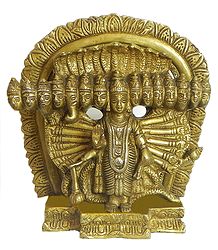
Vishnu is the lord of preservation and is known as the All-Provider. He performs the cosmic function of cohesion. The constructive nature of his cosmic function stands out in contrast against the destructive dispersive power of Shiva. Vishnu's function is to ensure the sustenance of the universe that Brahma has created. He represents the cosmic cause of existence and the symbolization of eternal life which keeps the universe as one.
Though he is one of the three Gods comprising the Trinity, his status in the minds of a big number of followers of Hinduism (this sect is often known as Vaishnavas) rose with time and eventually he came to be viewed as the supreme God. He is deemed to be omniscient, omnipotent and omnipresent. The Padma Purana identifies Vishnu with Brahman, the Supreme Being. Its version of the beginning of creation is thus: When the Supreme Being (identified as Vishnu himself), wanted to create the universe he transformed himself into three powers - the right side of his became Brahma, the Creator, the left became Vishnu, the Preserver and the middle portion became Shiva, the Destroyer.
Vishnu is seen as being the divine arbitrator of all disputes - whether involving humans or gods. He ensures the establishment of peace by interceding on behalf of others. Vishnu personified tolerance and patience and gentleness is the hallmark of his personality.
The name Vishnu owes its root to the word "Vish", which indicates "spreading in or pervading all directions". It is indicated that he is the core in all that exists as well as the force which keeps everything tied. He is said to pervade everything just as an infinite ocean. It is this ocean from which the universe is said to have emerged. Since water is also known by the word "Nara", his name Narayana, has a natural linkage with water. Narayana literally means he who moves on the waters.
The Hindu religious texts of the Puranas and some of the minor Upanishads elaborate upon the significance of the symbolization of Vishnu in Hindu religious art form. He has two popular representations - both incorporating his symbol, water. He is often shown as resting on the coils of the thousand headed serpent God, Sheshnag, who in turn is seen surrounded by the waves of a vast ocean (often an ocean of milk - or the Ksheersagara), with its hood open over the head of Vishnu. The river Ganga is said to originate from Vishnu's feet. Another frequent presence in this representation is the depiction of Brahma, the creator, sitting on a lotus that grows out of Vishnu's navel. Vishnu is shown as having four arms, each of which holds one each of the four divine objects that Vishnu carries. The other popular representation shows him with his four hands and four divine possessions, standing on the waves of a vast ocean (again, often of milk).
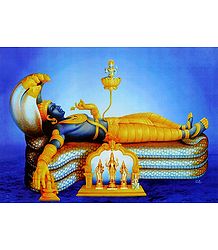
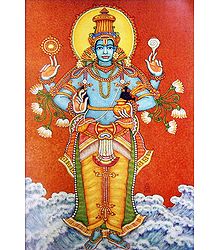
This ocean of milk on which Vishnu resides is the symbol of our inner self, or our Anthakarana - the consciousness in Man which is as pure as the white in an ocean of milk. God is thus shown as residing in our own inner self. It is said that one can become aware of one's inner self only by ridding oneself of all negative thoughts and feelings, controlling one's senses and by the practice of Namasmarana (reciting God's name), service and meditation. The abode of Lord Vishnu is called Vaikuntha, which according to Hindu mythology, is a place of great riches and where there is no sorrow. Vaikuntha basically points towards an ideal state of mind free of sorrow or grief or pettiness when the mind unites with God.
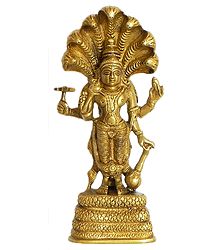
In his hands Vishnu is shown carrying a conch (Shankha), a mace (Gada), and discus (Chakra). A crown adorns his head while he wears earrings, a garland (Mala) of flowers, and a gem around his neck. His blue body is draped in yellow clothes and is marked by rich and regal ornamentation.
The four arms indicate the all-pervading and all-powerful nature of Vishnu. The physical existence of Vishnu is represented by the two arms in the front while the two arms at the back represent his presence in the spiritual world. The creative and intellectual aspects of the mind are represented by the right side of his body while love, kindness and compassion - associated with the heart - are represented by the right side of his body. One of the Upanishads (set of religious Hindu texts), titled Gopal Uttartapani describes the four arms of Vishnu.
The lower right hand is said to represent creativity and holds the conch, which is the symbol of the five elements. The Conch or Shankha is named Panchajanya, or the originator of the five basic elements - water, fire, air, earth and sky or space. It is said that the sound that evolves from blowing this conch is the primeval sound of creation. The blowing of the Conch by Vishnu is said to remind his devotees to practice kindness and compassion towards all of existence, kindness and compassion being the language the Lord uses to address his devotees.
The upper right hand represents cohesiveness and holds the discus which symbolizes the mind and shines like a tiny sun. Vishnu uses the discus as a weapon to slay evil by cutting off the heads of demons. The Discus or Chakra is named Sudarshan. This name is derived from two words - Su, which means "good", and Darshan, which means "vision". The discus as a weapon thus indicates the necessity of destroying one's ego and illusory self-existence and developing the vision to identify the eternal truth. The discus has six spokes and symbolizes a lotus with six petals, thus representing the power that controls all six seasons.
The upper left hand represents liberation or dispersion and holds the lotus which symbolizes the power from which the universe emerges. The lotus of Vishnu is named Padma. Since a lotus resides in muck and yet stays fresh and pure, Vishnu's lotus becomes the symbol of purity and represents the unfolding of creation. It represents truth or Satya and the originator of the rules of conduct or Dharma; and knowledge or Gyana.
The lower left hand represents individual existence and holds the mace, which symbolizes the primeval force from which all mental and physical strength is derived. The Mace, or Gada is named Kaumodaki.
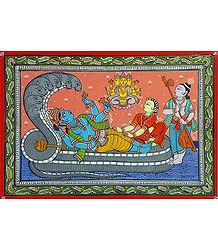
Shesh Nag, the divine snake, with its thousand hoods, in the common representations of Vishnu depicts mind of an individual with its numerous desires, which, just like the venom of a snake, kill by virtue of their evil possessive nature. The lord is shown as sitting over the coiled snake as if to depict that instead of desires controlling him, it is he who has control over desires. It is an indication of the necessity of an individual to control one's desires so as to grasp the eternal truth and become one with the Supreme Being.
The all-pervasive nature of Vishnu is symbolized by all that's blue in various representations of his. The sky in the background of his representation depicts the fact that he pervades the entire universe. Since the sky is blue in color, the same color of his body indicates his infinite nature. Just like the blue sky he too is formless and immeasurable.
The yellow color of his clothing associates his existence to the world. They indicate that he would incarnate himself in our world for upholding righteousness and destroying evil.
The flower garland around Vishnu's neck is a symbol of the devotee's love for him. The gem decorating his neck is a representation of Vishnu's function of fulfilling the genuine desires and needs of his devotees. The crown on his head symbolizes his supreme authority. The two earrings of his represent the inherent opposites in creation - knowledge and ignorance; happiness and unhappiness; pleasure and pain.
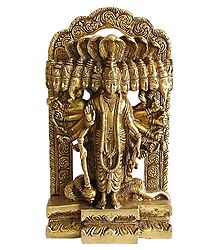
Lord Vishnu is sometimes depicted in a grand manner as representing a magnification of his essence containing the entire cosmos, in a form known as Vishwaroop (Vishwa - the cosmos; Roop - form or manifestation). This depiction came from the ancient Hindu philosophy which indicated that through the diversities of creation there always is a connecting essence that threads everything into a unified whole. While the Trinity of Brahma, Vishnu and Shiva represents the Supreme Being's diversified manifestation, the Vishwaroop form of Vishnu represents the spiritual concept of all creation being nothing more than diverse manifestations of a single essence. Since Brahma's function ceases once the process of Creation is completed and Shiva himself represents the cosmos or an extension of the cosmos, it is Vishnu, in whom the Creation sustains and prevails, who requires cosmic magnification as the form of Vishwaroop to drive home the point that the Supreme Being not only contains all creation but also sustains it.
The Vishwaroop depiction shows Lord Vishnu as having seven heads on each of his left and right. Each of these has its own cosmic function or represents an aspect of the cosmos. The gods depicted include Shiva, Brahma, Ganesha, Hanuman, Indra, Agni (Fire God), Surya (Sun God), Chandra (Moon God), Maruta (Wind God), Kubera (God of wealth), Varuna (God of water) and Yama (Time) and Brahma's three sons. Vishnu retains the central position. While Shiva, Brahma and Vishnu together form the Trinity, Ganesh and Hanuman represent faith and divinity. Agni or Fire represents life, energy and vitality. Maruta, the wind-god represents space, while Indra represents rains and cosmic balance. Yama depicts the infinite nature of time while Varuna the ocean God represents water. Kubera represents prosperity and riches. The Sun and Moon represent the cycle of birth, death, decay and finally dissolution. Brahma's three sons represent the entire mankind. Taken together as one entity they constitute the entire cosmos.
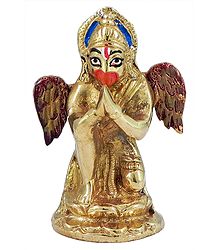
Vishnu's divine vehicle is Garuda, a giant eagle, often depicted as having a human body and senses and bird-like forehead, wings, beak and nails. He wears a crown on his head like his master, Vishnu. His stature in Hindu religion can be gauged by the fact that an independent Upanishad, the Garudopanishada, and a Purana, the Garuda Purana, is devoted to him. Various names have been attributed to Garuda - Chirada, Gaganeshvara, Kamayusha, Kashyapi, Khageshvara, Nagantaka, Sitanana, Sudhahara, Suparna, Takshya, Vainateya, Vishnuratha and others.
The Vedas provide the earliest reference of Garuda, though by the name of Shyena, where this mighty bird is said to have brought nectar to earth from heaven. The Puranas, which came into existence much later mention Garuda as doing the same thing, which indicates that Shyena and Garuda are the same.
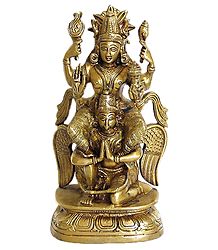
Garuda was born of sage Kashyapa and his wife Vinata. It is said that Valakhilyas - the group of 60000 thumb-sized sages - handed over the fruit of their great penance to sage Kashyapa, who in turn handed it over to Vinata - his wife. Vinata then bore an egg, directly from which arose Garuda, complete with huge wings. One of the most popular tales of Garuda describes his stealing the divine nectar of immortality or amrit from heaven. Garuda's mother Vinata was enslaved by Kadru, his step-mother, when Vinata lost a wager to Kadru, albeit through deceit, perpetrated by Kadru. Kadru asked for Amrit as ransom to release Vinata. On hearing this Garuda reached Indra's capital Amravati in search of Amrit. Indra's armies of Gods tried to stop Garuda but he defeated them all along with all other divine forces which tried to stop him from reaching the divine well holding the nectar of immortality. He brought the nectar with him to his step-mother, Kadru but answered Kadru's deceit with his own and without handing over the nectar, got his mother, Vinata, released. Vishnu had noticed the proceedings and was impressed by Garuda's honesty in that he had not once touched the nectar that he was carrying for so long. Vishnu requested Garuda to become his vahana or vehicle, to which Garuda agreed but put forth two conditions - one that he be held higher to Vishnu and second that he became immortal without drinking the immortality nectar. Vishnu granted his two wishes. Vishnu placed Garuda atop his flagstaff to fulfill his wish of being placed higher than Vishnu. Thus was born the concept of a Garudadhvaja - or a flagstaff with Garuda adorning the top. Every Vishnu temple has such a Garudadhvaja in front of the sanctum - a tall pillar (Dhvaja), with Garuda enshrined upon at a position higher than that of the idol of Vishnu.
Hindu art depicts Garuda with a serpent on his chest. There is an interesting tale leading to this symbolization. Garuda became arrogant with his new found position atop Vishnu along with immortality. Once, Indra, the king of Gods, granted the serpent Sumukha the boon of immortality. Garuda, being half eagle, looked upon serpents as his food and felt that Indra's boon to Sumukha was an affront to him since Sumukha being a serpent, was his enemy and food. Garuda therefore quarreled with Indra and in the process of doing so boasted that he was mightier than even Vishnu and that is why he was placed higher than Vishnu. As punishment for his arrogance, Vishnu pressed one of his fingers on Garuda's person. Garuda felt an unbearable pain and begged Vishnu for relief. Vishnu relented but to remind Garuda of his mistake of arrogance, placed Sumukha on his chest like a garland.
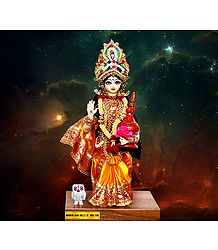
Vishnu's wife is Lakshmi or Sri, the goddess of wealth and fortune. She is believed to have emerged from the churning of the great ocean (Samudra Manthan) by the gods and the demons in the quest for the immortality nectar. She is believed to be the daughter of the sage Bhrigu and he wife Khyati. She is typically depicted as a fair skinned woman wearing red clothes with rich ornamentation. When shown with Lord Vishnu, she is usually seen sitting by his feet, with her hands on her feet. When depicted alone, she is usually shown either sitting or standing on a red lotus (or Kamal). She is propitiated alone as a goddess in her own right, as well as with Vishnu.
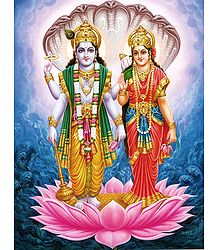
Lakshmi, when placed alongside Vishnu (or Narayana) came to be the foundation of Hindu religious devotion as Lakshmi-Narayana - the deity pair which not only preserves all of creation (Vishnu's cosmic function) but also ensured its growth and prosperity (Lakshmi's cosmic function).
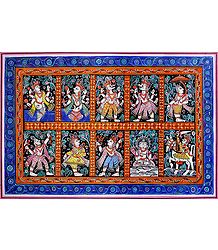
Lord Vishnu is said to have manifested himself in various incarnations, called Avatars, for the destruction of evil or restoration of faith and justice in the world. These incarnations are said to have been in the human form, in the animal form and even in the combined human-animal form. Though popularly believed to be ten in number, the Bhagvat Purana mentions twenty two such incarnations with innumerable more to follow.
It is believed that out of the ten incarnations (called Dashavatar) that are popularly believed in, nine have already been manifested while the tenth is yet to appear. Though all of the incarnations are highly revered, the incarnations of Lord Rama and Lord Krishna have found acceptance as gods in their own right and are propitiated deities in Hinduism. The first four of the ten avatars have appeared in the Krita Yuga (the first of the four Yugas or Ages that comprise one Mahayuga - for more details please read the section above on Lord Brahma). The next three avatars appeared in the Treta Yuga, the eighth incarnation in the Dwapar Yuga and the ninth in the Kali Yuga. The tenth is expected to appear at the end of the Kali Yuga.
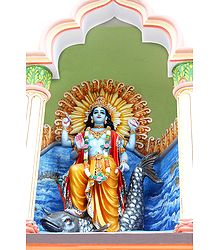
The first incarnation of Vishnu took place as a fish - the Matsya Avatar. Before the creation of the present universe the four Vedas - Hindu philosophical texts which contain all the knowledge of the cosmos - remained drowned in a deluge which existed since the end of the previous epoch. To begin the process of creation anew, it was important that they be retrieved and that they not reach the hands of the Asuras or demons. Brahma would use the knowledge of the Vedas to start the process of creation. Vishnu then took the form of a fish and retrieved the Vedas and also rescued Vaivasvata - the seventh Manu - the lawgiver for the present epoch. Very strangely, there is a striking similarity found between this tale and the story of Noah's ark in the Old Testament. However, the tale of the Matsya Avatar is said to have taken place eons before Noah's existence. It thus indicates, in some manner, the existence of extremely long cycles in the process of creation and possible early civilizations of which little is known today. In a way, the Matsya incarnation symbolizes the formation of the earliest of life forms - the protoplasm and invertebrates.
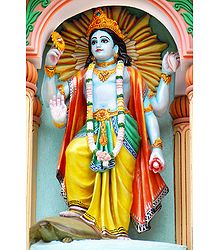
Kurma, or the tortoise, was Vishnu's second incarnation. It is believed that during the great deluge at the beginning of the current epoch of four Yugas, a great many precious objects were lost in the ocean. Among these was the pot of the nectar of immortality (Amrit Kumbha - Amrit means nectar while Kumbha means pot), which both the gods (Devas) and the demons (Asuras) were fighting for. However Brahma suggested that since the pot could not be retrieved without cooperation from both the demons and the gods and that the only way the pot could be retrieved was by churning the great ocean using the mountain Mandara as the churning stone and the serpent Lord Shesnag as the rope for churning. However, the mountain needed to be rested on something for it to be used for churning. It was then that both the gods and demons requested Vishnu to help them. Vishnu then took the form of a great tortoise and entered the ocean. The mountain Mandara was balanced upon the tortoise back and the churning began, with the gods on one side and the demons on the other. This churning is called the Samudra Manthan (Samudra stands for ocean while Manthan stands for churning). Thus many a valuable objects were retrieved from the ocean, the pot of nectar for immortality being one of them. At the end of the churning after the retrieval of the pot, Vishnu also took the form of the illusory Mohini and fooled the demons and passed on all the nectar to the Gods, after which the gods eventually defeated the demons. The Kurma Avatar represents the formation of the amphibian (Life forms which can survive on both land and water) form in the evolution of living beings on this planet.
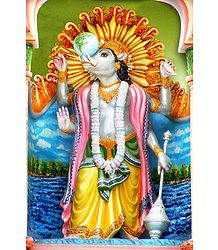
The third incarnation was that of Varaha, the Boar. It is said that the demon (Asura), Hiranyaksha after great penance managed to please Lord Brahma who gave him the boon of invincibility against all beings that he (Hiranyaksha) named. After becoming all-powerful, Hiranyaksha captured earth and dragged her to the bottom of the ocean where he kept her trapped. Lord Vishnu knew that Hiranyaksha missed out on naming the boar while Brahma granted him the boon of invincibility. Vishnu therefore took the form of a great boar, dived into the ocean and killed the demon. He then took the earth between his great tusks and surfaced out of the ocean thus rescuing earth. Varaha, the boar symbolizes the emergence of mammals on the planet.
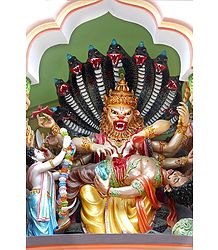
Vishnu appeared as Narasimha in his fourth incarnation. The evil Asura (demon) king, Hiranyakashipu, after great penance, obtained a boon of invincibility from Lord Brahma. The boon declared that Hiranyakashipu would die neither at the hands of a human nor an animal, neither during the day nor at night, neither on earth nor in heavens, neither indoors nor outdoors, neither by fire nor by water or any other weapon. This invincibility prompted him to turn into a tyrant and he assumed that he was the supreme power of the universe, greater than even Vishnu. His son, Prahalad, however, turned out to be one of the greatest devotees of Lord Vishnu. Hiranyakashiupu's several attempts at killing Prahlad to stem any growth of devotion for someone other than him, failed. Prahlad stuck to his chosen path of undiluted and pure devotion of Vishnu and his devotion saw him survive against all odds. This innocent and fervent nature of his devotion combined with the tyranny Hiranyakashipu had unleashed, prompted Vishnu to appear on earth as Narasimha with the body of a man and head and claws of a lion (thus being neither man nor animal). At dusk (thus at a time which was neither day nor night) he appeared from a pillar (thus being not born out of a natural process) in the courtyard hall (thus being neither indoors nor outdoors) of the evil king and proceeded to lay the king on his thighs (thus neither on earth nor in the heavens) and tore him apart with his bare nails thus ridding the world of the evil tyrant. Narasimha represents the emergence of hands and fingers in animals - another step in the evolution of the human form from animals.
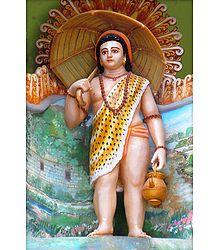
The fifth incarnation, the first in the Treta Yuga, was that of sage Vamana - a dwarf, this time to subdue King Bali - the demon king, who had assumed control over heaven, earth and nether worlds, by defeating Indra - ruler of heaven. His intention was to become the sole power in the entire universe. As all the gods, who had lost their significance and powers prayed to Vishnu to help them and rescue the universe from Bali. It was then that at a sacrificial event held by Bali, Vishnu appeared as Vamana, the dwarf Brahman son of sage Kashyapa and his wife Aditi. Brahamans formed the foremost caste and were highly revered, even by demons. King Bali felt highly obliged by the presence of the dwarf Brahman and offered him anything that he asked for. Vamana asked for only as much land as would be covered by three steps of his. Hearing this Bali was amused as he imagined the little stretch of land that the dwarf Brahman could claim. However Vamana soon assumed huge proportions and covered the entire earth. With his first step he claimed the heavens and with his second step the nether worlds. Since there was nowhere else to step on, King Bali offered his head for Vamana to step on. Since Vamana was pleased with Bali for his strength of resolution of fulfilling his word and also because of the great devotion of Bali's ancestor Prahlad (as described in the earlier paragraph describing the Narasimha Avatar), he spared Bali's life and granted him the nether worlds to rule on. Thus he rescued the Gods and earth from the clutches of tyranny. The dwarf incarnation of Vishnu represents the initial stages of development of Man.
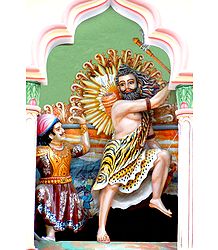
Parashurama was the sixth incarnation of Vishnu - the first who was fully human. Parashurama was a Brahaman by caste and the son of sage Jamadagni and his wife Renuka. Vishnu incarnated himself at this time to rid the world of the tyrant and corrupt kings (kings were always Kshatriya by caste). At that time the Kshatriyas were indulging in all sorts of sins and had unleashed terror all around. Prithvi (earth) prayed to Vishnu for rescuing her from the clutches of the evil Kshatryia clan. That is when Vishnu took birth in the form of Jamdagneya - son of sage Jamadagni. However Jamdagneya came to be more popularly known as Parashurama because of the axe (Parashu) that he used as a weapon. Skilled in art of battle and an excellent archer, Parashurama was under the tutelage of Lord Shiva. He had the gift of immortality and invincibility. Once when the thousand armed king of Mahishmati, Kartaveeryarjuna snatched away a magical cow that Jamadagni (father of Parashuram) possessed, Parashurama killed the king in battle and restored the cow to his parents. Later, seeking revenge, Kartaveeryarjuna's sons murdered Parashurama's father. In revenge, Parashurama killed all the sons of Kartaveeryarjuna. However having done so could not bring peace to him as he felt that he had to rid the earth of all these evil kings who caused so much grief to good men and women. He then proceeded to traverse earth in its entirety twenty one times, each time wiping out all Kshatriyas in his path. It is said that he created seven lakes out of the blood of all the Kshatriyas he had killed. After such bloodshed, Parashurama gave away all the land he had conquered to sages and virtuous men and led a life of meditation in repentance of all the bloodshed he had caused. However, he had no land left to build a hut on since he had given all land away. He therefore threw his axe into the ocean and a strip of land emerged at that point, which was highly fertile. This land is said to be the present day state of Kerala in India. The Parashurama incarnation of Vishnu symbolizes the Stone Age in the evolution of human civilization where the axe symbolizes the start of the use of metal by mankind.
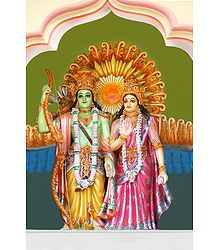
The seventh incarnation of Vishnu was in the form of a king - Lord Rama, the main protagonist in the Hindu epic, Ramayana. Lord Rama is the personification of righteousness and human values. He is worshipped as the perfect man and Hindus have given him the status of a god. He was the son of the king of Ayodhya, Dasharatha and his first wife, Kaushalya and as the first born, was entitled to the throne of Ayodhya after Dasharatha. However great ambitions for her son prompted Dasharatha's second wife, Kaikeyi to play a dirty game and she had Rama banished from the kingdom for fourteen years. Rama was accompanied to the forest by his wife, Sita and Lakshamana - the youngest of his three bothers - son of Dasharatha's third wife, Urmila. He along with Sita and Lakshmana, led a life of asceticism for fourteen years. In the meanwhile, Kaikaeyi's son Bharath did not accept the throne which was offered to him and instead ran the kingdom as a caretaker rather than a king. Towards the end of their time in the forest, Sita was abducted by Ravana - the powerful demon king of Lanka - in revenge for the insult brought upon his sister Surpanakha - who had evil designs on Lakshmana. Sita was kept in captivity in Lanka by Ravana. Lord Rama and Lakshmana, along with an army of monkeys, led by their king Sugreeva and able monkey-god Hanuman, attacked Lanka to rescue Sita. Rama killed Ravana in a fierce battle and thus rescued Sita, after which he went back to Ayodhya and was anointed the king. Unlike the earlier incarnations, Lord Rama appears not for a single mission but rather to teach mankind the importance of sticking to the concepts of righteousness, justice, truth and strength of character. In battle or in peace, Rama never let go of his ideals. So much so that in spite of all the love and trust that he had in his wife, he had to, in consonance with the norms of society of those days, request his wife to undergo an agni pariksha (test of purity by walking through fire). Even later, when questions were raised about the chastity of his wife, he banished her to forest in spite of all the pain that he had to undergo on account of the trust and love he had for his wife. However, the virtuosity of these actions of his, vis-à-vis his wife, have been highly debated and are viewed with skepticism by many. However, when viewed in the context of the norms and laws set by society of those times and Rama's position as the king of the land, the actions probably do not look as black in nature as they would have, in isolation. Lord Rama represents the time in the evolution of human civilization when mankind had begun to live as a cohesive society and have laws of administration and justice.
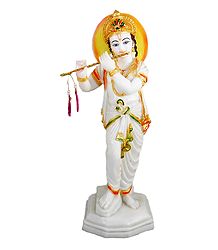
Lord Krishna is the eighth incarnation of Vishnu and the only incarnation of the third Yuga - the Dwapar Yuga. He was the main protagonist in the Hindu epic, Mahabharata. He too, like Rama, has been accorded the status of a god in Hindu religion. However, unlike Rama, Krishna is seen as more endearing and reachable - especially amongst womenfolk - than Lord Rama - the perfect Man that he is made out to be. He was the eighth son of King Vasudeva and Devaki, who had been imprisoned by Devaki's brother, Kamsa who was killing all their children as soon as they were born, because of a fear that one of their children would be the cause of his death. He was however unable to kill the eighth child whom Vasudeva managed to slip out of the prison. This eighth child turned out to be Krishna and he later, in his youth, slayed the evil Kamsa and restored the throne to his father. At a very young age, Krishna managed to slay a number of powerful demons. It is said that he is the only fully human incarnation of Vishnu who was aware of his godly powers from infancy. This is why he is often equated with Vishnu rather than being treated as a mere incarnation. He became the ruler of Dwarka and later played a pivotal role in the epic battle of Kurukshetra, between the Kauravas and Pandavas. Krishna was the cousin brother of the Pandavas and Kauravas. Since the Kauravas had wrongfully snatched away the kingdom of the Pandavas, they waged a battle of justice - Dharma - against the Kauravas in which all the kings of various kingdoms participated on either side. Krishna was on the side of the Pandavas with the mission of destroying Adharma - injustice and evil - and of establishing a rule of righteousness under the Pandavas. It was during this battle of Kurukshetra where Lord Krishna expounded upon the various philosophies that guide the values of righteousness, duty and justice and how all existence is only a tool in God's hands and it is He who defines all that was done, is being done and will be ever done. His messages that he preached to Arjuna - one of the Pandava brothers and Krishna's favourite - comprised the Bhagwad Gita which is one of the most revered texts of Hindu philosophy. It was during this preaching that Krishna showed Arjuna the Vishwaroop - the representation of the cosmos and its functions through himself. As has been earlier mentioned, Vishnu too is often depicted in the Vishwaroop form, strengthening the argument that Krishna and Vishnu are one and the same rather than Krishna being an incarnation of Vishnu. His death is believed to have marked the beginning of the Kali Yuga. Krishna has been depicted as being a great politician and a master of all sixty four arts that existed at the time. Krishna therefore reflects the development of the sciences in the history of evolution of humans.
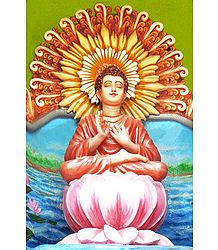
The ninth Avatar is that of Gautam Buddha - the founder of Buddhism. He appeared in the Kali Yuga. However there is another school of thought that says that Balarama -foster brother of Krishna was the ninth Avatar of Vishnu. However there is a conflict in views on this issue as the opposing school of thought believes Balarama to be an incarnation of Sheshnag - the snake God. The belied that Buddha was the ninth incarnation found popularity partly because of the success of Buddha's teachings amongst common folk that promoted Hindu commentators to include him in the series of incarnations. Buddha was originally prince Siddhartha and led a life of debauchery and waste. However he soon faced a number of events that forced him to take a second look at life. This quest for knowledge set him off on a path of renunciation and deep meditation. His penances under a Bodhi tree in Bodh Gaya in the present state of Bihar in India resulted in Moksha or enlightenment for him. He then spread the message of the necessity of practicing Ahimsa (non-violence) and detachment from worldly pleasures and desires, for the purpose of inner-peace and true knowledge. His teachings formed the basis of the Buddhism religion. At a time when people were losing faith in humanity and religion and sinning was commonplace as was violence and greed, Buddha brought with him peace and faith for mankind. This incarnation reflects the intellectual and spiritual progress of human civilization.
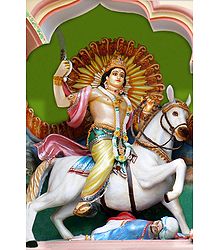
The tenth and last incarnation of Vishnu is yet to appear. It is believed that this appearance will take place towards the end of Kali Yuga, whence this Avatar will appear and slay all of those who are evil and will restore a moral and humanitarian order in society. This Avatar has been named Kalki and it is believed that he will appear on a white horse and will yield a flaming sword which will be his weapon with which he will strike down all evil. His appearance will also mark the end of Kali Yuga, after which the Krita Yuga will again begin where purity of mind reigns over all else. Since Kali Yuga is believed to carry on for a total of 4,32,000 years, of which only 5000 have gone by, it is to be assumed that it's a long time before the Kalki Avatar will make his appearance. Hindu religious texts elaborate the expected arrival of the Kalki Avatar as a return to Manu's social order of four varnas (castes) and a revival of Brahminical authority. It is said that as time goes by, righteousness will be engulfed by evil and faith in God will be replaced by misinterpreting the Vedas to serve Adharma or injustice. It is then that Kalki will be born in the home of Vishnuyashas, a Brahmin and a priest of Yajnavalkya at the village of Shambhala. Some say that Vishnuyashas himself will be rechristened as Kalki. Kalki, it is said, will be able to raise weapons and armies by his will and with this force and a horse (named Devadutta) gifted to him by the Gods (Devas), will wipe out all evil and those who will have desecrated Dharma (concept of justice and duty) and restore faith in God and righteousness in society.
Vishnu is the preserver of the cosmos and hence upholds the universal laws. To maintain order in the universe Vishnu battles the forces of disorder, chaos and evil, either by himself or as one of his Avatars or incarnations.
[ This is the second in our series of three articles on the Hindu Trinity of Brahma, Vishnu and Shiva. As we add the next in the series, we will send out a newsletter informing you of the same. To subscribe to our newsletter please become a member for free - click here. ]
This article was written by:
Madhuri Guin