Please wait...

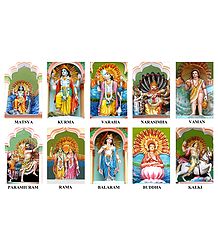
"Avyaasurbhuvana trayeem
anibhrutam kandooranai-adrinaa
Nidraanasya
parasya koormavapusho nishvaasa vaatormaya:
Yadvikshepana
samskritodadhi paya: prenkhola paryankikaa
Nithyaarohana
nirvruto viharatey deva: sahaiva sriya"
The above is a sloka or hymn on the Kurma Avatara, of Lord Vishnu
manifesting Himself as the Divine Tortoise in the Dashavatar (Ten
Avatars). Lord Vishnu is one of the Divine Trinity, the others being
Brahma and Shiva. Sri Mahavishnu is regarded as the Protector and the
Preserver of the universe. In order to maintain Dharma (righteousness)
during each yuga (epoch), He descends Himself in different forms
(Avataras) and
saves the beings of the world.
The meaning of the sloka is, "May
the ocean waves created by the divine breath emanating from the Supreme
One resting on the ocean floor, who took the form of the divine
Tortoise, protect and preserve all the creatures residing in the three
worlds." The extended meaning of the sloka illustrates the
entire episode of the Samudra Manthan. It talks of how Sri Mahavishnu
descended Himself as a gigantic Kurma (tortoise), bearing the
mountain, Mandara, on His back, so as to help the Devas acquire the
divine Amrita or the Nectar of Immortality. The Lord was actually
lulled to a short sleep by the rhythmic motion of the mountain, acting
as a type of churn dashery! He breathed deeply, even snoring slightly
in his sleep. This created tidal waves in the ocean, making it rise and
fall, causing a gentle swinging motion, adding to His comfort!
The sloka talks about the Lord taking the Kurma avatara in order to
protect the Devas (Gods and demi Gods) and bless them with the Amrita.
The whole mission of the Kurma avatara revolves around the familiar
Indian mythological story of the Samudra Manthan or the Churning of the
Ocean. This is probably one of the most oft repeated stories in Indian
mythology, also one of the most popular.
The
process of the creation of the universe is mentioned in great detail in
the Puranas. There are 18 main Puranas and though each one talks about
creation and how the world was created, not all the descriptions
necessarily tally with each other. However, these descriptions can be
broadly classified into two categories, as follows:
According
to the first version, the supreme, all-pervading Brahman
created and preserved the entire universe. This Brahman manifested
itself into three distinct supreme powers, namely, Brahma, Vishnu and
Shiva. Brahma's mission, as Prajapati, was to create the universe,
while Vishnu was the Preserver and Protector of the same. The third
supreme being, Shiva, was responsible for destruction in the universe,
so that new beings could be created yet again from the natural process
of destruction.
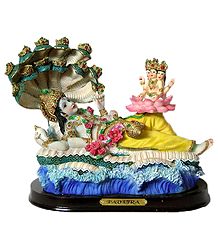
A huge body of water was created first, out of which arose a gigantic serpent, named Adisesha. Vishnu took His resting position on the bed of snakes. Next came a beautiful, brilliant golden egg, into which Brahma entered and stayed there for a thousand years, while working on creating the universe. The egg then hatched and split into two parts, one becoming the heavens and the other becoming the earth. The upper part gave rise to the creation of the sun. Since the sun emerged first, it is referred to as the Aditya. The lower portion of the egg slowly developed into rivers, mountains and the other landscapes of the earth as we know it today.
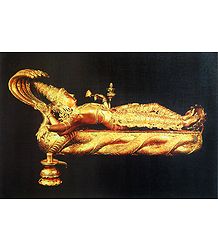
According to the second version, Vishnu was lying on the Adisesha, when suddenly a resonant sound of 'Aum', the Pranava Mantra (primordial sound), boomed across the atmosphere, causing Vishnu to awake from his rest. Then, from His navel grew a beautiful, resplendent lotus, on which was seated Lord Brahma. On Vishnu's command, Brahma got to the task of creating the world. He segregated the lotus into three parts, the heavens, the skies and the earth.<
Deviating
a little from the main topic here, it would be interesting to note a
clear connection between the mythological concept of the Hiranyagarbha
and the Big Bang Theory as we know it today. Both these aspects talk
about the creation of the world. Let us now try to draw a parallel
between these two theories - one completely religious and the other,
completely scientific!
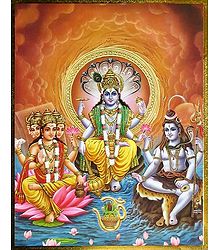
The
Nasadiya Sukta of the Rig Veda effectively describes the theory of
evolution by saying that there was no existence, nor was there anything
like non-existence, before the Hiranyagarbha. It further goes on to say
that there was no air, no sky, no shelter, no cover, no day, no night,
nothing at all. There was no water, no life or death, hence nothing
such as mortal or immortal existed. There was only darkness - a vast,
all-encompassing darkness. There only was a void, a huge, formless,
blank, and nothing else.
However, the Rig Veda also believes that it was the first Vaak (word),
the Primordial Sound of 'Aum' that gave birth to the entire universe.
From that word came the huge, monistic Golden Egg, the Golden Womb or
the Hiranyagarbha of Hindu mythology. Lord Brahma is considered to be
this Hiranyagarbha, as He created the world. Brahma, as His name
suggests, was brought forth by the Supreme Being, Brahman Himself. Lord
Vishnu descended Himself in order to protect and preserve this
universe, while Lord Shiva, the god of destruction, took over the task
of destroying several aspects of the world through the course of the
different yugas (epochs).
The Trinity of Brahma, Vishnu and Shiva work together on the natural
cosmic process of creation, preservation and destruction. Once Shiva
carried out destruction, Brahma created yet again, which gave rise to
the cyclical process of the cosmos.
Present-day
Science believes that the entire process of evolution in this universe
started with the Big Bang. But can one really conceptualize what
actually happened before the Big Bang? The answer to this question is a
definite NO. No concept of Time or Matter ever existed before the Big
Bang - it all came into being much later. Similarly, one simply cannot
imagine who actually created the Big Bang. That remains a mystery for
ever.
The Rig Veda, in this sense, conveys the same idea as that of the Big
Bang Theory. It talks about the world being created out of sheer
nothingness - no time, no matter, no space and no creator.
The
Puranas also talk about the cyclical process of creation, destruction
and re-creation. According to Hindu cosmology, a universe lasts for a
time period of roughly 4,320,000 years, which amounts to one day in
Brahma's life. Once each kalpa (eon - roughly a thousand 'Brahma
years') reaches its end, the world is destroyed by the elements of fire
or water. Hindu mythology believes that Brahma rests for one whole
night, which lasts as long as His day. The process of destruction,
called Pralaya (cataclysm), goes on in a cycle for a period of 100
'Brahma years'. This amounts to Brahma's lifespan being about 311
million human years.
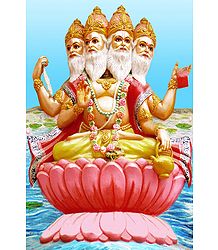
According
to Hindu calculations, Brahma is supposedly 51 years old at
this time and so, it is approximately 155 trillion years since He was
'born'. Once His lifespan is over, another 100 Brahma years pass till
the whole process of creation commences anew. This cycle of Brahma's
'birth' and 'death' go on forever.
The lifespan of Lord Brahma is again divided into several Maha Yugas
(that are one thousand cycles long), during which mankind is born and
dies over and over again. Each of these Maha Yugas lasts roughly
4,320,000 years and is again divided into four stages or Yugas, based
on the moral values in existence in that particular yuga. As the yugas
progress from one stage to the other, morality, virtuosity and
principles of righteousness deteriorate more and more, finally ending
with the Kali Yuga or the Iron Age. The Kali Yuga will be the worst
yuga, where there will be no appreciation for moral values, good
conduct and righteousness. Once this yuga reaches its peak, there will
be the pralaya and mass-scale destruction of the creation as a whole.
According to the Hindu pantheon, the present Kali Yuga has begun at the
midnight of 17th February in the year 3102 B.C.
Hindu cosmology has always been advanced, explaining the complicated
concept of relativity with extreme ease. As Dick Teresi, author and
coauthor of several books about science and technology, including "The
God Particle", puts it, "Indian cosmologists, the first to estimate the
age of the earth at more than 4 billion years. They came closest to
modern ideas of atomism, quantum physics, and other current theories.
India developed very early, enduring atomist theories of matter.
Possibly Greek atomistic thought was influenced by India, via the
Persian civilization."
There
was a time when all the Devas lived very happily, enjoying their stay
in heaven and taking good care of all the creatures walking the earth.
They all had immense powers and wielded them with true wisdom. One day,
sage Durvasa decided to visit Vaikuntha to pay his obeisance to Vishnu
and his Consort, Lakshmi. A Vidyadhara damsel residing there gifted
Durvasa with one of Lakshmi's garlands, which the Mother Herself had
given her, as she had been pleased with her performance on the Yazh (a
musical instrument).
While returning from his visit to Vaikuntha, Durvasa happened to pass
by Indraloka, where he met with Indra, the king of the Devas. When the
sage offered the garland to Indra, he merely plucked it with the
ankusha (goad) he used on Airavata (his elephant) and placed it on the
creature's head. Airavata, not realizing the value of the garland,
threw it down and stamped on it, completely crushing the garland.
Incensed by this extreme lack of respect, Durvasa, who was infamous for
his nasty temper, cursed Indra that he and the rest of the Devas would
lose all their power and glory and be shorn of all their divine powers.
The minute Durvasa left Indraloka, the whole kingdom of the Devas fell
into darkness and all of them lost their splendor and supernatural
powers.
Panic-stricken by the turn of events, Indra rushed to the Prajapati,
Brahma, and requested Him to save all the Devas. Brahma asked the Devas
to approach the Creator and Preserver, Sri Mahavishnu and address their
problem to Him. He further added that it was only Vishnu who could help
them out of their present crisis.
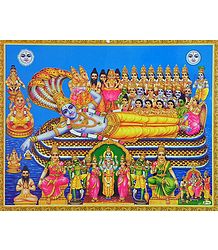
When
Vishnu heard of the unfortunate developments, He advised the Devas
that they could regain their lost aura only if they drank the Amrita,
which could be got only by churning the Ksheerasagara (Ocean of Milk).
But the next question was, who would churn the ocean and how would they
be able to accomplish this big task?
Again, Lord Vishnu had an idea. He suggested that they lift the Mandara
mountain and then place it deep into the ocean. If they wound the
divine snake king, Vasuki, around it, it would act as a rope to turn
the mountain, thereby churning the mighty ocean. This was acceptable,
but the Devas already being very weak, were sure they would not be able
to carry out this humongous task.
Vishnu advised them to draw a temporary truce with their worst enemies,
the asuras (demons). The asuras always possessed immense strength, so
they would help if they were offered some nectar in return. But Vishnu
also warned the Devas not to desire any of the other things that would
emerge from the ocean as a result of the Samudra Manthan. He asked them
to ignore all else, till the nectar appeared on the surface of the
ocean. He assured the Devas that once the Amrita appeared, He Himself
would protect it and see to it that it was not snatched away by the
asuras.
Once the plan was laid out methodically, Indra proceeded towards the
asura kingdom with the said treaty. Hearing of his plan, the asuras
were pleased too and decided to participate in the proceedings. They
also very willingly agreed to lift mount Mandara and place it in the
center of the ocean.
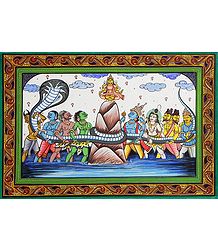
But as
they tried to lift the mountain, it became too unbearably heavy
for them. Many of the asuras got crushed under its sheer pressure.
Vishnu intervened yet again and, mounting Mandaragiri on the back of
Garuda
(Vishnu's vehicle, the mighty Eagle), He transported it right to the
middle of the ocean.
This done, the asuras wound Vasuki around the mountain and selected the
head side of the serpent, instead of the tail side, since they thought
of themselves to be superior, and were prodded to do by the Devas, in
accordance with the plan decided upon with Vishnu. The reason for this
was that during the churning, the serpent would spew venom and this
would kill the asuras instead of the Devas. Then began the
entire process of the churning of the Ocean of Milk, with the Devas on
one side and the asuras on the other.
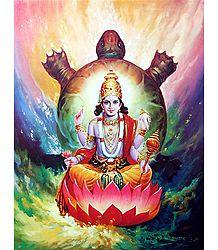
As the churning got underway, the huge mountain, having no support, dangerously wobbled from side to side and started to sink into the ocean. Seeing this, Vishnu acted immediately and took the form of the giant-sized, divine Tortoise or the Kurma Avatara. Plunging deep into the ocean, He bore the colossal mountain on His back.
Unmindful of His own pain and discomfort, Lord Vishnu patiently bore the mount on his back, stablilizing it, thereby making it much easier for the Devas and asuras to churn the Sagara (ocean). As the process of the churning continued, however, the Lord felt extremely comfortable. Instead of causing Him severe pain and irritation, the constant rhythm of the mountain turning back and forth on His back, actually lulled Him into a highly meditative, sleep-awake stage. He breathed slowly and deeply and this created gentle waves in the ocean that gave rise to a very comforting, rocking motion that further calmed Him!
Halahala
The churning of the ocean first gave rise to the Halahala, Kalakuta or the deadly poison, representing the ocean's impurities. The poison was strong and deadly enough to cause blindness and difficulty in breathing to all who came in contact with it. At the behest of the Devas and asuras, Lord Shiva immediately drank the poison. On seeing this, Shiva's consort, Parvati, was alarmed and clutched his neck in an effort to stop the poison from descending down His throat. The action of the poison turned Shiva's neck permanently blue, which is why He is also referred to as the Neelakantha (the blue-throated One).
There is another interesting interpretation about Shiva consuming the deadly halahala poison. It is said that Lord Vishnu Himself drank the poison, making Shiva a mere vessel to hold the same.
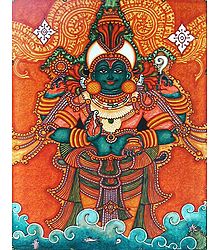
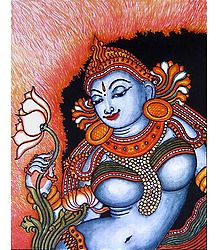
There were several ratnas or gems as well that arose from the Samudra Manthan. These ratnas were shared by the Devas and the Asuras. The gems were as follows:
In
accordance with His promise of protecting the Amrita from entering
the hands of the asuras, Lord Vishnu took the form of Mohini, a
beautiful damsel, and enticed the asuras to let her distribute the
nectar among them all, on the condition that they would never question
any of her actions. Totally taken in by her beauty, the asuras readily
agreed to her conditions.
Mohini asked the Devas to be seated in a row and started distributing
the Amrita to them first. Rahu, one of the Daityas (demons), divined
the true identity of Mohini as being Vishnu himself and understood that
this entire episode was a ploy to cheat the Asuras of the Amrita.
Fearing that he would never get a share of the Amrita otherwise, Rahu
disguised himself as one of the gods and sat down with them.
Mohini had already served the Amrita to Rahu when the Sun God and the Moon God revealed his identity to her. Furious, Vishnu lifted his Sudarshana Chakra (discus) and cut off Rahu's head. Legend has it that Rahu's head still roams around the heavens and that his undying enmity with Surya (Sun God) and Chandra (Moon God) is what causes several adversities to befall a Hindu during the period of his trine with either of the stars.
By the time Mohini was done with her task, there was not even a drop of nectar left in the pitcher. Once Her mission was completed, Mohini again reappeared as Vishnu, got onto His Vaahana, Garuda and flew back to His abode. The asuras felt completely cheated and humiliated and so, tried to attack the Devas. But the latter had regained their lost strength and hence the already jaded asuras were no match for them. Cutting their losses, they fled back to their abode in the Patala loka (netherland).
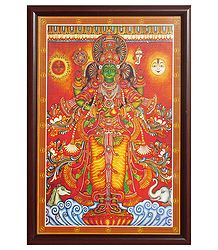
Sri Mahavishnu was the pivotal force behind the Samudra Manthan. The Lord had taken care of every little aspect while orchestrating the entire episode. It is only His Supreme Presence that helped the Devas regain their lost glory and power.
Without Sri Mahavishnu's help, nothing like this could have been possible and the Devas, suffering from the ill effects of Durvasa's curse, would have been stripped of their divinity and powers for ever.
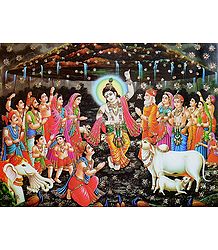
It is interesting to note, here, that Vishnu's act of wielding the Mandara mountain on His back bears close resemblance to Krishna's leela (miracle) of lifting the Govardhana mountain with the little finger of His left hand, in order to protect the residents of Vrindavan. Lord Krishna was one of the Ten Avatars of Lord Mahavishnu.
All tales from Indian mythology sound fantastic and fascinating. Many people, who merely listen to the stories with a casual attitude, question the logic behind these tales. Many even believe that these stories are a mere fabrication of someone's highly hyper-active imagination! But the truth is startlingly different.
Indian mythology has always tried to teach man some profound principles in life, through its many tales and anecdotes. These interesting tales actually have many hidden meanings and connotations, which, if delved into deeply enough, could reveal some of the highest philosophical truths to mankind.
Applied properly to real life, the Samudra Manthan can be seen as being an extremely effective guide on how to live our day-to-day life. Let us now analyze the Samudra Manthan in detail.
The Samudra or the Ocean of Milk actually represents the human Consciousness or the Jeevatma. The Churning of the Ocean embodies the journey of life undertaken by this Jeevatma during its tenure on earth. It represents all the moments of pleasure and pain, physical, psychological, emotional and spiritual struggles that it is put through in life.
The mind is an ocean, where our thoughts and emotions play on it like the waves of the ocean. The Mandara mountain represents the virtues of steadiness and concentration. Like the mountain, our concentration too will wobble if it not anchored onto something concrete.
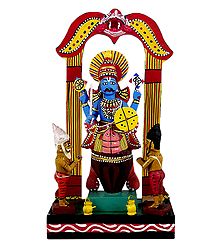
The Mandaragiri was held steady by the Lord, who took the form of a Tortoise. Here, the tortoise symbolizes the spiritual withdrawal of a person into his own Consciousness. Just as a tortoise withdraws into its shell, so can a man attain liberation only by withdrawing into the Atman residing inside him.
In order to undertake a spiritual journey, man has to surrender himself to the Supreme Being, depend on Him for steadiness and only then, embark on his voyage. The support of the Tortoise - that Supreme Consciousness - has to back him all the way if he has to succeed in this higher venture.
Both the Devas and the Asuras desired immortality. Vasuki embodies the desire in us to attain liberation by steadying our minds, concentrating and contemplating on the higher Self. The story also shows that if this 'desire' factor is not under our control, it can take over our lives and destroy us altogether.
The rope also signifies the need for cooperation. Our spiritual journey has to take into account a good balance of both spiritual and worldly life in order to attain salvation. There are many ascetics who have achieved enlightenment by performing severe penance on the Himalayas. Our worldly life, however, dictates that we continue to live a spiritual life while being involved in this Samsara (material world) itself.
The Devas actually represent the 'good' (Sat) within us, while the Daityas represent the 'bad' or the 'sin' (Asat) within us. Interestingly enough, the tale of Samudra Manthan, as related by the Srimad Bhagavatam, consider both the bad and the good as being sides of the same coin, coming from the same One Creator!
During Samudra Manthan, Vishnu advised the Devas to work along with the Daityas to churn the ocean. Similarly, we have to learn to balance both the positives and negatives of our personalities, harmonizing both these energies, in order to attain a higher state of spirituality in our lives. Only when we effectively combine both these energies can we hope to attain salvation and true bliss in this lifetime.
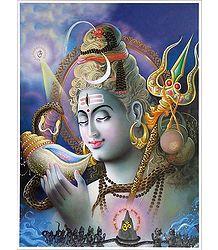
The Halahala or the Kalakuta poison represents the pain and suffering we have to undergo during our life's spiritual journey. As we delve deeper into spiritual sadhana (practice) and try to achieve the state of ekaagrachitta (intense concentration), we experience tremendous inner turmoil, which must be dealt with, before we can proceed ahead in our spiritual endeavor.
The story of Lord Shiva consuming the Halahala poison educates us on how we should deal with this inner turmoil with courage, discipline, austerity, detachment and total commitment to leading a life of asceticism. Shiva also teaches us how to hold the poison of our inner selves only at a surface level, without letting the same get into our system or our mind, thereby affecting our entire life.
When the poison arose from the Samudra, the Devas immediately sought succor from Lord Shiva, who obliged by swallowing the entire venom. This teaches us that if we encounter any difficulty in life, we should immediately request help from the all-pervading One and surrender to the Supreme Entity. Help would most definitely arrive at once and free us from all our troubles and travails!
Vishnu had advised the Devas to ignore the various precious gems, jewels and other aspects that arose from the Ocean during the Samudra Manthan. While the Asuras tried to snatch away as much as they could, the Devas remained focused on acquiring the Amrita. This focus is what led to the fulfillment of their goal as well.
Likewise, man's spiritual journey gives him several seemingly impressive psychic powers or Siddhis, from time to time. Many of these Siddhis keep developing and get honed as his endeavor moves further and further. But the true seeker should ignore all these, remain unaffected by these transient temptations and continue forward with his onward journey into spirituality.
Delving on these temporary siddhis may actually slow him down in his progress and may even cause harm to him in future. In case he uses these psychic powers, it should be for the welfare of others and not something to satisfy his own ego or materialistic desires.
Dhanvantari embodies general health and longevity. The emergence of Dhanvantari during Samudra Manthan indicates that one can attain spiritual success only when both one's body and mind are in perfectly sound health. Absence of deficiency of either can impede man's journey towards discovering his own higher self.
Mohini symbolizes the delusion of the mind, arising out of pride and ego. The Asuras had great pride on their immense strength and achievement. They were so blinded by their egos that they completely lost sight of their actual goal - acquiring immortality. Similarly, a feeling of pride and complacency oft times gets in the way of a man's higher endeavor. If he were to fall prey to these petty feelings, he would immediately proceed towards nothing but total self-destruction.
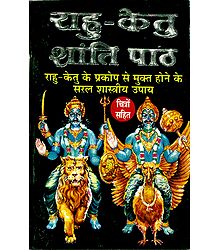
Rahu, an Asura, managed to partake of the Amrita and became immortal, in spite of Vishnu beheading him. This shows that no matter how much man tries to control the bad in the world, the strife between good and evil will continue for all time. The true seeker, should hence understand this nature of the Cosmos itself and proceed forward, unaffected, in his journey of seeking the Aatman.
The story of Samudra Manthan teaches us how to maintain harmony between our material and spiritual lives, by placing complete and unshakable faith in our Creator and accepting both the good and the bad in our lives (both from within and without) on an even keel.
This article was written by:
Priya Viswanathan, a teacher/performer of Bharata Natyam, Classical Music and Classical Instrumental Veena. A recipient of several awards for both music and dance, Priya is also a freelance writer online. She currently writes for About.com, a subsidiary of IAC - the parent company of Ask.com. (http://mobiledevices.about.com)