Please wait...

In
this issue, we
continue with the second part of the two-part series on the Great Sages
and Saints of India, who verily influenced the Indian way of thinking
and generated huge waves of progressive change in the spiritual and
societal spheres.
In the previous issue, we took a
glance at the life and times of great legendary saints such as
Chaitanya Mahaprabhu, Mirabai and the Sai Baba of Shirdi. This time, we
are back with more interesting stories and anecdotes from some more
saints' lives.
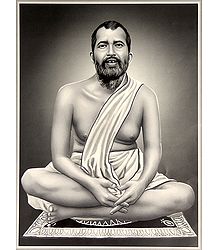
Perhaps one of the most popular saints of nineteenth century India, Ramakrishna Paramahamsa was born in 1836 in a poor Brahmin family in Kamarpukur, a sleepy little town in the Hooghly district, West Bengal. Born Gadadhar Chattopadhyay, Ramakrishna rose to great spiritual heights and largely influenced the modern Bengal Renaissance. What set apart Ramakrishna from most other saints was that he propagated non-idol worship, harmony of all religions and the realization of Godhead as the ultimate mission of life itself. He had immense love for that Supreme Energy called God and he saw the Oneness in all existence. Many of Ramakrishna's devotees even today consider him to be an avatar of God.
Gadadhar's birthThere
are records of several supernatural events taking place to indicate
Gadadhar's birth. His parents were a very pious couple and often had
spiritual experiences and visions. His father, Kshudiram, had a vision
in Gaya, where Lord Gadadhara (or Lord Vishnu) came to the former in
his dream and promised him that He would take birth in his household.
Ramakrishna's mother, Chandramani Devi, had a vision of a divine light
entering her womb, before he was born to her. Not only that, many of
the villagers even considered Gadadhar as an incarnation of a divine
being.
Gadadhar
was a very popular young lad in his village. Handsome and energetic, he
had a natural inclination towards the Fine Arts. He disliked school,
though, and showed no interest whatsoever in making money. He loved
roaming around amidst nature and spent much time in the lush fields and
orchards in and around the village. He had a set of friends who loyally
followed him wherever he went. From a very young age, Gadadhar would
make it a point to pay his respects to all the monks crossing the
village on their way to Puri. He would serve them untiringly and listen
with rapt attention to all their spiritual discourses and debates.
Gadadhar's
respect for all religions and castes can be clearly seen from an
incident that took place during his thread ceremony. According to the
existing tradition, he was required to request for alms from a Brahmin.
But Gadadhar refused and was adamant that he would have his first alms
only at the hands of a particular village woman of low-caste. This
created shock waves through the entire community, but the young lad was
adamant and had his way. His older brother, Ramkumar, who was the
acting head of the family after their father passed away, gave in to
Gadadhar's unconventional desire.
Ramkumar
had been asked to serve as priest at the Kali (an aspect of Goddess
Parvati) temple at Dakshineshwar. Gadadhar reluctantly agreed to
decorate the deity and when Ramkumar retired, took over as priest. As
he was praying to the Goddess Bhavatarini (the One who liberated Her
devotees from suffering), though, he often wondered why he was merely
praying to a stone idol, when the actual divine of energy of Kali was
all-powerful and all-pervasive.
Gadadhar would often be very
distressed and wept loudly when he prayed to the deity to reveal
Herself to him. He would spend many nights praying in the solitary
silence of the jungle. But when the Devi (Goddess) did still not
manifest in front of him, he decided to end his life, so that he could
see Her after his death. He was about to kill himself with a sword,
when he saw waves of light coming out from the temple idol. He became
extremely ecstatic and fell unconscious to the floor.
In
spite of the above incident, Gadadhar was restless and sought to learn
the truths of other religions. Strangely enough, his teachers would
come to him as if by some divine intervention and teach him their
religions' philosophy. He grasped the essence of all the other
religions with great ease and very soon, came to be known as a
remarkable man with a mystical, divine aura. He was visited by people
from all faiths and walks of life.
Gadadhar
received his initiation in Advaita (the philosophy of Oneness) Vedanta
from Totapuri, one of the wandering mendicants. The master radiated
immense masculine strength, a stern mien and had a strong, resonant
voice, and wore no clothing on his person. Ramakrishna grew to be very
fond of him and would address him as 'Nangta' or 'Langta', which meant
'the Naked One'.
Totapuri was a fabulous guru, who ably guided
Ramakrishna towards his mission of seeking oneness. The latter is said
to have sat in complete and deep contemplation for up to six months
after his master departed from the village.
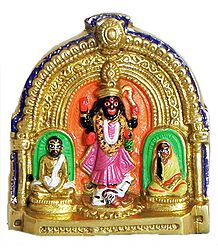
Alarmed by the immense change in Ramakrishna, the villagers advised his mother to get him married, so that he would learn to shoulder household responsibilities. Ramakrishna immediately suggested Jayrambati, a village near Kamarpukur, where his bride would be found residing in Ramchandra Mukherjee's household. The bride, Sarada, who was a mere five year-old at that time, went ahead to become Ramakrishna's first disciple. She showed equal prowess in grasping religious secrets and so impressed was Ramakrishna, that he considered her to be an aspect of the Universal Mother. He even performed a puja (prayer ritual) looking upon Sarada as Tripura Sundari (Parvati) Herself!
Sri
Ramakrishna Paramahamsa, as he came to be known by Mathur Babu, Rani
Rasmani's son-in-law, was frequently visited by the most influential
people of the state, such as Keshab Chandra Sen, the legendary Brahmo
leader, Shivanath Shastri, Trailokyanath Sanyal and Pratap Chandra
Mazumdar. He also had the privilege to meet Swami Dayananda.
Narendranath Dutta became his disciple and soon, Ramakrishna laid the
foundation of what was to become the Ramakrishna Order.
In
April 1885, Ramakrishna was diagnosed with throat cancer and he moved
into a garden house in Cossipore in December. His condition kept
worsening, till the time he took mahasamadhi on the 16th of August,
1886. His mission was taken over by his 16 disciples, one of them being
the illustrious Swami Vivekananda himself.
In his quest
for oneness, Ramakrishna practiced the teachings of the Tantric, Yogic,
Vaishnava and Sakta sects of Hinduism and is even said to have dabbled
in Islam and Christianity for a brief period of time.
It is said that Ramakrishna's realization of nirvikalpa samadhi let him understand the two-fold aspect of maya (illusion), namely, Avidyamaya (dark desires such as cruely, greed and lust) and Vidyamaya (higher principles of life such as spirituality, enlightenment, purity, kindness, devotion and love). He explained that the former was the cause of all misery in this mundane world and was responsible for the vicious birth-death cycle. On the other, he said, the latter would free one from all mundane bondages and take him on a higher plane of existence, ridding him of advidyamaya and making him a mayatita (beyond maya).
Ramakrishna used to say, "Jatra Jiv Tatra Shiv" (wherever there lives a being, there resides Shiva). This arose from the highest Advaitic philosophy of Reality of being. He used to tell his disciples, "Jive daya noy, Shiv gyane jiv seba" (it is not about kindness to living beings - it is a service to Shiva Himself).
Today, the Ramakrishna Mission has spread globally and has gained the deference and respect of philosophers all over the world. Noted British historian, Arnold J. Toynbee has written, "Mahatma Gandhi's principle of non-violence and Sri Ramakrishna's testimony to the harmony of religions: here we have the attitude and the spirit that can make it possible for the human race to grow together into a single family - and in the Atomic Age, this is the only alternative to destroying ourselves."
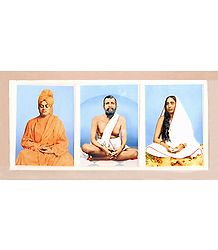
Swami Vivekananda, Ramakrishna's foremost disciple, founded the two pillars, the Ramakrishna Mission and the Ramakrishna Math, in order to spread Ramakrishna's message to the world. The Math has a monastic order based on his teachings.
The
Ramakrishna Mission has probably even been part-responsible for
coloring the Western concept of what Hinduism is all about.
Ken
Wilber and Andrew Harvey see a new phase of consciousness with his life
story. Max Muller says, "Sri Ramakrishna was a living illustration of
the truth that Vedanta, when properly realised, can become a practical
rule of life... the Vedanta philosophy is the very marrow running
through all the bones of Ramakrishna's doctrine."
Leo Tolstoy described him as a "remarkable sage".
Sri
Aurobindo considered Ramakrishna to be an avatar of God, at par with
Gautam Buddha. He says, "When scepticism had reached its height, the
time had come for spirituality to assert itself and establish the
reality of the world as a manifestation of the spirit, the secret of
the confusion created by the senses, the magnificent possibilities of
man and the ineffable beatitude of God. This is the work whose
consummation Sri Ramakrishna came to begin and all the development of
the previous two thousand years and more since Buddha appeared has been
a preparation for the harmonisation of spiritual teaching and
experience by the Avatar of Dakshineshwar."
Christopher Isherwood also considered him to be an incarnation of the
Divine.
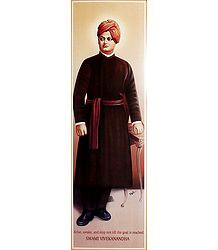
Swami Vivekananda was born Narendranath Dutta on the 12th January, 1863. This very brilliant disciple of Ramakrishna Paramahamsa went on to become one of the most influential Indian spiritual leaders propagating the philosophies of Vedanta and Yoga. The founder of both the Ramakrishna Math and the Ramakrishna Mission, he also brought about several reform movements in Hinduism itself.
While Vivekananda worked tirelessly for uplifting India from the clutches of discrimination on the basis of caste, creed and religion, he also simultaneously introduced his philosophy to America and England by conducting discourses, lectures and seminars on Vedanta in those countries. He was the first known Hindu Sage to spread the religion in the West, by introducing the Indian philosophy at the World's Parliament of Religions.
His most memorable first lecture started with the line, "Sisters and Brothers of America", which completely bowled over his foreign audience. They clapped for a whole two minutes after the initial address, as they had only been used to the impersonal "Ladies and Gentlemen" till then.
Vivekananda's persona and strong voice moved the audience immensely and his very first speech catapulted him to fame in Chicago, then spreading to the whole of America, including states such as Boston, San Francisco, Los Angeles, Memphis, New York and St. Louis.
Narendranath Dutta was born to Viswanath Dutta and Bhuvaneswari Devi in Shimla Pally, Kolkata. Even as a lad, he showed amazing intelligence and a sharp, photographic memory. He regularly practiced meditation and was known to be an academic genius in his schooldays. He also excelled in many kinds of sports, which made him a popular figure in school. He even set up an amateur theatrical company and gymnasium and learnt wrestling, rowing, fencing and many other sports. His tireless and robust energy radiated brilliantly from him and he also excelled at vocal and instrumental music.
Even as a mere boy, Narendranath was against the rigid customs and traditions that bound India in those days. He joined the Presidency College of Kolkata in 1879 to pursue higher studies. After a year, he entered the Scottish Church College of Kolkata to study philosophy. This course gave him an in-depth into Western philosophy as well.
Soon, he joined the Brahmo Samaj, a revolutionary religious movement headed by Keshab Chandra Sen. He, along with his classmate, Brajendra Nath Seal, also attended sessions of its branch, Sadharan Brahmo SamajDutta and Seal would take up study of Auguste Comte, Herbert Spencer, John Stuart Mill and G.W.F. Hegel. . Later, Dutta was destined to part ways with Seal and join Keshub Chandra Sen's Nava Vidhan.
Vivekananda was a keen seeker of the real God and was left dissatisfied with the Samaj's occasional sessions and prayers. It was at this time that Reverend William Hastie, the Principal of his college, told him about Sri Ramakrishna of Dakshineshwar.
Narendranath
first met Ramakrishna in November 1881. As usual, he posed the same
question whether the latter had seen God. Pat came the reply from
Ramakrishna, "Yes, I see God as I see you before me, only, I see Him in
a different sense. God is easy to realize, but only if one sheds
sincere tears to see Him. Then He surely does manifest Himself."
Narendra was speechless in awe as he could sense that those were honest
words, which came from the depths of the master's soul. He started
visiting Ramakrishna more and more often from then on.
Narendra
had a scientific bent of mind, so could not accept everything
Ramakrishna had to say. He even tested the latter's patience, but the
master remained loving and calm and even maintained a sense of humor,
which the former gradually got attracted to. By and by, Narendra fully
surrendered his ego to his master and became his most loyal follower.
Ramakrishna saw the huge potential in Narendra and specially taught him
rare principles of the Advaita Vedanta, which would have been difficult
for anyone else to grasp.
In the period of the next five years, a tremendous transformation took place in Narendra. The once restless, impatient young man was now ready to renounce all things worldly in his quest for God-realization. After his master's mahasamadhi in 1886, Narendra set a core group of monks and started living in a dilapidated house in Baranagore.
Vivekananda set out on a long, aimless journey in July 1980. He traveled the length and breadth of India, assuming various names like Vividishananda, Satchidananda and so on. Legend has it that Ajit Singh, the Maharaja of Khetri, suggested the name 'Vivekananda' for him, taking into consideration his sharp discernment of things in this world. 'Viveka', the power to discriminate between good and bad, the transient and the intransient, appealed to him. Besides, he recalled that Keshab Chandra Sen would call him that too, so he accepted it readily.
While
wandering about, he would stay with anyone that invited him, so he
learnt about various cultures and religions of India, and also about
how the poorest of the poor and the richest of the rich lived. This
made him realize that there needed to be a revolution in India to
abolish the tyrannical caste system.
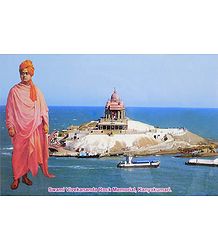
Reaching Kanyakumari, the southernmost tip of South India, on 24th December, 1892, he was amazed by the wonderful colors created by Trisagara Sangama or the meeting of the three seas, the Indian Ocean, the Bay of Bengal and the Arabian Sea. He swam across the sea and seated himself on a lone rock for three days, saying later that he had meditated on the past, present and future condition of India. This has now become a sacred spot, as the Vivekananda Memorial has been constructed on this very rock.
Vivekananda
then proceeded to Madras in Tamil Nadu to speak to the youth there.
There were many there who encouraged him to carry forth his mission by
traveling the world over. The Raja of Ramnad, who was the one to be
present for the conference in the United States of America, heartily
promoted the young monk and asked him to represent Hinduism in the
World Parliament of Religions. Other influential people such as the
Maharajas of Khetri and Mysore and Bhaskara Setupathi pitched in their
efforts too, thus sending Vivekananda on his first, landmark journey to
the USA.
Vivekananda gave many lectures in the US. In one such
event at California, he mentioned the struggle he went through during
his wandering days. He said, "Many times I have been in the jaws of
death, starving, footsore, and weary; for days and days I had no food,
and often could walk no farther; I would sink down under a tree, and
life would seem to be ebbing away. I could not speak, I could scarcely
think, but at last the mind reverted to the idea: "I have no fear nor
death; never was I born, never did I die; I never hunger or thirst. I
am It! I am It! The whole of nature cannot crush me; it is my servant.
Assert thy strength, thou Lord of lords and God of gods! Regain thy
lost empire! Arise and walk and stop not!" And I would rise up,
reinvigorated; and here I am today, living! Thus, whenever darkness
comes, assert the reality and everything adverse must vanish. For after
all, it is but a dream. Mountain-high though the difficulties appear,
terrible and gloomy though all things seem, they are but Maya. Fear
not, and it is banished. Crush it, and it vanishes. Stamp upon it, and
it dies."
A professor of Greek at the Harvard University, J.H.
Wright, asked the Swami to represent Hinduism in the World Parliament
of Religions in Chicago. Writing to the chairman of the selection
committee, he gave the monk a glowing tribute, saying, "Here is a man
more learned than all our learned professors put together." His first
speech was immediately accepted by the audience, who applauded him
non-stop for two whole minutes at his opening statement, "Sisters and
Brothers of America". A popular American newspaper described him as "an
orator by divine right and undoubtedly the greatest figure at the
Parliament".
Vivekananda's journey to the US laid the foundation for Westerners viewing Hinduism as not just an exotic entity, but as a serious, deep religion - an unfathomable treasure-trove of philosophical traditions and thought.
Vivekananda
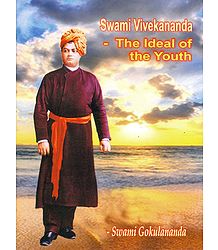
introduced both Vedanta and Yoga to the West. The Swami later traveled
to London and set up centers both in New York and London. Of course,
his work received severe criticism from Christian missionaries, but he
swerved not from his mission. He came back to India in 1897, after four
years of touring abroad.
A Memorial Plaque inside the Art
Institute reads: "On this site between September 11 and 27, 1893, Swami
Vivekananda (1863-1902), the first Hindu monk from India to teach
Vedanta in America, addressed the World's Parliament of Religions, held
in conjunction with the World's Columbian Exposition. His unprecedented
success opened the way for the dialogue between eastern and western
religions." On 11 November 1995, the stretch of Michigan Avenue that
passes in front of the Art Institute was formally conferred the
honorary name "Swami Vivekananda Way."
Back in India,
Vivekananda received a hero's welcome. He then founded the Ramakrishna
Mission and the Ramakrishna Math. He continued to receive criticism for
his revolutionary ideas, but he continued with his work.
Vivekananda breathed his last on July 4, 1902, at the age of 39. Though doctors averred that he had died of apoplexy, his devotees inferred that he had taken mahasamadhi. Viveknanda had once predicted that he would not live till he turned forty and this had come true.
Vivekananda wrote a great many works, compiled from all his lectures. He included the four Yogas, Raja Yoga, Karma Yoga, Bhakti Yoga and Jnana Yoga. Besides, his letters are still preserved as they have great spiritual value. Being a good singer and poet, he also composed many songs on his favorite deity, Mother Kali.
Vivekananda's work has been acknowledged by great legends such as Gandhiji, Subhash Chandra Bose and the first governor general of independent India, Chakravarti Rajagopalachari. Rabindranath Tagore, who was himself a prime member of Brahmo Samaj, said, "If you want to know India, study Vivekananda. In him everything is positive and nothing negative."
The
Swami's birthday is now considered the National Youth Day, in order to
commemorate him. His revolutionary writings even influenced freedom
fighters such as Bagha Jatin and Aurobindo Ghosh. The extremist
revolutionary, Bhupendranath Dutta, was Vivekananda's
brother.
Aurobindo
Ghosh, who considered him his mentor in spirituality, says,
"Vivekananda was a soul of puissance if ever there was one, a very lion
among men, but the definitive work he has left behind is quite
incommensurate with our impression of his creative might and energy. We
perceive his influence still working gigantically, we know not well
how, we know not well where, in something that is not yet formed,
something leonine, grand, intuitive, upheaving that has entered the
soul of India and we say,
"Behold,
Vivekananda still lives in the soul of his Mother and in the souls of
her children…"
--Sri Aurobindo—in 1915 in a Vedic
Magazine.
Guru
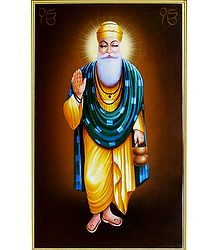
Nanak Dev was born in Nankana Sahib, the then Punjab and the Pakistan
of the present, on 20th October, 1467. He was the founder of the
religion called Sikhism and was the very first among the eleven Sikh
Gurus.
Guru Nanak was a powerful religious figure of his time.
He is even now respected and revered equally by Sikhs, Hindus and even
some Sufi masters. His main message to people was to have 'devotion in
thought and good conduct', among other things. Guru Nanak vastly
influenced the cultural history of the Punjab. In India, he was revered
as the one who gave the gospel of unconditional love and
goodwill.
Nanak Dev was born in Talwandi, a small village in the district of Sheikhupura, about 60kms West of Lahore. At the present time, his birth place has become a sacred spot, being marked by a Gurdwara Janam Asthan. His father, Kalyan Das Bedi, was an accountant for crop revenue in the village. He worked for a Muslim landlord called Rai Bular. Nanak's mother was Tripta Devi and he had a sister, Nanaki.
There
are two varieties of biographies of Guru Nanak's life, namely, the
Janamasakhis' and the vars of Bhai Gurdas. The most popular biography
is supposed to have been recorded by a close associate and friend of
the Guru, Bhai Bala, just before the master's death. But some research
also indicates this could well have been written much after his passing.
Bhai Gurdas, the one who recorded the Guru Granth Sahib, also talked about Nanak's life in his vars. But these too might have been recorded after his passing. Besides, this is a lot less detailed than the Janamasakhis and the Sikhs also trust the latter more for its genuineness.
The Janamasakhis give the minutest details about Nanak's life history. It is said here that the astrology who visited the household to cast infant Nanak's horoscope requested to see him. When he was brought before Nanak, he joined his hands in prayer and sincerely worshipped him. The astrologer said he regretted that he may never live to see how powerful Nanak would become later in his life and predicted that he would be revered not only by the Sikhs but also by Hindus and Muslims too.
Nanak had already started developing a deep interest for all things spiritual and divine by the age of five. He entered the village school and soon got himself familiarized with all aspects of Hinduism and Islam. He read the Vedas, Shastras and the Qur'an. He was very saddened by the society's discrimination on the basis of caste and religion and wished he could do to eradicate the same.
His first teacher was a Muslim. Nanak is said to have astonished his teacher by asking him what the hidden meaning of the very first alphabet in Persian was. The alphabet was almost a straight stroke, resembling the figure '1' and denoted the concept of oneness with God!
After completing his academics, Nanak took to more private study and meditation. It is said that Nanak loved the solitude of the nearby jungle and met with the religious men who frequented the place. Many of these men were well-versed with Indian religious literature and had traveled far and wide within the country. This gave Nanak a good grounding on the changing thoughts and trends of Indian philosophers and reformers.
Nanak's marriage took place in Batala town to a girl called Sulakhni. He had two sons, Sri Chand and Lakhmi Chand. The elder son followed in the footsteps of the father, was deeply spiritual and even formed a sect called the Udasi. He was revered as Baba Sri Chand. The term 'Baba' is used as a mark of respect in Sikhism. The younger one, on the other hand, was totally worldly and materialistic.
Neither of the sons took over from where Guru Nanak left off. After Sri Chand's time, his pagri (position) was taken over by the sixth Sikh Guru, Har Gobind. All those in the Udasi sect remained within the framework of Sikhism.
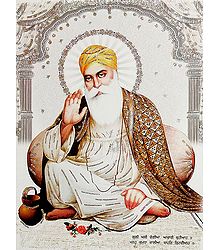
Guru Nanak laid a stress on keeping true faith in God and pursuing the path of good, which would lead one to God. He asked his followers to be in constant contemplation and worship God and recite His name always. According to him, God was transcendent, infinite and limitless. He often said that God was inside oneself, much like how one's beloved always resided in one's own heart. Guru Nanak believed in a benevolent, merciful God and kept reiterating that one could always find God in himself if he sincerely tried for it.
Like Ramakrishna and Vivekananda, Guru Nanak too denounced any form of idol worship, binding rites and rituals and asked people to access God's Energy directly instead, within themselves. He fought to eradicate superstitious beliefs from people.
He propagated Naam Japna (taking the divine name), while also living in this material world and discharging one's duties. He asked people to earn a decent livelihood and share their money with others less fortunate than themselves. His chant, 'Satnam Vaheguru' became the very landmark of Sikhism as a religion. He used to say, "The name is the God, the God of all Gods. Some propitiate Durga, some Shiv, some Ganesh and some other Gods but the Guru's Sikhs worship the True Name and thus remove all obstacles to salvation".
Further, Nanak gave immense importance to the presence of a Guru in one's spiritual pursuit. In his own words, "Without the Guru, no one can obtain God, however long the matter be debated. With the help of the Guru, man enjoys divine pleasure, he does not know any sorrow. The Guru is the raft or the ladder of the Sikhs. The Guru is found through divine grace."
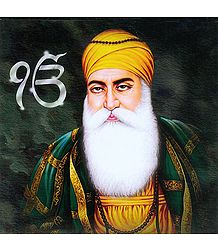
Guru Nanak staunchly believed in the concept of Karma and described people as being under the influence of the three-fold qualities of Maya, namely, Rajas (passion), Tamas (ignorance) and Satva (good). He was of the opinion that all the three qualities would be present in all people in different measure, thus binding them to their present worldly life.
These qualities make the jivas (individual souls) behave in certain ways, giving rise to their Karmas in their lives. He is also influenced by Karmas accumulated from his previous lives. Guru Nanak likened Karma like the seeds to be sown in a field. He said that we would be able to harvest exactly that which we sowed. This karma would decide how close a being could get to his Creator. This is the Sri Guru Granth Sahib's or the Gurbani's law of Karma and is much the same as other laws influencing the oriental school of thought in general and Hinduism in particular.
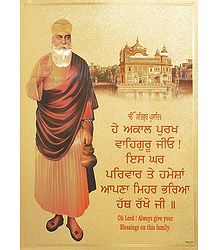
Guru Nanak too received much criticism for his unconventional thoughts at that time. Some of his other main beliefs were:
Equality of all beings - The Guru fought to abolish caste, creed and race discrimination. He used to say, "See the brotherhood of all mankind as the highest order of Yogis; conquer your own mind, and conquer the world. There is one awareness among all created beings. One who recognizes the One Lord among all beings does not talk of ego."
Equality for women - Nanak was very particular about women's empowerment and believed in equal social status for women. He said, "From woman, man is born; within woman, man is conceived; to woman he is engaged and married. Woman becomes his friend; through woman the future generations come. When his woman dies, he seeks another woman; to woman he is bound. So why call her bad? From her, kings are born. From woman, woman is born; without woman, there would be no one at all. O Nanak, only the True Lord is without a woman." He constantly fought against eradicating the terrible ritual of Sati (a widow ending her own life by jumping into her husband's funeral pyre).
Unity of religions - Nanak too laid importance on the unity of all religions. He addressed people from all religions without discrimination. He believed in the universality of all religions.
The Bhakti Movement - One of the most important contributions of Guru Nanak was to create a clever conglomeration of the then-prevalent Bhakti movement and Sufism and use it to bring waves of positive changes in the social milieu of the time. He differed from the Bhakti and Sufi movements, in that he never believed in renunciation and leading an ascetic life.
The Guru spent his last years in Kartarpur, serving in a Langar or a community kitchen. When the time came for him to nominate a successor, he put his sons and disciples to severe test. One of his disciples, Lehna, showed unswerving faith and devotion to him. Once, Nanak asked his disciples to eat a corpse lying on the road. It was only Lehna who unblinkingly removed the sheet covering the corpse, only to find Nanak lying there! Nanak was pleased with his devotion and named Lehna his successor, calling him Guru Angad.
Guru Nanak breathed his last on 22nd September, 1539, at 69 years of age. Just before his demise, he instructed his followers to sing the Sohila, a hymn praising God's virtues. There is a story related to the master's death. Just before his passing, there arose a debate among his devotees. The Hindus wanted to cremate his body, while the Muslims wanted to bury it in line with Islamic tradition. It is said that Nanak asked his devotees to place garlands on his body and that sect whose garland remained fresh even after three days would get to decide how to dispose of his body. But on the next day, when they lifted the cloth that covered his body, only the fragrant flowers were left and the body was nowhere to be seen!
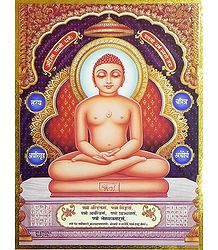
Mahavira was the 24th and the final Tirthankara (the one who achieved enlightenment through a life of asceticism) of the religion, Jainism. Mahavira, which literally means, 'the Great Brave One', was born on the 13th day of the rising moon of Chaitra in the year 599 BC. Some works give his year of birth as 615 BC, but this depends on the religious tradition followed by the particular sect of Jainism.
Mahavira was born Vardhamana. His other names are Vira, Viraprabhu, Ativira, Gnanaputra and Sanmati. He is also referred to as the Nirgrantha Nathaputta (or the Naked Monk of the Jnatr clan) in the Theravada Buddhist scriptures.
Mahavira
was born to King Siddhartha and Queen Trishala ruling Kundagram in the
kingdom of the then Vaishali (which is the Bihar of today). It is
believed that there were several auspicious signs of his impending
birth even as he was in his mother's womb. He brought to the kingdom
increased beauty, wealth and prosperity. That was the reason he was
named Vardhamana, which means, 'enhancing or increasing'. Further, the
Queen herself had 16 very auspicious dreams foretelling about the
manifestation of a great soul, before giving birth to the Prince.
The
Jains believe that immediately after Vardhama was born, Lord Indra
Himself bathed him in celestial milk and conducted rituals fit for a
Tirthankara. Yet another belief is that Vardhamana was first conceived
by a Brahmin, Devananda and was moved to Trishala's womb later, as all
Tirthankaras were supposed to be born in Kshatriya (warrior) clans
only.
Though born in a royal family and being exposed to the finest luxuries, Vardhamana showed a rare detachment from it all and an especially virtuous nature. He would regularly meditate and go into introspection. He slowly moved more and more away from worldly life.
At age thirty, Mahavira left his kingdom and family and went away to live life as an ascetic. He continued in this way for twelve years. He was largely indifferent to all creatures, though he took care never to harm any of them. He wore no clothes, led a severely austere life and undertook enduring penance in those years. This is what gave him his name, 'Mahavira'. At the end of this grueling time, Mahavira achieved the state called 'Keval Gyan'. He was completely enlightened, and so, was completely calm and harmonious with everything around him.
Mahavira spent the rest of his life to preaching the Eternal Truth he had come to realize. His main aim was to free people of the worldly fretters that bound them. He would travel around in the severest of climes, wearing nothing and roaming around barefoot. Soon, he had over 4,00,000 followers! It was Mahavira's undying efforts that helped spread the ancient religion to all corners of India.
Mahavira attained Nirvana or Moksh (complete salvation and the end of life) at the age of 72. He was residing in the Pawapuri area at that time, also known as Apapuri. He attained samadhi on the last day of the Jain calendar, which coincides with the major Hindu festival, Dipavali (the Festival of Lights).
There is no agreement on the year of his birth and passing. Some scholars believe he lived from 599-527 BC, while some other aver that he lived from 549-477 BCE.
Mahavira's philosophy, the aim of which was to elevate a human being spiritually, was made up of eight cardinal principles, three of which were metaphysical and five, ethical. Jainism existed much before Lord Mahavira and he only spread the vast spiritual treasure given to the religion by his predecessors.
The metaphysical aspect consists of three aspects, namely, Anekantavada, Syadvada and Karma. The five ethical principles, called Panchavrats, includes Ahimsya (non-violence), Satya (truth), Asteya (non-stealing and lack of avarice), Brahmacharya (chastity) and Aparigraha (limiting possessions).
Mahavira preached that every soul took birth again and again on this earth and inherited good and bad karma, accumulated from all his previous births. The soul then undergoes the rigors put forth by Maya (illusion) and gets caught in its worldly bondage.
In order to get out of this vicious circle, Mahavira said that it would be necessary to follow samyak-darshana (right faith), samyak-jnana (right knowledge) and samyak-charitra (right conduct).
According to Jainism, these vows cannot attain fruition unless they completely accept the philosophy of Anekantvada (non-absolutism) and Syadvada (the theory of relativity). The monks and nuns of Jainism strictly follow these laws, whereas the rest of the people follow these till the extent possible. Mahavira showed no difference between the genders and welcomed any man or woman was desirous to lead a life of austerity.
He also did not conform to caste and creed restrictions of that time. His teachings and grace were accessible by people from all walks of life, including the so-called 'untouchables' at that time. He established the fourfold Chaturvidh Jain Sangh order, which consisted of Sadhu (monks), Sadhvis (nuns), Shravaks (laymen) and Shravikas (laywomen).
The Tirthankaras in Jainism are respected as veritable Gods on earth and there is no other idol worship. What sets apart Jainism from the other religions is that the Jains never really pray to the Tirthankaras, monks or nuns in order to acquire material benefits. All they pray for is the strength to stick unflinchingly to the five main principles and tread the holy path of life, to liberate them from all worldly bondage and suffering.
Lord Mahavira's teachings were orally recorded and compiled by his direct disciples in the Agam Sutras. These Sutras were passed on orally to the future generations. Many of them have been destroyed, modified or lost in the last few centuries. After a period of a thousand years, the Agam Sutras were recorded on Tadvatris or leafy papers used in the days of yore. There are two types of Jains. The Shwetambar Jains consider these Sutras as authentic and the ultimate, whereas the Digambar Jains merely use them for the purpose of reference.
After Mahavira's samadhi, the whole scenario started changing in Jainism. The Sangha structure got more complicated and huge differences mushroomed on the smallest aspects. But his main principles remained unaffected.
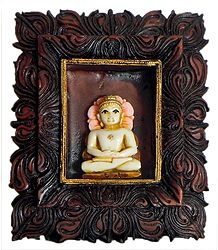
Mahavir continues to be and always shall remain as one of the strongest figures of Jainism. Interestingly, his images were sculpted over six centuries after his samadhi. These are aesthetically modeled and reveal the Tirthankaras' spirituality other than their actual likeness to the masters. All the images actually came from the minds of the artisans, so they did not differ vastly from each other, except for certain regional and other differences.
Mahavira hence resembles the other Tirthankaras, except for his lion emblem and a slightly different structure of the head. Mostly, one can see him as sitting in the 'padmasana' or 'kayotsarga-mudra' posture. Images made for the Digambara sect have not even a piece of clothing on them, while those made for the Swetambara are adorned with clothes, jewelry and even a crown. Additionally, the master is seated on an ornate throne in such images.
Yet other images show his birth, with his mother, Trishala, resting with her maids attending on her. Some of them also illustrate her having the dream about the 16 auspicious signs. There is also a symbolic representation of Mahaviras 'tri-ratnas' in various sculptures.
Mahavira is one of the most powerful and revolutionary Masters India has ever seen. Even today, Mahavira Jayanti (birthday) holds tremendous religious importance to the Jains, who celebrate it with devout prayers, processions and festivity. Jain temples are decorated with flags and Jains visit their ancient temples at Palitana and Girnar in the state of Gujarat.
The 8-day ritual of Paryushan is also undertaken during this holy period, when people fast for days together and remain in prayer to the great Master. The holy biography of Mahavira, the Kalpa Sutra, is also read on this day.
This article was written by:
Priya Viswanathan, a teacher/performer of Bharata Natyam, Classical Music and Classical Instrumental Veena. A recipient of several awards for both music and dance, Priya is also a freelance writer online. She currently writes for About.com, a subsidiary of IAC - the parent company of Ask.com. (http://mobiledevices.about.com)