Please wait...

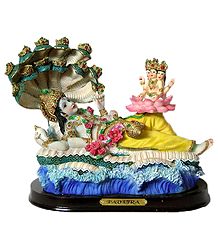
"Yada
yada hi dharmasya
Glanirbhavati bharata
Abhyutthanam adharmasya
Tadatmaanam srijami Aham
Paritranaya sadhunaam
Vinashaya cha dushkrutam
Dharma samsthapanarthaya
Sambhavami yugey yugey!"
Whenever and wherever
there is a decline in righteousness (adharma)
and a rise in irreligion, O Bhaarata (descendant
of Bharata)
I shall present Myself at that time
In order to protect the pious
and destroy foolish wrongdoers,
also to reestablish religion and probity
(dharma),
I shall incarnate, age after age
Thus spake Lord Krishna, avatar of Lord Mahavishnu, in the Bhagavad Gita. Mahavishnu took ten avatars or incarnations in order to protect the world through the different yugas or eons. Out of these ten avatars, the Shri Rama avatar and Shri Krishna avatar have gained the most importance, thanks to the emergence of the huge epics, the Ramayana and the Mahabharata respectively.
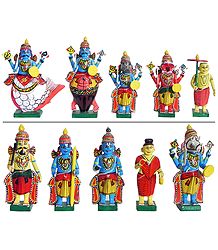
The Dashavatars (ten avatars) of Vishnu are:
Matsya (The Fish), Kurma (The Tortoise), Varaha (The Boar), Narasimha (Half-man and Half-lion), Vamana (Dwarf Brahmin), Parasurama (The One wielding the Axe), Rama (the Purushottama - The perfect human being), Balarama (Krishna's brother), Krishna (The perfect Statesman) and Kalki (The Warrior riding a White Steed). Each and every avatar descended on Earth with a specific purpose, to protect creation through a multitude of ages.
Though Shri Rama and Shri Krishna were essentially the same, since they came from Mahavishnu Himself, we can still see a lot of difference in their personality and characters. Both the avatars manifested as human beings on Earth and came with a certain purpose. Once that purpose was served, They left the mundane world as we know it.
The main purpose of the Rama avatar was to destroy Ravana, the Asura (Demon) King, while the principal aim of Krishna's avatar was to convey the supreme message of the Bhagavad Gita, to vanquish evil and bring back justice and righteousness to humankind. Here's a sketch of both avatars, Rama and Krishna, and a comparative study between these two avatars.
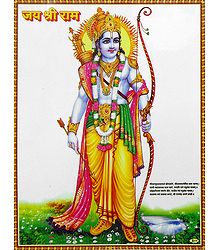
Lord Rama, the seventh avatar of Vishnu, is regarded as the Marayada Purushottam, or the most ideal human being. Also referred to as Ramachandra and honorifically as Sri Rama, this son of King Dasharatha and Ruler of Ayodhya, is one of the main anchors of the Hindu religion. Rama is a very popular figure in Southeast Asia as well. Rama is revered as a King who really lived on Earth and annihilated evil powers from the earth during His age. This avatar has been glorified and deified for many centuries now, what with the giant epic, the Ramayana, written by sage Valmiki. Further, Saint Tulsidas' excellent translation of Valmiki's works, called Ramcharitmanas, helped the epic reach the ordinary masses and aided them to develop a better understanding of the finer aspects and the ultimate message of the Ramayana.
The whole concept of time in Hinduism is very different from the 'linear' aspect of time as we know it today. The Hindu aspect of Time, like every other Indian concept, has a cosmic angle to it. Hinduism believes that each complete cosmic cycle of creation and destruction goes through four stages or epochs, namely, Satya Yuga, Treta Yuga, Dwapar Yuga and finally, Kali Yuga. Since the cosmic process is believed to be continuous, the movement of this cycle of time too has no beginning and no end. It is therefore, ananta (infinite).
Lord Rama is said to have descended Himself during the Treta Yuga. The eldest son of King Dasharatha and Kausalya, Rama is deemed the very embodiment of Dharma and the Parabrahman or the Supreme Being. Rama is the husband of Sita, who is Herself considered an aspect of Goddess Mahalakshmi, the Divine Consort of Vishnu. Sita is also considered by the Hindus as the ideal embodiment of a perfect woman.
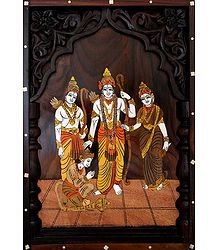
Rama is not very different in appearance from Krishna. He has a bluish skin tone, similar to that of Vishnu and Krishna. He is usually shown in a standing posture, with a smiling countenance, holding a huge bow in His left hand and a quiver of arrows tied to His back. The most popular portrait of Rama is that with his Consort, Sita, standing on His left; blessing His faithful monkey attendant, Hanuman, sitting at His feet on the right; His brother, Lakshmana, standing just a little behind Him, to His right.
Being the Prince of Ayodhya, he is the shown adorned in all royal finery, with the usual 'tilak' on His forehead.
The whole story of Rama's life revolves around showing respect to elders and strict adherence towards duty, no matter how harsh the circumstances. Rama, the descendant of the brilliant Raghuvamsa dynasty, has two step mothers, Kaikeyi and Sumitra, who have a son each, namely, Bharata and Shatrughna. All his three younger brothers are also known for their piety, purity and strength of character.
Even in his youth, Rama constantly engages himself in destroying several evil forces and demons so as to bring back order and harmony to society. Along with Sage Vishwamitra and Lakshmana, He travels many places and restores peace to many a yagna (holy sacrificial rite).
During one of His many sojourns, He frees a lady from her own husband's curse. Ahalya, wife of sage Gautama, is famed for her beauty and piety. Indra, the King of the Devas, is filled with unholy desires for this lady. So when she is alone at home one day, Indra comes to her in Gautama's guise. When Gautama realizes what had transpired during his absence, he curses Ahalya and turns her into a stone. She remains there for years together, till Rama steps into the ashram along with Vishwamitra and Lakshmana. She is free of her curse and comes back in all her beauty, the minute Rama places His foot on the stone
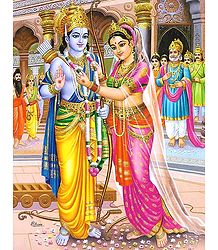
Janaka, King of Mithila, is intent on conducting a swayamvara (marriage ceremony) for his adopted daughter, Sita. The challenge for the prospective grooms is to string Shiva's bow, kept at the sabha (congregation). Many kings, including the ten-headed Demon King, Ravana, fail at repeated attempts. Rama lifts the bow in one go and strings it effortlessly, thus winning Sita's hand in marriage.
Kaikeyi wants Bharata to ascend the throne and rule the kingdom, so at His father's behest, Rama, the rightful Yuvaraja, abandons his claim to the throne and leaves to the forest for fourteen years, accompanied by his wife, Sita and brother, Lakshmana. The whole of Ayodhya is in darkness and Dasharatha dies of a broken heart, but Rama being duty-bound, refuses to return to the kingdom before the stipulated time period. Bharata refuses to rule Ayodhya, visits Rama in the forest, carries Rama's padukas (footwear) on his head and places them on the throne instead.
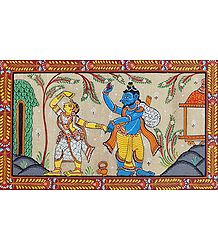
Rama, Sita and Lakshmana spend many happy years in the forest. One day, Ravana sends Maricha, to go to Sita in the guise of a golden deer. Sita, enchanted by the deer, asks Lakshmana to pursue the deer. At that time, Ravana comes in the guise of a bhikshuk (beggar) and demand alms from Sita. Carelessly, she crosses the Lakshman Rekha (the line drawn by Lakshmana for her safety) and ends up being abducted by the terrible Ravana.
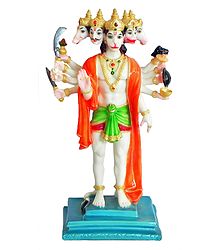
Rama's whole mission starts with protecting Sita and destroying Ravana's kingdom, Lanka. He gets together with the Vanarasena (army of monkeys) of Kishkindha, headed by Sugreeva. This is where He meets his legendary, powerful devotee, Hanuman. Ravana tries to tie up Hanuman and lights fire to his tail, but the latter is too quick for him. He takes a vishwaroopa (massive form), jumps around Lanka and sets the whole kingdom on fire. When Lakshmana falls to one of Ravana's arrows, Hanuman retrieves the medicinal Sanjeevani from the Aravali mountain and saves his life.
Hanuman acts as Rama's messenger, steals into Ashokvan (where Sita is held captive) and assures Her of freedom from this bondage. With a lot of help from Hanuman, they win a terrible battle against Ravana and rescue Sita from his clutches.
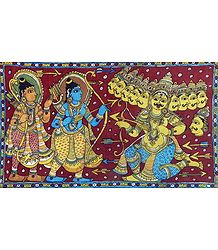
Ravana is vanquished and killed and the joyous troupe returns to Ayodhya to celebrate the Pattabhishekha, or the Coronation, of Lord Rama as the King of Ayodhya. Rama is worshipped for his unending compassion, his Eka Patni (wedding only one wife) stand and his courage in pursuing the right path.
The story of Rama inspires awe and devotion in the Indian subcontinent. The word 'Ram' or 'Rama' is very commonly used among Indians. 'Ram Ram' is a greeting used mostly in North India. The phrase, "Ram Nam Satya Hai" (Ram is the ultimate truth) is chanted by a procession carrying a dead man on his last journey. 'Hey Ram' was the famous expression uttered by Mahatma Gandhi before he was assassinated by Nathuram Godse. Such is the respect and devotion shown towards this Hindu deity.
Shri Krishna, the ninth avatara of Vishnu, is as popular, if not more, than Rama. While the word 'Rama' is used more than Krishna, there are many more Krishna temples and religious sects in India. Shri Krishna is worshipped as a major deity among the Vaishnavaites (followers of Vishnu). He is regarded as the Supreme One by the Gaudiya Vaishnava sect. Krishna's stories are entertaining and span His whole life, right from infancy to adulthood. All these stories, however, contain a deep, spiritual inner meaning. Lord Krishna's mission was to deliver the Bhagavad Gita and thereby emerge as a Supreme philosophical teacher.
The Krishna Avatar is regarded as the Sampoorna (complete) avatar, as he has the sixteen necessary kalas or distinctive traits. Rama is not regarded as such, as he shared these qualities with his brothers. Krishna is never shown praying to any God - He is deemed to be beyond all Gods and gunas (qualities). Rama prayed to the Surya Devata (Sun God), as He is the descendant of the Raghuvamsa.
Krishna's life is filled with stories of dalliances with the Gopis (cowherd women), but the love they had for each other had been absolutely pure and transcended all barriers and human limitations.
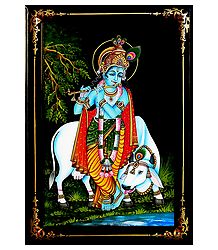
Krishna is depicted in various ways, during many stages of his life. But one of the most common images of Krishna is that of a cowherd boy leaning against a cow, playing His instrument, the flute. The word 'Krishna' itself means 'dark' or 'black' in Sanskrit. It also means 'all-attractive'. Many works of poetry describe Krishna as the 'one whose complexion is tinged with the shade of dark clouds'.
While Rama is depicted as a very serious avatar, Krishna is seen as a playful figure, performing many miracles, stealing the hearts of young Gopis with his enchanting music, romping around with His Eternal Lover, Radha and so on. It is only the Bhagavad Gita that portrays Krishna in a somber light, that of a Divine Teacher.
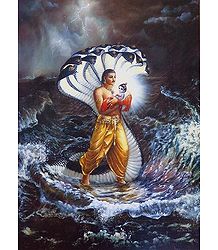
Krishna was born in the Dwapara Yuga, in a royal family of Mathura, to Devaki and Vasudeva. Devaki's brother, Kansa, receives a divine intimation that his sister's eighth child would be the cause of his death. Fearing this, he puts the couple in prison and kills all their children one by one. When the eighth child is born, Vasudeva is miraculously let out of the prison. It is a stormy night and the doors open by themselves, letting him out. He is mysteriously guided to leave baby Krishna with Yashoda and Nanda of the Yadava (cowherd) clan or the Yadukula.
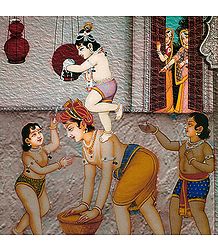
During childhood, Krishna performed many leelas or miracles to save the residents of the town. There are many stories of the pranks little Krishna often played on the Gopis. He would break into a Brajanari's house in her absence to steal the butter and curd kept there. There is a famous story of Krishna asking his friends to make a human pyramid, so that He could climb on top of them and steal the butter pot kept hanging from the ceiling. Once he climbs on top, He breaks the pot and all the youngsters have a good time enjoying the butter and the curd flowing from the pot! This tradition is followed even today during the festival of Gokulashtami. Many boys get together to form a huge human pyramid and break the 'dahi handi' (curd pot) hung at a height, several meters above the ground and share the goodies placed in the pot!
Then there is another anecdote where Yashoda, in sheer frustration, beats Him up for stealing butter and asks Him to open His mouth to see traces of the butter. But when He does open His mouth, Yashoda is stunned to see the three worlds residing within Him! This is when she realizes His divinity.
Krishna often broke earthen pots of water that Gopis carried on their heads, on their way home from the river. He once stole clothes their clothes while they bathed in the river, climbed onto a high branch, secured the clothes there and refused to hand them over to the Gopis unless they came out and begged for it.
Kansa hears of Krishna and keeps trying to kill him with demons and evil powers. Once Krishna is old enough, He confronts Kansa and kills him, thereby granting moksha (liberation) to him.
There are two famous stories of how Krishna saves the local people while in trouble. Lord Indra, being angry that the villagers refuse to pray to Him, unleashes a huge storm on the town. When the whole town is on the verge of getting destroyed, Krishna lifts the Govardhana mountain with the little finger of His left hand and asks all residents and animals to take shelter under it. Indra realizes His mistake and immediately, the storm relents. This is why Krishna is also known as the Govardhana Giridhara.
The other story is that of the Kaliya Nartana. A huge serpent, Kaliya, stays in the local river and pollutes the whole river with his poison. Many residents who drink the water meet with death. This is when young Krishna dives into the river, challenges Kaliya and finally subdues him. To signal his victory to the residents, He climbs on top of Kaliya and dances on his hood.
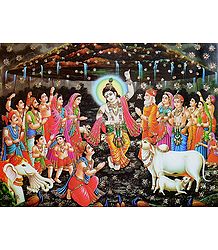
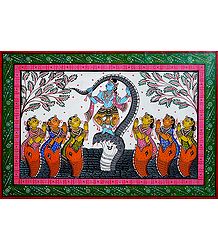
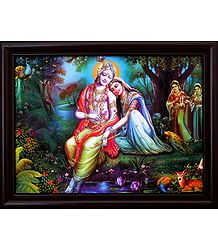
Most stories of Krishna revolve around His dalliances with the Gopis of the village and His enduring divine love for His childhood sweetheart, Radha. Krishna immensely enjoyed playing the Rasa Lila, a joyous dance, with the Gopis, who were actually considered to be highly evolved saints and sages in their previous births.
Krishna would play the flute, enchanting the Gopis. The Gopis' love for Krishna went far beyond human love - their entire self would mingle with Him during the Divine Communion. While Radha and Krishna danced in the center, the Gopis surrounded them in a big circle, each Gopi having her own Krishna dancing with her. Each Gopi related to 'her Krishna' in various ways - as her father, son, friend or even lover. This actually signifies the joining of the Jivatma (individual soul) with the Paramatma (the Supreme Divine).
The Rasa Lila is still played all over India during the Navratri festival. Both men and women adorn themselves in all finery and dance the night away, thus symbolizing the divine dance of Krishna, Radha and the Gopis.
Krishna later married Rukmini and Satyabhama. He is said to have had 16,108 wives. But Krishna's supreme love for Radha transcends all else and has endured the test of time. Radha and Krishna's love story has been glorified to such an extent, that there are several hundreds of Radha Krishna temples and religious sects in India today.
The Pandavas were the five sons of King Pandu and his two Queens, Kunti and Madri. Pandu dies of a curse, leaving behind Kunti. She receives a boon from sage Durvasa, whereby she just has to call on a Deva (God) to be blessed with a son from Him. To test this, Kunti calls on Surya (the Sun God) before her marriage and immediately gets a son, Karna. But fearful of being tagged as an unwed mother, she quietly abandons the child. She later has three children, Yudhishtira, Bheema and Arjuna, while being married to Pandu. She also transfers the boon to Madri, who gives birth to twins, Nakula and Sahadeva.
The Pandavas' cousins, the Kauravas, are children of the blind King Dhritarashtra and Gandhari. Gandhari is blessed by sage Vyasa and is given a boon so as to be able to produce 100 children. Even two years into the pregnancy, though, she only has a mass of flesh in her womb. With his divine powers, sage Vyasa cuts this mass of flesh into a hundred and one pieces, thereby giving Gandhari a hundred sons and one daughter, Dushala.
The Kauravas' eldest son, Duryodhana, was very against Yudhishtira ascending the throne, so he always tried to taunt the Pandavas, much to their chagrin.
Planning to kill them, he appears to behave very sweetly with them and gets a Palace of Wax built for them. His plan is to set fire to it once they settle down in there. But the builders warn the Pandavas of Duryodhana's ploy and also build tunnels and escape routes for them.
While Duryodhana exults thinking he succeeded in killing them, Kunti and the Pandavas flee the kingdom through these tunnels and live incognito in the forest. After a few days, they shift to the nearby Panchal city, ruled by King Drupad.
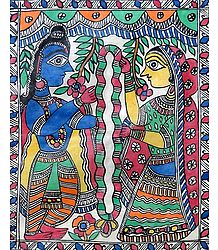
King Drupad had once conducted a yagna in order to wreak revenge on Drona, who had gained control over half his kingdom. Out of the sacrificial fire emerged two figures, that of Draupadi and Dhrishtadyumna. Draupadi was blessed with eternal youth and beauty. As she emerged out of the fire, a divine voice proclaimed that she would destroy the Kauravas. She was a graceful, beautiful woman with a dark complexion. This was the reason she was also called 'Krishnaa' - Lord Krishna Himself addresses her as 'Krishnaa' several times in the Mahabharata. Being the foster daughter of the Panchal Naresh (king of Panchal), Draupadi is also called Panchali. Draupadi is not only a friend of Krishna's, she is also extremely devoted to him.
Drupad announces his daughter, Draupadi's swayamvara. Arjuna is desirous of marrying the beautiful and brave Draupadi, so the five brothers proceed to the swayamvara, disguised as Brahmins.
The challenge is to look into a bowl of water, showing the reflection of a moving fish kept hanging directly above and hit its eye with an arrow. Arjuna, renowned for his archery, hits the target and wins Draupadi's hand in marriage and the five brothers return home with Arjuna's new wife in tow.
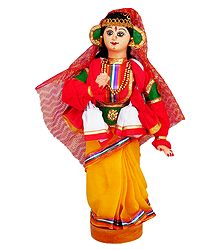
While the Pandavas reach home with Draupadi and requests their mother to see what they had brought home, Kunti absently asks them to share among themselves, whatever it is that they have brought home. She notices Draupadi only after she speaks these words, by which time, it is too late to retract them. So Draupadi ends up marrying all the brothers.
There is a karmic reasoning for Draupadi marrying all the Pandavas. In one of her previous births, she propitiates Lord Shiva and when He appears in front of her, she asks Him for a boon to have a husband with the five qualities of being strong, handsome, a great archer, sharp-witted and intelligent. Since Shiva couldn't create a single man with all these qualities, He blessed her saying she would have five husbands in her next birth, each one having one of these qualities. Thus, Panchali becomes the wife of the five Pandavas.
This is about the time when the Pandavas meet Shri Krishna. The Pandavas grow very close to Krishna, realize His divinity and utterly surrender to Him. Draupadi and Krishna become very close and attached to each other. She is very often referred to by him as his 'Sakhi' (friend) in the Mahabharata.
The Pandavas come out of exile and set up Indraprastha, under the sovereignty of Dhritarashtra. Their palace is very beautiful and also very treacherous. What seems to be is actually not what it is. The Pandavas invite Duryodhana over to the palace. He steps on the ground thinking it is dry, only to fall into a pool of water. Seeing his condition, Draupadi bursts into peals of laughter, thus earning his ire. Duryodhana vows to make her pay for humiliating him in such a fashion.
Kunti's abandoned son, Karna, joins the Kaurava fold and connives with them to destroy the Pandavas. They approach Duryodhana's uncle, Shakuni, to suggest a good method to vanquish the Pandavas.
Well aware of Yudhisthira's fondness for gambling, Shakuni asks them to arrange an elaborate game of dice and invite the Pandavas to Hastinapura to play the game with them. Shakuni, being a spineless cheat, famous for employing unfair means to win the game, keeps tempting Yudhishtira to play more hands. Shakuni casts the dice for Duryodhana. He lets Yudhisthira win the first few rounds and then employs his sly strategies, making Yudhishtira lose heavy stakes. First, he pledges his necklace, then crown, horses, sentries, army and finally, his kingdom, Indraprastha and loses that too.
Then Yudhishtira is asked by Duryodhana to pledge his own brothers and loses that stake too. He puts himself at stake and faces defeat there as well. Finally, when there is nothing else left to lose, Duryodhana asks him to pledge his own wife, Draupadi. Vidura, Dritarashtra's step brother and also his wise minister, advises Duryodhana against committing such a grave sin. But the latter does not relent and continues with his tirade. Finally, Yudhishtira stakes his wife and loses her too.
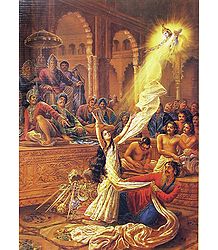
'Vastraharan' literally means disrobing. This incident marks the turning point, which actually sparked off the great Kurukshetra war. Duryodhana orders a female attendant to present Draupadi to the sabha. But when she refuses to come in front of the royal sabha, Duryodhana commands his younger brother, Dushasana, to forcefully drag her into the forum. Dushasana grips Draupadi by her hair and pulls her into the hall.
The Kauravas and Karna proceed to insult her as the Pandavas' whore. This incenses Arjuna, who swears to kill Karna sometime. Dushasana proceeds to disrobe Draupadi in front of the shocked, helpless audience. Draupadi appeals to her husbands to protect her, but they can do nothing in the face of events. She then begs of Dhritarashtra and all the other dignitaries present to help her out, but they too are forced to keep silent.
Draupadi, shedding tears, shamed and in a great rage, prays to Krishna to protect her. Dushasana tugs at her sari in an attempt to disrobe her. But he fails in that attempt. As soon as one layer of cloth falls away from her, there's yet another inner layer covering her, protecting her modesty.
Draupadi surrenders her whole self to Krishna's grace, closes her eyes, lifts her folded hands above her head and loses herself in Krishna contemplation. Dushasana pulls out yards and yards of the material off her, but there is still more cloth covering her each time. After a point of time, Dushasana falls to the ground out of sheer tiredness. Unable to bear Draupadi being violated thus, Bhima swears to rip open Dushasana's chest and drink his blood.
Krishna, the very one who stole the Gopi's clothes, actually bequeaths Draupadi with more and more layers of clothing to prevent his dear friend and foremost devotee's modesty from being outraged.
The whole assembly, that is witness to this great miracle, is filled with silence. Panchali again appeals to Dhritarashtra to protect her, but Duryodhana stops her in her tracks and gestures lewdly, asking her to come and sit on his thigh. Bhima roars in anger and swears to crush that thigh before he kills him.
This is when Panchali takes her terrible vow. She vows to keep her long, flowing hair untied till Bhima is able to soak her hair in Duryodhana's blood.
Dhritarashtra grants her three boons, using which Panchali also frees her husbands from bondage and returns their royal status to them.
Krishna tries to alleviate the tension between the Pandavas and Kauravas by engaging in diplomatic talks with the latter party. But the Kauravas are disinterested in any kind of compromise, so the epic battle of Kurukshetra is fought for 18 long days. The battle starts at sunrise each morning and ends at sunset. Krishna decides to be unarmed and become the Parthasarathi, the charioteer of Arjuna, also addressed as Partha. The Pandavas' army is much smaller than the Kauravas. So they develop clever strategies to win the war.
On the first day of battle, however, Arjuna is overwhelmed by emotion when he realizes he has to fight and kill his own grandfather, the colossal legend Bhishma, his respected teacher, Drona and the others on the battlefield. He drops his weapons to the ground and slumps in defeat, his hands quivering in sorrow and fright. Struck with extreme grief, not knowing right from wrong, Arjuna goes to Krishna for help and advice.
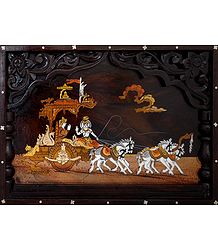
When Krishna sees Arjuna falling apart on the battlefield, He steps forward to give him advice on life and on the higher purpose of living. This conversation is the Bhagavad Gita, which is the actual mission of the Krishna avatar. The Bhagavad Gita is one of the most sacred Hindu spiritual texts. This is when Krishna takes a massive Vishwaroopa and shows Himself as Lord Mahavishnu, the Ultimate Source of life and death. Krishna educates Arjuna on the purpose of life and the importance of leading a righteous life. He reminds Arjuna that this is a battle between dharma and adharma, so it would not be a crime to slay anyone who was adharmic.
Shri Krishna's message gives Arjuna renewed spiritual strength to fight the battle. At the end of 18 days, all the biggest warriors of the Kaurava side die, leaving the Pandava side victorious.
The Pandavas return joyously to Hastinapura, where Yudhishtira is duly crowned as King.
The Krishna avatar came to an end when a hunter accidentally struck Krishna on his foot with his poisonous arrow. Realizing what he had done, he weeps uncontrollably and begs forgiveness of Krishna. The Lord smiles it off and forgives him, assuring him that this was all only a Divine Drama which has already been pre-destined.
The Ramayana and the Mahabharata are undoubtedly the greatest epics of all time. But there are also some controversies and questions arising out of the stories herein, which sometimes makes one wonder why Rama and Krishna were so glorified. An in-depth analysis of both the heroes, in reality, presents a slightly different picture.
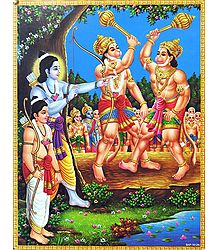
When Rama first meets Sugreeva, the latter tells Him of the atrocities he has to suffer at the hands of his brother and the leader of the Vanarasena, Vali. Rama then decides to kill Vali and make Sugreeva the leader instead. Since both the monkey brothers look alike, Rama asks Sugreeva to wear a garland round his neck, so that He would be able to identify him. While the brothers engage in a fierce battle, Rama hides behind a tree and shoots a fatal arrow at Vali, thus ending his life.
Rama comes from the Kshatriya (warrior) sect, which does not excuse any act of cowardice. So how can one condone this act of hiding behind a tree and attacking his friend's brother, with whom he never had any enmity in the first place? Besides, Rama is known to be an epitome of non-violence. How does such an act qualify as non-violent?
The Valmiki Ramayana ended with the Coronation of Rama. But the story continues in the Uttar Ramayana. After a long captivity of a year in Ashokvan, Sita is delighted to hear that Rama won the battle against Ravana and will soon come to take her back to Ayodhya. She dresses up in all finery and readies to meet Him. But to her extreme shock and grief, He refuses to look at Her and tells Her that He killed Ravana only to punish him for his wrongdoings. Rama further tells Sita that She is free to go wherever She pleases.
Enraged at this, She orders Lakshmana to light a pyre for her and jumps into the fire. But to everyone's amazement, She emerges unharmed from the fire. Rama immediately embraces Her and announces that this was only a leela which They created to let the people know how pure and pious Sita actually was. The Agni Pareeksha (test of fire) would never harm anyone pure and innocent as Sita.
In spite of taking the Agni Pareeksha, however, Sita is humiliated by Rama yet again. When Rama overhears some subjects talking among themselves, doubting Sita's chastity, He decides to banish Sita from the kingdom. But He does not do so Himself. Instead, He asks Lakshmana to leave Her safely in Valmiki's ashram (spiritual abode). Sita is pregnant with Rama's twins at the time, yet she is sent away from the kingdom, as Rama claims that it is His duty as a King to cater to the needs of his subjects. His other reasoning is that anyone whose piety is blighted is not fit to be Queen, so She has to relinquish Her position and leave the palace.
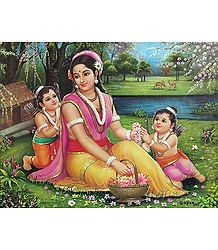
The story doesn't end here. In the ashram, Sita gives birth to twins, Luv and Kush, who grow to be bright young men. When Rama happens to meets them many years later, is impressed by their brilliance and enquires about their lineage, they narrate the whole Ramayana to Him. He then realizes they are His own sons, relents and invites Sita back into Ayodhya, saying it was only She who was in His heart all these years.
But Sita still boils with rage at Her past humiliation and refuses to return to Him. She pleads with Her Mother, Bhumi Devi (Mother Earth) to open up the ground and accept Her. The very next instant, the ground breaks open, revealing a huge chasm under it. Sita jumps into that chasm and is swallowed up by it.
A crestfallen Rama returns to Ayodhya with His sons, leaves them there and then ends His avatar by taking a Jala Samadhi (taking Samadhi in water).
The question here is, was Sita too, not a subject of Rama? The Queen is also the praja (subject) of the King, and hence it becomes the duty of the King to protect her as well. Besides, asking one's brother to leave one's pregnant wife to the forest for no fault of her own, comes across as an act of cowardice.
There are related stories which talk about how Vishnu had been cursed by a rishi (sage) that He would have to stay separated from His Companion in His next coming. While these offer a karmic connection, can one really condone such acts in today's modern times? Further, if everything - right or wrong - were to be explained away as mere karma, there would be little place left in society for courts of justice.
The Mahabharata, though also filled with injustices galore, seems to be more relevant to the Kalyug. Though many wrongs have been committed here too, this epic also teaches one the art of statesmanship and how to deal with and win against a wrongdoer.
Probably the biggest injustice in the whole of the Mahabharata was Yudhisthira's act of pledging Draupadi in the game of dice. When he had put himself at stake and had lost that bet, thus becoming a slave himself, what right did he have to put his wife at stake?
The mighty Bhishma Pitamah was the commander-in-chief of the Kaurava side. He was all too powerful for the Pandavas. He wreaked much havoc on the Pandava army. In a fit of rage and frustration on the third day of war, Krishna pulled out His Chakra (discus) to kill Bhishma. The Pitamah only looked at him and smiled calmly, reminding Him that He was not supposed to use his weapons in the battle. Krishna realized His own mistake and withdrew from there.
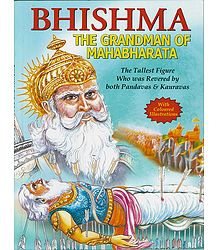
On the tenth day of the Kurukshetra battle, though, Krishna asked Arjuna to stand behind Shikhandi and attack him. Bhishma had resolved never to fight against a woman, so he was helpless as Arjuna attacked him with arrows from behind Shikhandi. Arjuna took aim at all vulnerable points in his armor and kept shooting arrows through his body, till Bhishma fell on his shara-shayya (bed of arrows). This violates the Kshatriya dharma, as no warrior is supposed to attack another in such a cowardly fashion.
With the fall of Bhishma, Drona Acharya took his post. Krishna was well aware that Drona too was extremely powerful and was too mighty for the Pandavas. Hence he employed a crooked way to defeat Drona. The Acharya was very fond of his son, Ashwatthama, and wouldn't be able to stand it if something were to happen to him.
If Drona was to be defeated, they would need to give him the news of Ashwatthama's death. Yudhisthira, the ever-truthful one, though, refused to lie to Drona saying that his son was dead. So he killed the elephant Ashwatthama instead, and announces to Drona, "Ashwatthama hatah iti kunjaraha", meaning, "Ashwatthama, the elephant is dead". But he says the word, "kunjara" (elephant) very softly, so that the Acharya would not be able to hear it. Drona thinks it is his son who died in the battle and is grief-stricken. He, too, is killed in battle.
How fair was it to defeat and kill Drona through such unfair means? Both Bhishma and Drona were good, wise people, who never indulged in adharma. They fought the battle only because it was their duty to fight for the kingdom.
Karna too was a good person who respected Krishna. But he owed a lot to Duryodhana and so, fought for him. When Karna's chariot wheel got stuck in the mud, he put down his arms and got down to set it right. This is when Krishna asked Arjuna to shoot and kill Karna.
Kshatriya dharma goes against killing an unarmed warrior. But this rule was completely ignored in the killing of Karna. How just was this act?
Jayadratha killed Abhimanyu, son of Arjuna and nephew of Krishna, by luring him into the Chakravyuha battle formation. Struck with grief, Arjuna vowed that if he couldn't kill him before sunset, he would kill himself. Duryodhana kept Jayadratha hidden and so Arjuna couldn't kill him. When Krishna saw what was happening, He threw His chakra at the sun, making it look like the sun had set. When Jayadratha came out to watch Arjuna's death, Krishna withdrew the chakra, so Arjuna could kill him.
Duryodhana was a brave warrior and gave Bheema a good fight. When Krishna saw Bheema tiring, he indicated the thigh region, thereby asking him to hit Duryodhana there. He knew that was Duryodhana's weakest spot. Bheema understood what He meant and hit him on the thigh with his mace, resulting in Duryodhana's defeat and death.
Kshatriya warfare does not allow hitting a warrior below waist level. So how can this act be condoned?
These and other questions are bound to come up in people's minds from time to time. The general explanation is that these are Godly deeds and dramas and hence, shouldn't be questioned.
Of course, Rama and Krishna are unquestionably divine and Their stories teach us a lot about rights and duties, dharma and adharma and many other things about life itself. But yet, should we choose to overlook Their 'small flaws' and accept only their good teachings? Or should we adopt a more scientific attitude and question some of Their actions?
This article was written by:
Priya Viswanathan, a teacher/performer of Bharata Natyam, Classical Music and Classical Instrumental Veena. A recipient of several awards for both music and dance, Priya is also a freelance writer online. She currently writes for About.com, a subsidiary of IAC - the parent company of Ask.com. (http://mobiledevices.about.com)