Please wait...

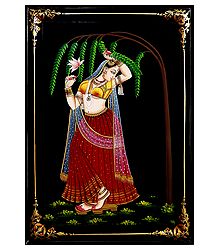
Indian music is very unique in that, it is highly spiritual in nature. The singer/artist tries to reach God through his music. Like all the other Indian classical Performing Arts, classical music too, is a journey of the Jeevatma or the soul towards the Paramatma or the Divine.
As they say, ‘Western music moves the heart, while Indian music moves the soul’.
“Geetam Vadyam
Nrithyam Trayam Sangeetam Uchyatey”
This phrase in Sanskrit implies that the
word ‘Sangeetam’ or
music includes the practice of Geetam
(Vocal Music), Vadyam (Instrumental
Music) and Nrithyam (Dance).
‘Sangeeta sadhana’, or the practice of such music, is the key to attaining the Divine, according to Indian music.
India’s rich cultural system is made up of the silken fabric of dance and music. Both the pure Classical Indian forms as well as folklore rely heavily on one aspect of Sangeetam – the nada. The nada can be defined as sound or more specifically, as resonance.
“Ananda lakshanam
anahata namnee deyshey
nadatmana parinatam thoo aroopam eeshey
prachnan mukheyna manasA paricheeya manam
samshanti nethra salilai: pulakaischa dhanyA:”
This Sanskrit sloka describes the nada. It says, “The true nature of nada is bliss. The source of this Divine Energy is the anahata chakra, which is situated in the heart region. This chakra or spiritual center is the seat of the Primeval Sound, ‘aum’, the creator of the world. This Divine Energy is formless and can be perceived only through mystical experiences. So state the great seers, in an extremely ecstatic state, shedding ceaseless tears of joy”.
According to Sarangadeva of Sangeeta Ratnakara fame, nada is produced thus:
- The Atma or the soul desiring to speak or sing, stirs the mind.
- The mind strikes the fire residing in the body.
- The fire strikes the wind in the body.
- The wind residing in the Brahmagranthi and rising along the upward path, manifests successively on the navel, heart, throat, head and mouth.
Thus the nada is produced by the conjuction of prana or life-force (‘nA’) and anala or fire (‘da’).
Sangeetam and sangeeta sadhana is an important part of India’s rich cultural heritage. Music is akin to the Divine and the upasana or the practice of music is regarded as a prayer to the Divine Light.
Saint Thyagaraja, one of the Trinity of Carnatic (south Indian classical) music, extols the importance of this aspect in several of his compositions. In his Telugu kriti (or composition), ‘Naadatanumanisam’, he states:
‘Nadatanumanisam Sankaram Namamimey Manasa Sirasa’, meaning, “I bow to that Lord Siva who is the very essence of nada or resonance (sound)”.
Yet another famous composition of Thyagaraja goes as follows:
‘Sobhillu Saptaswara Sundarulu Bhajimpavey ManasA’, where the composer talks about the Divine Light glowing through the seven swaras or notes.
There are several stories relating to each God in Indian mythology. While this can astound and overwhelm any foreign student interested in studying Indian art and culture, it is a normal way of life in India!
The Hindu pantheon contains thirty-three crores of Gods, Goddesses and Divine Beings. Idol worship is one of the main types of religious worship in India. While this can be quite confusing to say the very least, the ultimate aim of the Hindu seeker is to go beyond idol worship and realize the true state of the formless Brahman, the Ultimate One.
Nadopasana, or
the worship of that One Universal Power
through music, is the final aim of the musician
or singer.
Nada gives rise to srutis, which in turn
gives rise to swaras or notes. It is these
notes that give rise to various ragas
of Indian music.
“Shrooyatey Iti Sruti” – any sound that is heard is called Sruti.
This definition, however, is very general. Sruti goes to mean the smallest interval of a sound that can be perceived by a trained ear. Classical Indian music abounds with semi-tones and quarter-tones to enhance the quality of music. Some of the quarter-tones used are very subtle and can only be heard by those who are deeply involved in the study of music.
Sruti also has various other meanings. It can mean the ear, hearing, even the Vedas. The term sruti also denotes the drone instrument, which constantly gives the singer/musician the required pitch.
Indian music relies very heavily on srutis and sruti values. Subtle and gross differences in sruti values is what gives us the swaras or notes in Indian music.
The swara or the note is derived from the roots of the two words, ‘Swayam’ and ‘Ranjakam’. So the word ‘swara’ means, ‘that which pleases on its own accord’. World music has seven universal notes.
The number seven is of great esoteric significance in our lives. We have seven days of the week, seven colors of the rainbow, the seven seas, the Saptarishi or seven sages and so on.
The seven notes of Western music are Do, Re, Mi, Fa, So, La and Ti, while its Indian counterpart is Sa, Re, Ga, Ma, Pa, Dha and Ni.
The origin of swara goes back to the Vedic period. Tracing the origin of the swara is an interesting journey.
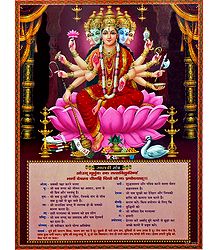
- The earliest Aryan dwellers chanted the Rig Veda hymns with just one note. This was the first stage, wherein the Gayatri mantra, or the ‘Om Bhur Bhuvaswaha’ was chanted only with one note.
- Then came the gatha or the gathika, wherein two notes were used for chanting. This is when cadences came into being, along with the chant.
- The third stage was the most important one – when the saman chant was introduced in hymns. This stage included chanting with three swaras or notes. It is believed that Indian music came about after the introduction of the sama veda.
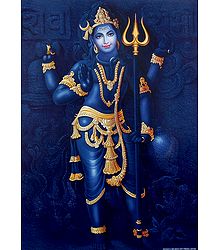
There is a fascinating mythological tale about the origin of the swaras, as follows:
It is believed that Lord Shiva once addressed a celestial congregation, for the welfare of mankind. While the subject of His address became the Vedas, the differences in His tonal quality became the seven swaras.
Shiva is known to have five faces or the ‘panchavaktra’, which are, Satyojata, Vamaka, Tathpurusha, Isana and Aghora.
He first addressed the audience at the centre, and then the immediate left and right. The centre tone became the basic note or the sadja (sa), while the ones on the immediate left and right became the ‘ni’ of the lower octave and ‘ri’ respectively.
Shiva then addressed the audience to the far left and right. Here, two notes emanated out of each face, to reach to the farthest sides. So there emanated the notes ‘dha’ and ‘pa’ of the lower octave on the left side and ‘ga’ and ‘ma’ on the right.
This totaled to seven swaras, Sa, Re, Ga, Ma, Pa, Dha and Ni.
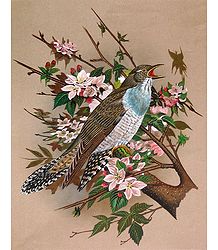
One interesting fact that the origin of swaras gives us is that they were derived from Mother Nature Herself! The tonal quality of each note is associated with the call of a specific animal or bird, as listed below:
NAME
OF SWARA |
NOTATION WRITTEN |
NOTATION |
SOURCE |
Sadja |
Sa |
S |
Cry
of the peacock |
Rishabha |
Re |
R |
Lowing
of the bull |
Gaandhaara |
Ga |
G |
Bleating
of a goat |
Madhyama |
Ma |
M |
Call
of the heron |
Panchama |
Pa |
P |
Call
of the cuckoo |
Dhaivata |
Dha |
D |
Neighing
of the horse |
Nishaada |
Ni |
N |
Trumpeting
of the elephant |
Though the seven note system in music is universally accepted, Indian system adds an extra 5 notes, depending on the variation of the srutis. The manipulation of these swaras is what gives rise to one of the most important concepts of Indian classical music, the raga.
The 12 swaras are as follows:
| NAME OF THE SWARA | NOTATION |
| Sadja | S |
| Komal Rishabha | R1 |
| Teevra Rishabha | R2 |
| Komal Gaandhaara | G1 |
| Teevra Gaandhaara | G2 |
| Komal Madhyama | M1 |
| Teevra Madhyama | M2 |
| Panchama | P |
| Komal Dhaivata | D1 |
| Teevra Dhaivata | D2 |
| Komal Nishaada | N1 |
| Teevra Nishaada | N2 |
The following is the Sanskrit definition given to the word, ‘raga’:
“Ranjayati Iti Raaga:”
That which pleases the ear is referred to as a raga. The raga can be defined as a melodic type or melodic mould. It is a collection of notes in a particular order, giving rise to a melody type. The raga is the very soul of Indian music.
It is very difficult, almost impossible, to define a raga in just a word or two. Though the above-mentioned definition of a raga exists, it is only valid for academic purposes.
As Harold.S.Powers states, "A raga is not a tune, nor is it a 'modal' scale, but rather a continuum with scale and tune as its extremes." The Indian raga is far more complex than the simple modal scale and encompasses in itself a variety of ways in which you can treat its notes or swaras. The raga is also much more complicated than just a tune. The raga can also present itself as a method of on-the-spot creative improvisation (like the Alapana or the raga vistara) by the musician/artist.
Ragas are ever-changing, dynamic entities. They veritably pulsate with life and help produce an almost unlimited flow of ideas in the artist. The raga, being so vast a subject, goes beyond the most detailed definition and has to be experienced by both the singer and the listener to be properly understood.
Raga is the pivotal concept of Indian music. It is uniquely melody-based and is a fine example of ‘absolute music’. Nowhere else in world music can you see the existence of a phenomenon like the raga. Hence the Indian raga system generates much interest among musicians and musicologists of world music.
The raga is a compilation of a series of notes in an octave, which bear a definite relationship to one another and occur in varied phrases of permutation and combination, thereby giving a shape and a unique personality to it. The raga must have a minimum of five notes in the order as prescribed by the ancient texts on music. Further, it must have a Sa and either the Ma or the Pa. There are exceptions in Carnatic music, of course, but those ragas have limited scope and do not sound very pleasing when sung for too long.
The raga is ornamented with various shakes and graces too, thereby enabling it to emote and breathe life and expression into a song.
Western music places importance on scales. Western classical music deals with various major and minor scales as the basis of its music. These scales are of equal temperament, meaning they are rendered in the same way by each and everyone singing or playing that particular scale.
Indian music, on the other hand, stresses on scales of unequal temperament, or what is termed as ‘just intonation’ or ‘correct intonation’. Here, the notes of each raga or melody are rendered in different raga. The notes of a scale are embellished with shakes and oscillations, which enhance the beauty of the raga. These shakes are referred to as ‘gamakas’.
It is the usage of these gamakas or ornamentations that makes Indian music what it is today. These gamakas give character and a unique emotional quality to the raga as a whole.
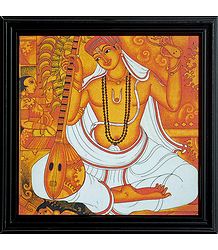
Ragas are said to have healing properties, if sung properly. Emperor Akbar’s great court singer, Tansen, is said to have been able to light oil-lamps, bring rain and even save lives with his music. There is also a historical reference to how he brought a dead man to life by singing a particular raga.
Ragas in Indian music are known to have healing properties. While ragas like Sahana heal the body of mild ill-health, Todi relieves severe sinus headaches. Singing the Carnatic ragas Bharavi and Athana restore sagging spirits and bestow a feeling of well-being both on the singer and his audience.
The raga, as discussed earlier, is capable of emoting and expressing feelings and thoughts. This happens through the clever use of the appropriate srutis, swaras and pakads (the most important phrases of a raga).
This emotional quality of the raga is known as the rasa, or the quality of that emotion. Raga and rasa go hand-in-hand in Indian classical music. If rendered properly, every raga is capable of giving rise to some emotion, both in the person singing it and among the general audience too.
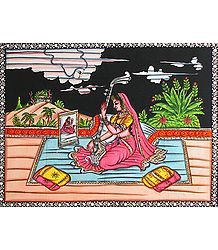
The Natya Shastra, an ancient treatise on Indian Performing Arts (believed to have been written by Bharata Muni, somewhere between 400 BC and 200 AD), talks about the ‘navarasas’ - nine types of rasas or emotions. These are:
- Shringara
(Love/Eroticism)
- Hasya (Mirth)
- Karuna (Compassion/Pathos)
- Raudra (Anger)
- Veera (Valour)
- Bhayanaka (Fear)
- Bibhatsa (Disgust)
- Adbhuta (Wonder/Amazement)
- Shanta (Peace/Serenity)
Each raga admits of one predominant rasa. One raga might even portray more than one emotion, if treated in different ways. Oscillating one note feebly may give rise to veera rasa, while shaking it more vigorously could give rise to raudra rasa.
The exposition of the raga and the resulting rasa(s) all really depends on the caliber of the musician and the extent to which his imagination stretches to define the boundaries of the raga.
Though the Natya Shastra speaks only of nine rasas, one more rasa may be added to the list and that is gana rasa. Gana rasa is the pure aesthetic enjoyment of music, without any other emotion involved. This may also be termed as ‘Sangeetananda’ or joy derived from singing or listening to music.
This capacity of the raga to give rise to rasas or emotions is what makes Indian music occupy a unique place in the history of world music.
Of course, one experiences a plethora of emotions when one listens to artists like Bach, Beethoven or the famous singer, the late Amalia Rodrigues. But the extent to which the rasa theory of Indian classical music has been systematized makes it a cut above the rest of world music.
Each raga in Indian music is assigned a particular form and the singer/musician sings melodies keeping this image in mind. The raga devatA or the presiding deity of the raga is as important as the raga itself.
This is yet another point where Indian classical music stands out from the rest of the world music. Each raga or melodic mould is actually personified and given a form and shape.
The concept of the raga devatA, in fact, is so important, that it is often said that singing raga phrases wrongly would cause injury or even headaches to the raga devatA!
Raga, being a very vast subject, it has been classified in several ways, from time immemorial.
Various methods of raga classifications have been tried out by experts from as early as the 9th Century, considering aspects of music that held its sway in that particular era. One of the earliest attempts of raga classification was the grama/murchana/jati differentiations.
But many of these classifications have not helped in the present scenario, as the ancient ragas themselves have evolved. Besides, many hundreds of new ragas have also come into existence today. So they would fit nowhere in the ancient system of raga classification.
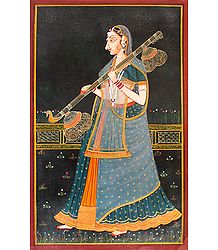
Ramamatya expounded the 72 Melakarta (the full raga or the parent raga) system for Carnatic music in the 16th Century, which was further elaborated and clarified by Venkatamakhi in the 17th Century. This type of raga classification is the very anchor of the Carnatic system of music and has come to stay in this system.
Famed scholar and musicologist Pandit Vishnu Narayan Bhatkande, studied the Melakarta system in detail and came out with a monumental contribution to the world of Hindustani music. Out of the 72 Melakartas, he selected 10 sampoorna or full ragas and referred to them as Thaats. The 10 Thaats, which are the basis of Hindustani music today, are Bilaval, Khamaj, Kafi, Asavari, Bhairavi, Kalyan, Todi, Purvi, Marva and Bhairav.
Again, there are controversies regarding this classification too, but Bhatkande’s Thaat system is the widely accepted by most musicians in Hindustani music.
Raga classification has also been done on various grounds – on the number of notes they take, on the mood they create, on the bhava or feeling/expression they generate, the time they are sung at, the features they take and so on and so forth.
After the sampoorna ragas, there came the janya ragas. These child ragas, which were derived from the Melakartas, had one of few notes missing in them, or would take notes foreign to the parent raga. So ragas were further classified on such basis.
Depending on the swaras they took, these Varjya (with notes missing in them) janya ragas were classified as follows:
Audava –
Taking5 notes in the aroha/avaroha
(the ascent or descent)
Shaadava – Taking 6 notes
Vakra – Taking notes in a
zig-zag manner, not following the right
order
Upaanga – Taking notes in
conformity with the parent raga
Bhaashaanga – Taking foreign
notes or ‘anyaswaras’,
not belonging to the parent raga.
It is believed that certain ragas are most beneficial while sung at an appropriate time during the day. Both the Hindustani and Carnatic music systems believe in the time theory, but it is the former that places much emphasis on this theory.
The time theory was first constructed and propagated about 500 years ago by the famous Hindustani (north Indian classical music) musician, Pandit Bhatkande. Pandit Bhatkande is hailed as the father of Hindustani music, as he was the one who built a systematized module for Hindustani music.
Hindustani singers faithfully follow the time theory by rendering ragas only at their specified timings. The time theory is split into two parts – the Purva ragas and the Uttara ragas. The Purva Ragas are those sung between 12 noon and 12 midnight, while the Uttara Ragas are ideally sung between 12 midnight and 12 noon.
The ragas to be sung between twilight and dusk are called Sandhi Prakash ragas. These are supposed to be sung around 4 and 7 o’clock, both in the morning and evening.
Besides the time of day, seasonal ragas also exist. It is best to sing certain ragas at certain times of the year. For example, raga Basant Bahar is best sung during spring, raga Amritavarshini during the rainy season or to bring in more rain and so on.
The reason for compartmentalizing these ragas is probably because they already have the capability to generate a particular emotion, which can be heightened by that season. Spring is a season for the heart to blossom with love. Singing a raga that exudes the Shringara rasa, brings out the real beauty of the raga.
There has been a close inter-relation between music, painting and poetry. Much of Indian music has come into existence through the heartfelt outpourings of brilliant composers like Mirabai, Tulsidas, Purandaradasa Thyagaraja, His Highness Maharaja Swati Tirunal and so on. So, Indian music and poetry have a strong link that binds them together.
A clear link has been drawn between music and painting too. Since each raga is capable of emoting and is given a unique personality, it was inferred that these ragas could be actually expressed on canvas.
The connection between the raga and painting came into the fore between the 16th and 19th Centuries, when painting of miniatures was encouraged by the Moghul rulers.
There have since even been several successful attempts at interpreting music through the use of colors and painting.
The Bhakti (devotion) and Bhajana (sacred) tradition was petering out by the 13th Century and the new trend was towards secular music – the singing of ragas. A number of new ragas were coming into existence, bringing this field to the forefront.
Nevertheless, musicians of the old school still believed in the rasa theory and the time theory. They also believed in the raga devatA concept and carried on with propagating their views on music.
The 14th Century saw a change in the music scene. Music literature included a description of ragas in short Sanskrit verses called ‘dhyana’ (meditation/contemplation). These little poetic verses highlighted the characteristics of the ragas, breathing life into them and giving each of them a particular swaroopa (persona) of a deity, nayaka (hero) or a nayika (heroine).
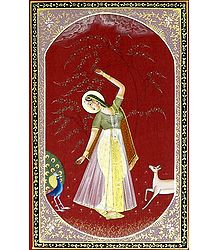
This is what led to the raga-ragini systems and the subsequent creation of the ragamala paintings, a series of portrayals of these raga-ragini bhavas (expressions) on canvas. These ragamalas or garland of ragas, is what clearly illustrated the close connection between poetry, painting and music.
To quote H.J.Stooke, “Poetry, painting and music were thus brought into a new relationship” with the advent of the ragamalas.
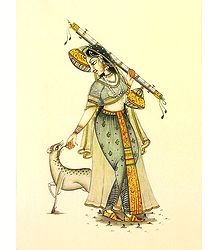
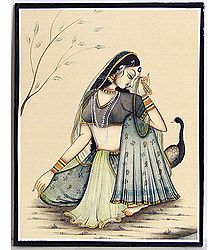
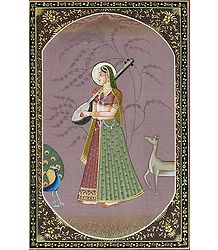
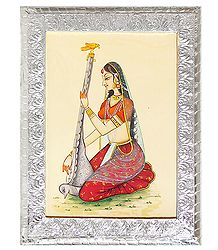
The ragamala paintings usually depict the raga as a human, divine or semi-divine figure, with or without other characters around. The theme for such paintings is usually Shringara (romantic) or Bhakti (devotional) oriented. Most of the paintings also have the raga or ragini name inscribed in them, as also the dhyana or the Sanskrit verse, as mentioned above.
The ragamala paintings are an obsolete art today, as it has no relevance in today’s music. Ragas have evolved through the decades, so many of these paintings do not seem relevant to the raga they mention. Besides, these paintings do not have any provision to describe newer and later raga additions. So this, though a wonderful system at one time, has faded away into obscurity now.
The raga-ragini system makes for an interesting study. Because the ragas in Indian music have been given a sacred, demi-God status, it is only natural that they were classified into ‘human-like’ groups and assigned familial relationships with each other.
The raga-ragini system of raga classification occurred between the 16th and 19th Centuries and preceded the modern classification of ragas, as it exists today.
The raga-ragini system tries to draw a parallel between the dynamic and the static – the Prakruti and the Purusha. Further, the raga-ragini system also illustrates the fluctuation in human behavior and responses to situations. It is related to the various mood changes in a person, with apt ragas to portray these emotions.
It is the classification of ragas on the raga-ragini basis, that gave rise to the close link between poetry, art and music, as mentioned before. Various nayaka-nayika (man-woman) relationships and emotions were depicted with poetry, painting and music.
Again, Hindustani music relies more heavily on the raga-ragini system. Carnatic music merely acknowledges the existence of this theory.
The raga-ragini (male-female raga) classification can be traced right since the time of the treatise, ‘Ragatarangini’, written by Lochana Kavi. This book discusses in detail several songs of the Maithila dialect of the Hindi language. These songs were set to many ragas and raginis prevalent during that time. In his book, Lochana Kavi has dealt with both regional and local ragas and raginis of Mithila during that time.
The raga-ragini classification of ragas is created with the following principle:
There are 6 principal male ragas, namely Bhairav, Malkauns, Hindol, Deepak, Shri and Megh ragas.
These ragas have five wives or raginis each and these raga-ragini ‘couples’ also have 8 children or raga putras each. This gives us a total of 84 ragas.
Mentioned below is a detailed list of the ragas, raginis and their children:
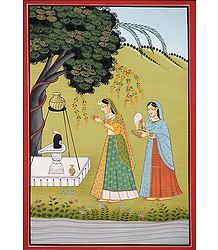
raga –
Bhairav
Raag Bhairav is known to be the first raga,
that emanated from Siva himself. A simple
and common raga, this is seldom heard in
concerts today, as it is deemed as a morning
raga.
raginis – Bhairavi, Punyaki, Bilawali,
Aslekhi, Bangli
putra ragas – Harakh, Pancham,
Disakh, Bangal, Madhu, Madhava, Lalit, Bilawal
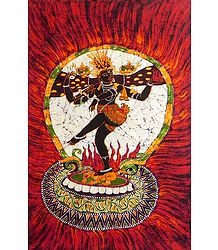
raga –
Malkauns
Malkauns is one very beautiful raga, derived
from the Bhairavi Thaat. This raga is said
to have been created from Siva’s Taandav
(cosmic dance), so it has a vigour and energy
about it.
raginis - Gaundkari, Gandhari, Seehute,
Devagandhari, Dhanasri
putra ragas - Mustang, Maru, Mewara,
Khokhat, Parbal, Chand, Bhora, Nad
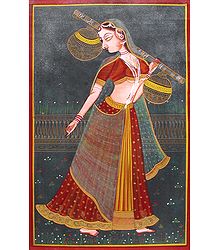
raga –
Deepak
Tansen, one of the ‘navaratnas’
in Emperor Akbar’s court, is said
to have lighted lamps with this strong,
vibrant raga.
raginis - Kachheli, Patmanjari, Todi,
Kamodi, Gujri
putra ragas - Kaalanka, Rama, Kuntal,
Kamal, Kusum, Gaura, Champak, Kanra
raga –
Shri
This is a very old raga, taken from the
Poorvi Thaat. As the name suggests, it is
also a very auspicious raga.
raginis - Bhairavi, Gauri, Karnati,
Sindhavi Asavari
putra ragas - Salu, Sagra, Sarag, Gund,
Gaund, Kumbh, Hamir, Gambhir
raga –
Megh
As the name of the raga suggests, it lets
us envision monsoon in all its primitive
force and lets us conjure up images of thick
clouds, thunder and lightning.
raginis - Sorath, Asa, Gaundi-Malari,
Gunguni, Sooho
putra ragas - Biradhar, Kedara, Gajdhar,
Jablidhar, Jaldhara, Nut, Sankar, Syama
This system of raga-ragini classification was also accepted and upheld by the Tansen school of thought.
The raga-ragini classification had not accepted very easily by scholars at that time. Many musicologists argued that this basis for classification of ragas was merely imaginary and nothing to do with the actual ragas.
But the raga-ragini theory started gaining importance when the scientific principle of the male-female raga elements showed up in the Vadi-Samvadi swaras or notes. Vadi-Samvadi notes are notes showing the male and the female character of the swara.
In actuality, the raga-ragini parivara (family) system is believed to have existed many centuries ago, much before the bifurcation of Indian music into Hindustani and Carnatic music.
Indain music was one before the 13th Century, that is, till the Moghul invasion. It was after this that there was such a clear line of distinction between north Indian and south Indian music. Though both systems are similar even to date, the difference lies in the way the notes are treated and sung.
The ancient raga-ragini system too had six main ragas, each with 5 wives or raginis. Each of these raga-raginis had 8 sons or putras and 8 daughters-in-law or vadhus. So then the ragas totaled to 132.
There is no unanimity among the different schools of Hindustani music regarding what the main ragas are and who their respective raginis are either. There is another school of thought that names six other ragas as the main ragas. According to them, the six major ragas are Kanada, Vasanta, Mallara, Vibhashaka, Gandhara and Dipaka. According to this school, Kanada’s raginis are Mayuri, Todi, Gaudi, Varati, Vilolika and Dhanasri.
This school of thought also points out to the existence of dasa and dasi (male and female servant) ragas and dhoota and dhooti ragas too, giving them certain specific characteristics.
The raga Kanada’s raginis, Mayuri and Todi have been mentioned to have dasi ragas like Shyama, Vaya, Vagiswari, Saradi and Vrindavani. Paraj, according to them, is also a male dasa raga of these ragas.
This raga-ragini ambiguity lasted for a long time, but disappeared as soon as the MelakartA and Thaat (parent raga) systems came into being in Carnatic and Hindustani music respectively.
The ragamala paintings ceased to be of great importance from the 19th Century onwards. Now, it is an obscure art and has lost all its followers.
Further, many of the original ragas and rAginis have evolved and transformed with the passing years, so their ancient iconography held good no more.
Yet another reason for the decline of the raga-rAgini system is that contemporary musicians and singers no longer perceive the connection between the ancient poetic descriptions and paintings of the ragas and rAginis.
The raga-rAgini classification, though not practically viable in today’s music scenario, is very useful from the historical, academic, artistic and philosophical point of view. Knowing more about the raga-rAgini classifications and studying them in detail could also enhance our own knowledge of the subject of music and could probably even help us sing and perform better in future.
This article was written by:
Priya Viswanathan, a teacher/performer of Bharata Natyam, Classical Music and Classical Instrumental Veena. A recipient of several awards for both music and dance, Priya is also a freelance writer online. She currently writes for About.com, a subsidiary of IAC - the parent company of Ask.com. (http://mobiledevices.about.com)