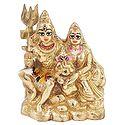
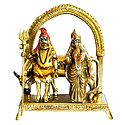
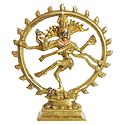
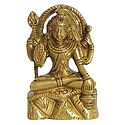
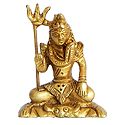
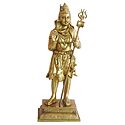
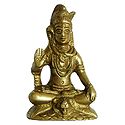
This antiquated Dhokra (lost wax casting) item depicts Lord Shiva - one of the trinity of Gods in Hinduism - sitting on the divine bull Nandi - Lord Shiva's divine vehicle. Siva is typically depicted as a fair, near-naked man with long hair worn in a top-knot. He usually has two arms when shown seated in meditation as an ascetic and four arms when shown performing his tandava dance of cosmic destruction. In his ascetic form he sits on or is clothed in a tiger, leopard or lion-skin. He carries a double-headed drum and a trident or gig, called in Sanskrit a trishula, which he uses as a weapon. His chief decoration consists of the crescent moon in his hair, and bracelets and necklaces of living cobra snakes (nagas). His forehead is marked with a design of horizontal stripes.
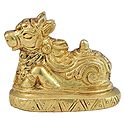
His vehicle is a bull whose name is Nandi. Shiva's bull is tame and serves as his vehicle (vahana). An analysis of the deities with associated animals suggest a reflection or reinforcement of some of the qualities perceived in the deity. Lord Siva rides the Bull, Nandi, which stands for the bullying, aggressive, blind and brute power in man. It also stands for unbridled sexual energy, kama. Only Lord Siva can help us control these and transform them.
Nandi who represents by its white, purity , justice and eternal joy is, more than a vehicle, Lord Shiva's constant companion on all his errands. The companionship of Shiva and Nandi is the earliest known phenomenon in Hindu pantheon. Of all Aryan, or Brahmanical deities, Shiva alone is known to have an origin receding back to Indus days. In excavations of Indus sites it is Shiva alone whose images in Mahayogi and Pashupati, or the herds keeper form have so far made their appearance. Another significant image is that of the ox, widely known as Indus bull. Obviously the dairy based Indus culture worshipped as its principal deity a Shiva type god, the keeper of herds, and the one who used a bull as his vehicle. Later Nandi itself acquired the status of an independent deity and there are in the country several temples devoted independently to him. In all cases a Nandi image installed outside the gate of the garbhagraha or the sanctum facing Shiva is an essential feature of a Shiva temple. The bull symbolizes both power and ignorance. Lord Shiva's use of the bull as a vehicle conveys the idea that He removes ignorance and bestows power of wisdom on His devotees. The bull is called Vrisha in Sanskrit. Vrisha also means dharma (righteousness). Thus a bull shown next to Shiva also indicates that He is the etemal companion of righteousness.



This antiquated Dhokra (lost wax casting) item depicts Lord Shiva - one of the trinity of Gods in Hinduism - sitting on the divine bull Nandi - Lord Shiva's divine vehicle. Siva is typically depicted as a fair, near-naked man with long hair worn in a top-knot. He usually has two arms when shown seated in meditation as an ascetic and four arms when shown performing his tandava dance of cosmic destruction. In his ascetic form he sits on or is clothed in a tiger, leopard or lion-skin. He carries a double-headed drum and a trident or gig, called in Sanskrit a trishula, which he uses as a weapon. His chief decoration consists of the crescent moon in his hair, and bracelets and necklaces of living cobra snakes (nagas). His forehead is marked with a design of horizontal stripes.
His vehicle is a bull whose name is Nandi. Shiva's bull is tame and serves as his vehicle (vahana). An analysis of the deities with associated animals suggest a reflection or reinforcement of some of the qualities perceived in the deity. Lord Siva rides the Bull, Nandi, which stands for the bullying, aggressive, blind and brute power in man. It also stands for unbridled sexual energy, kama. Only Lord Siva can help us control these and transform them.
Nandi who represents by its white, purity , justice and eternal joy is, more than a vehicle, Lord Shiva's constant companion on all his errands. The companionship of Shiva and Nandi is the earliest known phenomenon in Hindu pantheon. Of all Aryan, or Brahmanical deities, Shiva alone is known to have an origin receding back to Indus days. In excavations of Indus sites it is Shiva alone whose images in Mahayogi and Pashupati, or the herds keeper form have so far made their appearance. Another significant image is that of the ox, widely known as Indus bull. Obviously the dairy based Indus culture worshipped as its principal deity a Shiva type god, the keeper of herds, and the one who used a bull as his vehicle. Later Nandi itself acquired the status of an independent deity and there are in the country several temples devoted independently to him. In all cases a Nandi image installed outside the gate of the garbhagraha or the sanctum facing Shiva is an essential feature of a Shiva temple. The bull symbolizes both power and ignorance. Lord Shiva's use of the bull as a vehicle conveys the idea that He removes ignorance and bestows power of wisdom on His devotees. The bull is called Vrisha in Sanskrit. Vrisha also means dharma (righteousness). Thus a bull shown next to Shiva also indicates that He is the etemal companion of righteousness.)