Please wait...

Devotion for Lord Krishna is equated with a huge range of emotions and states of mind - from eroticism and sensuality to renunciation and surrender. Complete immersion of one's soul in Krishna's soul, is regarded as the path to unadulterated devotion for Krishna. Radha and Mirabai are seen as the twin zeniths of devotion for Lord Krishna. Opposites in some sense and yet so much one in their love for the lord, the devotion of Mirabai and Radha for Krishna show the oneness of eroticism and renunciation, and finally, the convergence of both into the omnipresent soul of Krishna in the form of single-minded love and devotion.
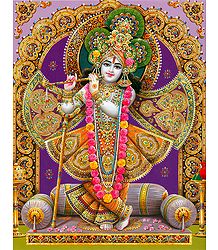
| Guide
this little boat over the waters, what can I give you for fare? Our mutable world holds nothing but grief, bear me away from it. Eight bonds of karma have gripped me, the whole of creation swirls through eight million wombs, through eight million birth-forms we flicker. Mira cries. Dark One take this little boat to the far shore, put an end to coming and going. |
The
Dark One's love-stain is on her, other ornaments Mira sees as mere glitter. A mark on her forehead, a bracelet, some prayer beads, beyond that she wears only her conduct. Make-up is worthless when you've gotten truth from a teacher. the Dark One has stained me with love, and for that some revile me, others give honor I simply wander the road of the sadhus lost in my songs. |
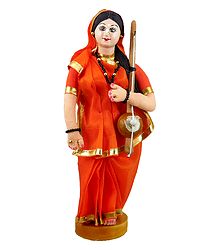
Meerabai was a born poetess. Through her numerous poems, marked with simplicity and lack of pretension, she has beautifully expressed her intensity and depth of love for Krishna. Meerabai's bhajans (songs dedicated to the lord), composed centuries ago still capture the thoughts and emotions of devotees today. These songs are highly regarded for the mystic quality as well as their rich inner meanings. Meerabai offered her soul to the lord, singing and dancing, in a trance, to please her beloved and her lord, Krishna. And through these songs and her devotion she has left behind a legacy of thoughts and ways of making one's soul reach Lord Krishna.
Portraying herself as a lover of Krishna, longing for him, Mirabai's poetry puts love for Krishna above love for friends and family. She perceived Krishna to be her husband, lover, lord and master. Even though those around her try to stop her from her quest for Krishna, she remains unstoppable in her pursuit of Krishna, whatever the consequences.
Making use of erotic imagery as one of the tools to portray her love for Krishna, she is able to describe her pining for him, her quest for union with him. Even though her symbolism is erotic, her love is divine and pure - selfless, all-absorbing, immaculate, insatiable and endless. The expression of Mira's love is very intimate in nature.
It is through love that she communes with God. "Mira's Lord is none other than Giridhara." (Giridhara being Krishna) - these are usually the ending words of Meera's poems which are predominantly an expression of her oneness with Krishna. Mira's love for Krishna is all-encompassing. The lord of her heart and soul, she used to weep for him and spend sleepless nights for a sight of him. Mirabai says she had "sold" herself - surrendered herself - completely to him. She says "I am colored with the color of dusk", dusk implying the color of Krishna. As if her love for Krishna permeated every pore of her body, just like dye permeates a garment. This aspect of union through surrender is predominant in Mira's poetry.
For Mirabai, her freedom lay in her union with her lord. She sings:
"Love in which there is laughter
and sobbing,
Moaning, throbbing and clasping in tight embrace,
That alone is liberation for me,
I care for no other."
This great saint of Hinduism and one the greatest devotees of Krishna, Mirabai was born into the royal family of Rana Ratan Singh of Merta in Rajasthan in 1498 A.D. As a three-year old child she grew extremely fond of a statue of Lord Krishna. So much so that her mother had once jokingly remarked that Krishna would one day be the girl's (Mirabai's) groom. This remark made an indelible mark on the impressionable mind of the young child.
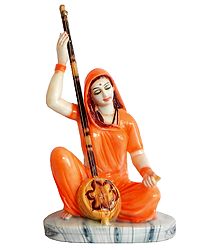
She nurtured the notion of Krishna being her sole lord, her lover, friend and husband as she matured into a woman. She agreed to her marriage to Rana Kumbha of Mewar in Rajasthan, against her heart's wishes, to honor her grandfather's promise to Rana Kumbha. In spite of her marriage, her heart still belonged to Lord Krishna and she spent a great deal of time in the Krishna temple at her husband's palace, albeit after fulfilling her household duties. Conspiracies were unfortunately hatched against her by several around her, to defame her, and eventually to kill her, but all of those could not deter her from her chosen path of devotion. Her husband however is seen to have been a sympathizer of Mirabai, till her death in 1546 A.D. According to other versions, though, it is believed that her husband died within ten years of their marriage.
Such great was her devotion that it is believed that she merged with the lord in his temple at Dwarka in Gujarat. According to one version, she is believed to have entered the sanctum of the temple in a state of singing ecstacy. The sanctum doors are believed to have closed on their own and when later opened, the sari (garment) of Mirabai was seen enwrapped around the idol of lord Krishna.
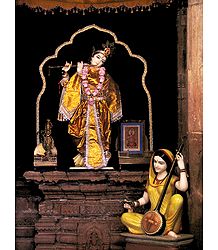
Through her devotion-filled yet tumultuous life she gained a number of enemies, owing to her rising fame and her undeterred and unconventional devotion to Lord Krishna. But more than she gained enemies, she gained followers and admirers. Not only the common people, but also the Mughal emperor Akbar and his famous court musician, Tansen, are believed to have visited her in disguise and are said to have touched her feet, in awe of her devotion for Lord Krishna.
What set apart Meera from the other devotees of Krishna was that she looked upon Krishna as her husband, rather than only as a master. She believed that in her previous life she was one of the several gopis in Vrindavan, in love with Krishna (Vrindavan was the place where Krishna spent most of his childhood. Gopis were the several female companions of Krishna). Mira used to consider herself an incarnation of one of the gopis mentioned in the Bhagavata Purana, called Lalita, a very close female companion of Radha, who was the greatest devotee and a beloved of Lord Krishna.
Much like the gopis, as mentioned in tales of Krishna, Mirabai looked upon Krishna as her lover, seeking physical union with him. Her writings were at the same time, spiritual and erotic. Mira's songs portray a personal universe where the only existence was that of Krishna - her sole object of desire.
Through her love songs addressed to her beloved, Krishna, Meera paints on a literary canvas, the longing of the individual soul (atman) to merge with the universal soul (paramatman). These songs talk about the beauty of the object of her love and her passion and longing for union with him, the madness of her love, and the pain of separation from him. They oscillated between feelings of sensual bodily love for the lord to a state of spiritual love, but at all times, openly describing her heart's longings. Within the songs, she shifted between feeling anguish at being separated from her lover to feeling jealousy and suspicion about her lover. At other times she would be ecstatic with visions of being close to him. At all moments, she would imagine herself to be a part of the existence of Lord Krishna, as she would imagine him to be a part of her existence.
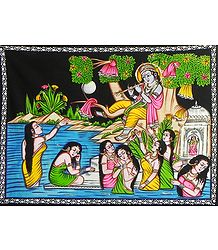
Even when, at times, her poetry describes scenes of Krishna's childhood pranks, as described in various Hindu texts, she does not fail to superimpose her own character as one of the lovelorn Gopis in the scenes. One of these songs depicts the story of the young Krishna stealing the clothes of the gopis as they bathed in the river Yamuna. Mirabai imagines herself as one of the gopis and sings about her true spiritual self being revealed to the lord as she stood naked in front of Krishna.
Mirabai's state of mind is typically called madhurya by the Vaishnavas, followers of a prominent school of Hinduism. In such a state, love for God acquires the flavor of a relationship that is found in the union of the lover with the beloved.
A Mira poem is traditionally called a Pada, a term used by the 14th century preachers for a small spiritual song. This is usually composed in simple rhythms and carries a refrain within itself. Her collection of songs is called the Padavali. Primarily devotional in nature, Mirabai uses sprinklings of eroticism in her songs. The typicality of Indian love poetry of those days was used by Mirabai but as an instrument to express her deepest emotions felt for her lord. Her typical medium of singing was Vraja-bhasha, a dialect of Hindi spoken in and around Vrindavan (the childhood home of Krishna), sometimes mixed with Rajasthani.
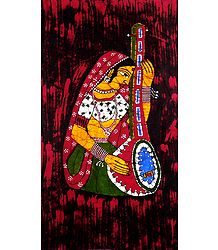
As compared to the literature of the then-existing Hindu schools of devotion (bhakti), which typically saw devotees as servants of the lord, Meera Bai's poetic preoccupation with worship and love as it exists between lovers, sets apart her devotional philosophy. This love-based philosophy of Meera Bai took time to catch on but as she grew popular, her songs and philosophy caught the imagination of the common-folk as a means of reaching out to their popular deity, Lord Krishna. Disregarding her royal lineage, Meera Bai traveled across vast distances of North India, spreading her gospel of love for Krishna being the only weapon that could conquer the transient nature of life. Through her tender and simple odes and hymns, which were rich, sweet, inspiring, and yet void of any rhetoric or esoteric language, she brought to the masses the genuine outpourings of a heart dedicated completely to the lord.
When seen in the context of the conservative and male-dominated society with a unidimensional perception of life and religion, Mirabai can be seen as a perfect example of a woman - a symbol of courage and defiance - who was far ahead of her times in seeking freedom not only from social barriers but also the ultimate freedom from the bondage of human existence.
The insane nature of Meera's love for Lord Krishna and the sheer frenzy of her passion saw her face the intense and brutal opposition of her ways by society and family, with calmness and patience. Her intense experiences of love for Krishna can only be explained as those had by a divine lover, and not by a docile lover. The singular and all-encompassing truth of her life was her love for the lord and that is what allowed her to face all the turmoil and opposition that came along with the conviction that she had towards her love. In her state of frenzied pursuit of Krishna, she was totally oblivious of the world of political intrigue and royal life she was surrounded by.
At sunset,
on the river bank, Krishna That night in her husband's arms,
Radha felt --Kamala Das, in "The Maggots" |
Punish me, lovely fool! -- Poet Jaidev in the Geet Govindam, |
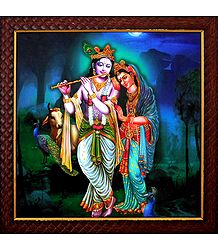
Love in all its forms finds its epitome in the "dual-unity" of Lord Krishna and his beloved, Radha. Krishna is seen as the universal symbol of the lover and the ideal hero (nayak) while Radha as the universal symbol of the beloved and the ideal heroine (nayika). As lovers, their divine love-play encompassed a whole range of variations. It is as if all lovers in the universe can find some part of themselves reflected in the love of Radha and Krishna.
Such is the charisma of the love-lore of Radha and Krishna, such is its vastness spread over a million emotions, and such is its brilliance, that the name of their love and them as lovers has become a sanctifying force for all contact between the sexes, sometimes also a cover for human prurience.
Womenfolk in India feel a natural pull towards Lord Krishna as a God. This is partly because Krishna is a God "created" specially for women. This fact, in turn, has led to the stature of Radha rise in Krishna-based lore. Radha seems to be, in a significant measure, contributing to the aura surrounding Lord Krishna. The personality and feelings attributed to Radha were in great measure, identified by the Indian women, who felt those same feelings as silent desires and fantasies.
Krishna is the master of love and yet allows domination by his lover, Radha. As a result, Radha's love for Krishna can be seen as being complete in all respects - love, which is a devotion that God Himself worships. The story of Radha and Krishna is able to talk directly to our innermost sensual and spiritual feelings, thus being able to capture our very soul in its ecstatic yet mystical and charming yet profound flavors.
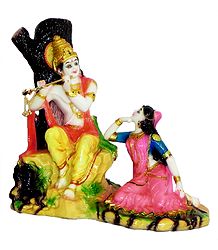
The daughter of a cowherd-leader, Vrishabhanu and his wife, Kamalavati, Radha was born in Barshana, a village near Vrindavan, which was the childhood home of Krishna. She was married off to a man known by the name of Ayan. She however, could never love her husband because her heart belonged to Krishna. The nature of her illicit and adulterous affair with Krishna though might seem to be for her own-selfish interests, in her union with Krishna, against the norms of family, society, and even religion, she gives an example of how to give everything up for God. For it was God who also loved Radha - her selfishness actually being selflessness, the real truth behind the Raas Leela - the love play of Radha and Krishna.
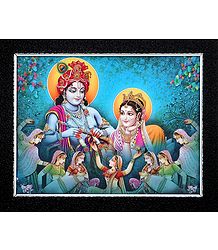
Krishna, even as a child, used to be a favorite of womenfolk of Vrindaban, his childhood home. As he grew up, his aggressive and yet attractive behavior with the strong but transparent sexual overtones were secretly approved of by females. As a lover, he turned out to be an ideal for each woman who experienced his love. During his love sessions with the Gopis (female companions of Krishna) he was careful and dexterous enough to create a divine illusion of being individually available to each of the Gopis. He was a perfect partner in lovemaking - both untiring and accomplished. But his mastery over love was capped by his treating women as partners in love rather than sex objects, by his experiencing the same suffering of separation and longing as was experienced by his lovers.
It was this heroic lover - a perfect lover for many - whose heart was captured by Radha. Radha - who turned out to be the special companion for Krishna - for whom Krishna longed - but not only for her body and mind but also her soul - wherein lies the divinity of Radha's love for Krishna.
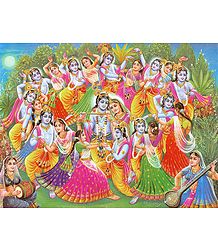
Radha had, on the orders of Nanda, Krishna's foster father and leader of the cowherds, escorted Krishna through the forest each evening. However, on the way in a grove, Krishna and Radha played out their secret passion. Krishna, however is unfaithful to Radha as he indulges in his romances with several other Gopis, while Radha's thoughts rest solely on Krishna. Radha is jealous as she imagines the "vines of his great throbbing arms circle a thousand gopis". More importantly, she experiences, the turmoil in emotions of a proud, passionate woman who feels deserted by her lover. She yearns for Krishna and this draws Krishna's thoughts to Radha's.
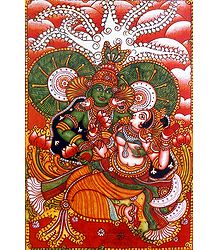
Krishna's heart, which had always reached out to many Gopis, pleasuring all and loving all, felt a unique tug towards this unique woman - Radha. Radha became the focus of Krishna's heart's desires - an irreplaceable lover whose power of pulling Krishna to herself, could not be any longer ignored by Krishna. Radha made Krishna repent for his straying ways and when Krishna could finally take no more, she relented. At such times, their passionate lovemaking was marked by an aggressive sexual position taken by Radha. She took the man's position of being on top, and even after they had made love, she commanded him to plait her hair and attend to her toiletries.
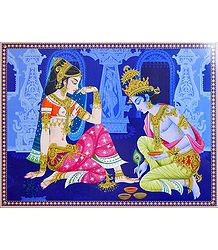
As Jaidev writes so beautifully in the Geet Govindam about this sequence:
"Paint a leaf on my breasts!
Put colour on my cheeks!
Lay a girdle on my hips!
Twine my heavy braid with flowers!
Fix rows of bangles on my hands,
And jewelled anklets on my feet!"
Her yellow-robed lover
Did what Radha said.
Such was the strength of Radha's love for Krishna and her longing for him, that even He, being God, would try to placate the angry Radha. Keshav Das, a celebrated poet in his treatise on erotica, Rasikapriya, describes how Krishna would send flowers to an angry Radha - "flowers which longed to become fragrant by a touch of her breasts, or an ivory necklace, yearning to fulfill its destiny by going on a pilgrimage to her bosom, the seat of holiness."
The power of her longing was so great and the focus of all her reflexes on Krishna was so concentrated that her soul merged with Kirshna's soul to have achieved unity with him (this state is termed aikya). Radha, when separated from Krishna, became Krishna - reaching a state of blissful absorption in him (tanmayate). As her spiritual reach for Krishna crossed all limits, the separation of the desired and the desirer vanished and so also did the pain of separation, the yearning and the longing. Physical separation could no longer dictate mental or spiritual separation from the lord, as Krishna appeared wherever Radha set her divine eyes upon.
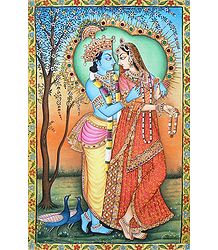
Radha is considered to be Krishna's greatest devotee. The love felt by Radha for Krishna transcended the conventional limits of love and reached the highest pinnacle of devotion. By extension, the love-making of Radha became her worship for Krishna. Conversely, the love-making of Krishna became the worship that God himself does, of his greatest devotee. In spite of being distinct from her Lord Krishna, she was one with him - she was his energy and power. Radha was the soul of Krishna, the God. She is the female counterpart of the Godhead - a complement without which even God would remain incomplete and cease to be God. The soul's desire for unification with God is reflected in Radha's passion for Krishna.
A beautiful portrait of Radha in words has been painted by Sri Swami Sivananda Saraswati Maharaj, the founder of the Divine Life Society, in his drama "Radha's Prem". Here are a few words from the introduction to the play:
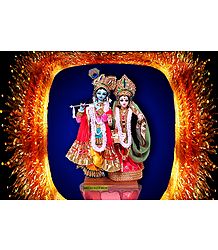
"She is the worshipped of all the worshipped deities. She is the fosterer and mother of the worlds. She is the presiding deity of the Lakshmis of Vaikuntha or of the six divine attributes of Lord Krishna. She is the chief of Krishna's divine energies. She is the seat of concentrated beauties or the source and centre from which the Lakshmis draw their beauties.
Radha is the embodiment of Mahabhava. The word Radha etymologically means a devotee. Radha is the chief of Krishna's sweethearts. All the Lakshmis of Vaikuntha are Her Vilasa-Murtis. The queens of Dwaraka are Her reflections. Lalita and other Gopis of Vrindavan are Her manifold forms. She pervades the Gopis in Her subtle form in order to contribute to Krishna's enjoyment. Radha is Krishna's delighter, charmer and life's all. She is the queen of all the lovely maidens of Vraja. She is the Crest-Gem of all celestial beauties. Radha and Krishna are inseparable as fire and its heat, ice and its coolness, the flowers and its fragrance.
The body of Radha is made up of sweet tenderness and loveliness for Sri Krishna. The substance of her subtle form as Mahabhava is Krishna Prem. Ardent passion for Sri Krishna is her dress. Her sweet radiant smile is the camphor. All good qualities are her garlands. All the Bhavas form the ornaments, her limbs. Lord Krishna's name, qualities form the ornaments of Her ears. Krishna's name and qualities flow out in a stream from Her tongue. She serves Krishna with the drink of Premarasa or Shyama-rasa."
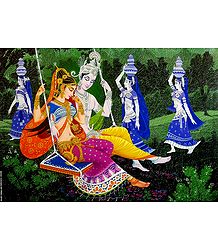
The tale of Radha and Krishna, and their love, has to be termed as "adulterous" in plain human terms. Radha and Krishna's secret rendezvous in the forest at night was always with the acknowledgement that they would have to separate at dawn, going back to the social mores and conventions of the world. Radha, in no way reflected the virtues listed out for women in Hindu religious texts, or even in unwritten common social norms. She does not also come close to being the mother-goddesses of Hindu mythology. Yet, in madly craving for her lover, she succeeded in inducing a similar craving for her in him - God himself - she has personified "mahabhava" - the untouched emotional state which exists both within and beyond all social and religious norms and conventions. The spiritual symbolization of this "adulterous" affair of Radha's being the highest devotion, being passion for God, is not merely a symbol - it was in reality the highest devotion, the greatest passion for God. The erotic and sexual love between Radha and Krishna, which could not even be celebrated or acknowledged by them innocently or publicly, is considered "pure love", as opposed to impure worldly love persuaded by selfish desire.
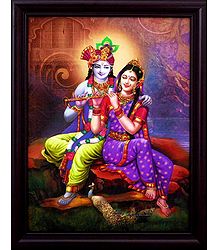
In spite of Radha being someone else's wife, she steals out in the night to be with Krishna. The interpretation of this is thus: The union of our soul with that of God is possible only if our craving for this union is frenzied and urgent like that of a passionate but illicit affair, instead of the calmness and quiet that exists in a married conjugal state. It is only when our craving is so ardent and so passionate that we are ready to abandon all and risk everything for achieving what we desire, instead of taking our object of craving for granted.
Music plays a monumental role in the expression of the love between Radha and Krishna. As Krishna played his divine flute, Radha could not resist the pull it induced in her, and in spite of being married to another man, she used to run to a passionate rendezvous with her lover, Krishna. The secret, adulterous and scorned love shared between the two found its outlet in Krishna's beautiful music.
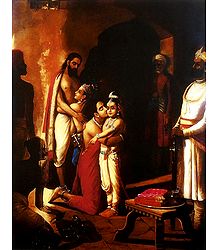
The tale of Radha and Krishna usually focuses on the aspect of love-play between the two lovers. Little else is popularly known about the life that the two had beyond their secret affair. In his youth, Krishna left for Mathura, his birth-place where the evil king Kansa (who was also Krishna's maternal uncle) had kept Krishna's real father (and the actual king) and his mother in chains. After killing Kansa and rescuing his parents, he went on to Dwarka where he became a king. Later in life, he played a pivotal role in the feud between the Kauravas and Pandavas - later to form a major chunk of the Hindu epic, Mahabharata. However, Radha does not find a mention in this epic even once. And yet, Radha seems to be so big a force in Krishna's life that the term "Radha-Krishna" is universally known.
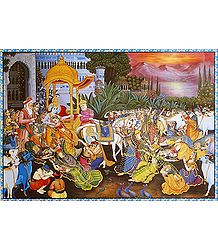
It is said that before Krishna left Vrindavan for Mathura, he had told Radha that she would never ever see him again. Radha was left alone with her love for Krishna, with no hope of ever setting her eyes on him again - Krishna had to leave Radha to make himself available as the savior of righteousness. After the war of Kurukshetra, when the Pandavas, assisted by Krishna defeated the Kauravas, when a stray poisoned arrow of a hunter pierced the feet of Krishna in Dwarka, his time for heavenly ascension had come. It is said that Radha along with the Gopis of Braj (Vrindavan and the adjoining areas) joined Krishna in his heavenly abode. In another version, it is said that before his ascension, Krishna disappeared from Dwarka and appeared in Braj, where the supreme divinity left Krishna's body for His heavenly abode, followed by Vishnu and Lakshmi leaving Krishna's body for their abode in Vaikunth. Finally, Krishna, Radha and the Gopis went to their abode in Golok. Radha's lifetime of love, devotion and yearning for Krishna had succeeded in drawing him to her, even if not during her lifetime. Radha merged with Krishna, in body, mind and soul, for an eternity, in Golok.
Varied Indian cultures and media - religious and erotic, classical literary and folk - have rendered this tale poetically, but with remarkable similarity with each other's renditions. The tale of Radha-Krishna, instead of being based on a definite plot with characters having a shared life, progressing to a definite future - tragic or happy, is rather a text recalling and describing the ephemeral moments of love spent between them, the pains and pleasures resulting from those moments, and eventually, through them, creating an exemplary love-devotion concept which remains unparalleled to date.
The suppressed personalities of women in India find an opening to freedom and self-worth through the persona of Radha. The desire for physical fulfillment, which more often than not is consciously or sub-consciously swept under the carpet by women, especially in the conservative environment of India, is exhibited to be pursued so openly by Radha, with Krishna. Radha, for the Indian womenfolk, is a means of believing that the clamp of social norms and customs and social-propriety can be broken, for fulfillments of one's soul's desire. Even if this means was the secretive, illicit and adulterous affair of Radha with Krishna.
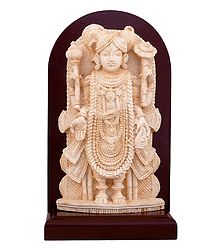
Lord Krishna's mystique has created an aura around him in Hindu Mythology. The equation that the feminine gender shares with him is unique in the Hindu religion. In spite of being Narayana himself (one of the trinity of supreme Gods in Hindu religion) his personality is that which humans can identify with. He is a God and yet loves passionately and indulges in love-relationships which do not conform to the conventional societal and religious standards that "good" beings are believed to work within. He is all-powerful yet surrenders to his greatest lovers. He is the highest deity and yet he worships all those whose devotion for Krishna envelopes their very soul.
It is this Lord Krishna, to whom so many have dedicated their souls to. Devotion and love for Lord Krishna has been the sole purpose of their existence. But for a few of those, their existence itself had become synonymous with love for Krishna. Their love for Krishna shone in brilliance which was as brilliant as the aura of Krishna himself. Radha and Meerabai were two such devotees, whose love for Krishna reached a pinnacle of devotion, where their identities merged into Krishna's. And in spite of the same love for the same lord, Meerabai differed from Radha in soul and mind.
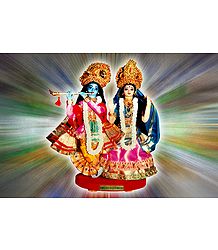
Krishna was besotted with Radha - his eternal beloved - and for this love of his for Radha, he could let himself be spurned and at times even humiliated by Radha - to please his lover. Radha often was the dominant of the two partners, summoning Krishna to even attend to her toiletries, chiding him when he sneaked out for his secret dalliances with the rest of the Gopis, and in love-making, often assuming the role of the man, by being on top of Krishna. Krishna did all within his powers to keep Radha happy, as any passionate lover would do for his mistress. But he had to leave her, for her entire life, only to be with her again till eternity, after his ascension, along with Radha and all other Gopis.
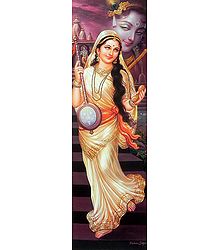
Meerabai on the other hand, never had Krishna near her. She imagined herself to be Lalitha, one of the Gopis, so much in love with Krishna. And in spite of the love and desire for Krishna, like all the other Gopis, she could not have Krishna exclusively for herself - for Radha was the one who ruled Krishna's heart. For a Gopi, the pleasure of arranging for Krishna to be with Radha was more than the pleasure of having him for herself - so also was the state of soul of Meerabai - how else would she be, for she was Lalitha. Meerabai lived a life of pain and suffering where not only was she looking for Krishna, but also knew that Krishna's heart lay elsewhere. Her mind was that of a subjugated lover, instead of the mind of the dominating lover that Radha had. Meerabai was the passive waiting lover rather than the demanding mistress that Radha was. But her passion was as ardent as Radha's and so also her love for Krishna. And her love too, like Radha's was rewarded by Lord Krishna by eventually having her soul merge with his - after all Meerabai was Lalitha - the Gopi - and Krishna did take all the Gopis with him, along with Radha, to his heavenly abode after his ascension.
Meerabai and Radha were the epitome of devotion - both equal in their love for Krishna but opposites in the manifestation of the love. That is why their lives were different, but their fates the same - unity with their love, unity with Lord Krishna.
This article was written by:
Madhuri Guin