Please wait...

"Draupadi has five husbands - but she has none
-
She had five sons - and was never a mother …
The pandavas have given Draupadi …
No joy, no sense of victory
No honour as wife
No respect as mother -
Only the status of a Queen …
But they all have gone
And I'm left with a lifeless jewel
And an empty crown …
My baffled motherhood
Wrings its hands and strives to weep".
A long poem "Kurukshetra", written by Amreeta Syam, conveys this angst of Panchali (Draupadi), born unasked for by her father, bereft of brothers and sons and her beloved sakha (friend) Krishna.
Draupadi was a heroic princess of the Hindu epic of Mahabharata. One who was firm and a woman with an unbending will. The Proud and angry heroine of the epic Mahabharata, Draupadi has remained an enigmatic woman of substance.
Draupadi was the daughter of Drupad, the king of Panchala, and the wife and queen of the five great Pandavas, renowned alike for her loveliness and her granite will. Volcanic, she reduced her enemies to the ashes. This fiery princess bent on vengeance could be compassionate and generous, too. Draupadi had developed the strength to bear the trials of life. She had resolved firmly not to harm the good people, and not to bend before the wicked. Draupadi was a woman, but she became as famous as the heroic Pandavas because of such determination. Her personality was one of lightning and thunder. This unforgettable heroine is in no way less than Bheema or Arjuna in strength and spirit, valour and virtue. Her story is a saga of suffering and disgrace but she took everything in her stride and vanquished each one of the perpetrators of her humiliation and agony. Draupadi finds her five husbands discarding her repeatedly: each takes at least one more wife; she never gets Arjuna to herself for he marries Ulupi, Chitrangada and has Subhadra as his favourite. Yudhishthira pledges her like chattel at a game of dice; and finally, they leave her to die alone on the roadside like a pauper, utterly rikta - drained in every sense.
Draupadi, meaning daughter of Drupad, was known by several other names as well. As the princess of the kingdom of Panchal she was known as Panchali. As the grand daughter of Prushata she was known as Parsati. [ Draupadi is ayonija, not born of woman. ][*] Draupadi is born of fire and therefore, often referred to as Yagnyaseni. She is also called Krishnaa because she was copper skinned, fiery eyed and had long, black hair. She was gifted with blue-lotus fragrance wafting for a full krosha (2 miles) and hence was called Yojanagandha (she whose fragrance can be felt for miles). [ Draupadi alone enjoys the unique relationship of sakhi (female-friend) with her sakha (male-friend) Krishna. She was a true virgin, and has a mind of her very own. ][*]
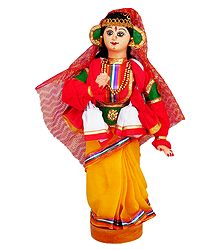
For many years Drupad, king of Panchal, had no children. So, to have children he performed tapas (rigorous rituals); he thought only of God day and night and prayed to Him. God blessed him, and two children were born out of the haven fire lit by Drupad to fulfill his determination of vengeance against Dronacharya, his enemy, through his death. The first to emerge out of the holy pyre was a son, called Dhrishtadyumna, and the second, a daughter called Draupadi. Thus Draupadi was born from the fire of vengefulness, anger and passion. Actually she arrives as a bonus because Drupad was performing the yajna for obtaining a son who would take revenge on Drona and had not asked for a daughter at all. Draupadi springs from the fire full grown, in the bloom of her youth, from the yajna vedi - the holy pyre - not requiring a human womb, ignoring the absence of Drupad's queen who was unable to respond to the priest's summons because her toilet was incomplete.
Draupadi was extremely beautiful, intelligent and virtuous woman, with her body smelling like a fresh bloom lotus. There are few women in Hindu mythology who were aggressive and who spoke their mind in a world of men. Draupadi was one of them. She is considered by many as the first feminist of Indian mythology. At the time of her birth, a celestial voice had proclaimed: "This unparalleled beauty has taken birth to uproot the Kauravas and establish the rule of religion". The circumstances leading to her birth began to take shape while her father was yet young.
Drupad was the prince of Panchal. His father King Prushta sent him to the hermitage of sage Agnivesh for his education. There Drupad got acquainted with a brahmin, Drona, the son of sage Bharadwaj. In a moment of camaraderie Drupad swore that they would equally share whatever the two owned. Both went their different ways after completing their education.
In due course Drupad became the king of Panchal. But life was not good to Drona and he was steeped in poverty. In despair he turned to Drupad, in hope for help, based on the promise once made by Drupad. However, Drupad insulted Drona and told him that friendship took place only between equals and he could help Drona only if he came begging for alms, instead of quoting the promise of Drupad based on friendship. Drona left but the insult festered in his soul, waiting for an appropriate time to burst out.
In time, Drona was appointed the instructor in warfare to the royal princes of Hastinapur, the sons of Pandu and Dhritarashtra. However, time could not douse the flames of revenge still burning within him. As gurudakshina (fees that were due to an instructor, after the students' education was complete) he asked the princes to get Drupad to him as a prisoner. The princes being skilled in the art of warfare successfully brought King Drupad bound in chains to Drona. The brahmin laughingly said to the king, "Once you had promised me half your wealth, but had refused to redeem the pledge. Today I own all your wealth, but I will honor our childhood bond, I will give half to you and let bygones be bygones."
But Drupad was not willing to let bygones to bygones. It was now his turn to nurse the insult. He was too old himself to take revenge. None of his three sons, Shikhandi, Satyajit and Vikra, were skilled enough to defeat Drona. In order to obtain such an offspring he requested sage Yaja to conduct a sacrifice. Yaja was assisted by his younger brother Upayaja (some text say that Yaja assisted Upayaja) and hence two offerings were prepared. From his first offspring to the sacrificial fire a full-grown son emerged, armed with a sword and a bow. He was Drishtadyumna, destined to slay Drona. From the second offering a full-grown daughter emerged, whose dazzle blinded the eye. She was Draupadi. When Draupadi emerged from the fire there was an oracle that she would side with God against the evil Kauravas.
[ Draupadi is the only instance we come across in epic mythology of a sati becoming a kanya. It is stated that in an earlier birth as Nalayani (also named Indrasena), she was married to Maudgalya, an irascible sage afflicted with leprosy. She was so utterly devoted to her abusive husband that when a finger of his, dropped into their meal, she took it out and calmly ate the rice without revulsion. Pleased by this, Maudgalya offered her a boon, and she asked him to make love to her in five lovely forms. As she was insatiable, Maudgalya got fed up and became an ascetic. When she remonstrated and insisted that he continue their love-life, he cursed her to be reborn and have five husbands to satisfy her lust. Thereupon she practiced severe penance and pleased Lord Shiva with her prayers. He granted a boon to her. Nalayani said that she wanted a husband and to ensure that her request was heard, she repeated it five times in all. Shiva then said that in her next life she would have five husbands. She obtained the boon of regaining virginity after being with each husband. ][*] Thus, by asserting her womanhood and refusing to accept a life of blind subservience to her husband, Nalayani, the sati, was transformed into Yajnaseni, the kanya. Some sources have a slightly different narration. Draupadi made her request only once but she added a long list of qualities that she wanted in her husband. Lord Shiva said that it would be impossible to find one man with all these qualities. Hence she would have five husbands in her next life. All of them together would posses the qualities she had enumerated. [ According to Brahmavaivarta Purana, she is the reincarnation of the maya Sita (shadow Sita - wife of Lord Rama, an incarnation of Lord Vishnu, and hero of Ramayana) who, in turn, was Vedavati, reborn after molestation at Ravana's hands, and would become the "Lakshmi of the Indras" ][*] (one of the forms of Goddess Lakshmi, eternal consort of Lord Vishnu) in heaven.
Draupadi and Lord Krishna shared a very special relationship. As is known to admirers of the great epic poem Mahabharata, Draupadi always considered Lord Krishna as her Sakha or beloved friend and Krishna addressed her as Sakhi, this as symbolic of the platonic love existing between the fiery Draupadi and the eighth incarnation of Lord Vishnu, Krishna. Draupadi is the instrument of Lord Krishna. Using her, he realized his mega-plan of annihilating the evil Kauravas. The choice of Draupadi as the instrument, which caused his actions, explains the special place she had in his scheme of things, Draupadi was put through severe tests in her life. The only true friend, who validated her persona and came to her rescue each time she found herself in dire circumstances, was Krishna, whose divine presence she experienced constantly in her life.
It was the Swayamvara (a ritual in which the princess was allowed to choose her groom from amongst a group of contenders) of Draupadi, the princess of unequalled beauty, where the Kings and Princes gathered in hundreds, each eager to marry the princess. King Drupad, father of Draupadi arranged a contest. At the center of the hall a mechanical device was erected; on it was placed a revolving object in the shape of a fish. The reflection of this revolving fish could be seen in the water below. A very heavy bow was kept nearby. Any one who desired the hand of Draupadi in marriage had to lift the huge bow, bend it and tie the bowstring, then, looking at the reflection, he had to take aim with five arrows and bring down the rotating fish. Such a one would be a hero worthy of Draupadi's hand. Many of the assembled kings retreated, as soon as they heard of this contest. The hundreds of princes who had come to marry Draupadi were all beaten.
{{image-2}}Both Krishna and Draupadi appear for the first time together in the Swayamvara Sabha and make decisive interventions. It is Panchali's categorical refusal - wholly unexpected - to accept Karna as a suitor that alters the entire complexion of that assembly, and indeed, the course of the epic itself. The affront to Karna sows the seeds of the assault on her in the dice-game. Pandavas in disguise of brahmins came to the Swayambhara Sabha, and Arjuna won Draupadi by piercing with arrow, the eye of a moving fish on a high pole. Other than Pandavas, kings and princes became very angry and it is her Sakha-to-be, Krishna, who steps in to put an end to the skirmish between the furious kings and the disguised Pandavas.
The Pandavas and Draupadi returned home from the Swayamvara hall. The princess who had not seen the midday sun, had to walk miles in the sweltering heat to reach her new home. Arjuna announced to his mother that he had brought home a prize that he so skillfully won. When Kunti (mother of Pandavas) heard this without seeing them, she asked them to share whatever they had brought among themselves. This was how she daily greeted them in order to ensure they remain united. Keeping their mother's word, they divided Draupadi amongst themselves as if she were an object. It is true that Arjuna was able to receive Draupadi's hand by completing a difficult and skillful task, but she was not a prize that he won because it was Draupadi's Swayamvara; she had the right to choose her husband. Arjuna proved himself worthy, Draupadi herself made the true decision. She could have married Karna who could have also performed the same task, but she denied him permission to participate. In certain ways therefore, Arjuna degraded Draupadi by claiming her as a prize and his elder brother, Yudhishtira, further insulted her by carrying out their mother's wish by treating her as if she were an object won in a contest.
The five Pandavas were regarded as handsome and gallant and they definitely would not have had a problem wedding women of high birth and beauty, yet they all chose to be the husband to the fair Draupadi. She was a victim of circumstances and had no control over the situation when she was told that she had to marry five men at the same time. She was expected to love all her husbands equally, which indeed is a difficult thing to do. She was afraid of the kind of sexual commitment she was being asked to make. She placed her worry in a less explicit manner before Krishna. "How am I to divide myself physically and emotionally between five husbands?" Lord Krishna told Draupadi to spend one year with each husband. During that period the rest of her husbands will not have any sexual contact with her. They will be forbidden to enter the chamber in which Draupadi and the husband-of-the-year are spending intimate moments. If one does so, even accidentally, he would be exiled for twelve years. Thus Draupadi became the common consort of the five Pandavas.
Her conjugal life was strictly regimented, requiring tremendous self-control. All her sentiments and emotions needed a great deal of adjustment when she changed her lifestyle for each husband accordingly. It would not be too difficult to realize the tremendous responsibility that she had to bear as a wife of the five heroes who led a stormy life. Despite the difficulties she emerged as one of the most respected women in the epic story. She bravely accepted this challenge to her womanhood, shouldered the task and brought it to a fruitful conclusion. In due course Draupadi had five sons, one from each of her husbands. Prativindhya was the son of Yudhishtir, Srutasoma of Bhima, Srutakirti of Arjun, Satanika of Nakul, and Srutakarma of Sahadev.
Draupadi was living not only in a polyandrous relationship, but a polygamous one as well because the Pandava brothers had other wives. Bhima was already married to the demoness Hidimba. Arjun married several princesses after his marriage to Draupadi, including Lord Krishna's sister Subhadra. Whereas the other princesses stayed in their fathers' kingdoms, Subhadra came to Indraprastha to live with him. After the deaths of Shishupala and Jarasandha, Nakul and Sahadev married their daughters as a token of friendship. Draupadi managed this delicate relationship harmoniously. But she had not forgotten the reason of her birth and was biding her time.
Draupadi's unparalleled beauty and intelligence becomes the cause of her misery. She is charmed by Arjuna, the winner of the archery contest, set for her hand but she is bundled off by her father as the bride of all the five Pandavas on the advice of sage Vyasa. Her cruel fate divides her as a possession among five husbands and cuts up her personality.
Draupadi spends a year with each of her husbands in turn. She is denied fullness of married life with Arjuna whom she loves with all her heart. She is born out of the sacrificial fire (yajna) and called "Yajnaseni"; true to this appellation she burns with men's ill-treatment and she is also the reason of others burning on account of her reactions. She is in the open assembly-hall provoked retaliatory oaths and vows.
In ancient India, women occupied a very important position, in fact a superior position to men. It is a culture whose only words for strength and power are feminine - "Shakti" means "power" and "strength". All male power comes from the feminine. Literary evidence suggests that kings and towns were destroyed because a single woman was wronged by the state. For example, Valmiki's Ramayana teaches us that Ravana and his entire clan was wiped out because he abducted Sita. Ved Vyasa's Mahabharatha teaches us that all the Kauravas were killed because they humiliated Draupadi in public. Draupadi is presented as having a very impressive brilliant and strong personality and is projected as the primary cause of the battle of Kurukshetra.
After Draupadi married the five princes, the Pandavas, their mother Kunti and Draupadi returned to their kingdom, being then ruled by their uncle, Dhritarashtra. The kingdom was split into two, Indrapastha and Hastinapur, to avoid conflicts between the Pandavas and Kauravas. The Pandavas made the city of Indraprastha their capital. The palace at Indrapastha was constructed by the architect demon, Moy. The palace was heavenly and was replete with all kinds of wonderful illusory architecture.
Once they thought of performing the great sacrifice (yagna) of Rajsuya. A huge and wonderful hall was constructed The beauty, grandeur and decoration of the assembly hall for the Yagna made a visitor speechless with wonder. Lord Krishna personally supervised the performance of the Rajsuya Sacrifice. The Kauravas has no mind to see the splendour of their cousins. Still they also attended. Unfortunately Duryodhana was put to shame there. In the new palace he took a pond for polished floor and fell into the water. Draupadi laughed at this. Further on he saw the floor shining wih high polish and thought it was a pond; so he lifted up his clothing that it may not get wet. Again there were waves of laughter. At that moment, Draupadi laughed at Duryodhana, saying "son of a blind would be blind himself". Some versions of Mahabharata do not support this, though it does mention the hearty laugh. These insulting moments pierced Duryodhana deep within him. Nevertheless, because of this insult and the envy within him, of the Pandavas' luxury, Duryodhana decided to humble them and hence proposed them to play a game of dice.
Yudhishthira was very fond of gambling (game of dice). But he was no expert. Shakuni, maternal uncle of Kauravas, was a very experienced player. Yudhishthira went on losing. He offered his chariots, horses and elephants as stakes and lost them; and eventually he lost his kingdom, Indraprastha, as well. Finally he and his four brothers became the slaves of the Kaurava king. He lost Draupadi also in this gamble. The Kauravas having won, Duryodhana ordered that Draupadi be dragged into the court. The Pandavas bent their heads in shame. Yudhishthira now knew what an unjust action he was guilty of. But it was now too late and regret was of no use. When Draupadi heard this news she was dazed. But instead of meekly obeying her husband Yudhishthira , she sent back a query which none could answer. She questioned her husband Yudhishthira, if he had pledged her before or after he had lost himself in the gamble. She argued that if he had pledged himself first, he had no right over her as he was already a slave. She later challenged the game as illegal as she argued, that Duryodhan, a Kaurava, had not placed his brothers and wife as a matching stake. Mahabharata tells us how the assembly started to hiss loudly when Yudhishthira staked Draupadi. Plausibly the ownership of the wife by the husband was recognized but not respected in society. The Ramayana preaches that there is no greater gift for a man than his wife. But the phrase gift to a man gives the impression that the wife is merely an object to provide happiness for the man.
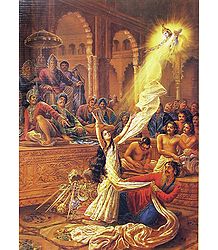
Duryodhan ordered Dusshasana to drag Draupadi by her hair to the royal court before the great assembly of people and then to disrobe her completely. Karna calling her a public woman whose being clothed or naked is immaterial. Draupadi looked at all elders in the court - Dhritarashtra, Bheeshma, Drona, Kripa and Vidura - with her eyes shouting for help. But all elders were silent. The subjects were stunned. Her husbands sat with their heads bowed. Draupadi had a marvelous blend of intensity that suits kshatriyas and forgiveness that fits devotees. She was very intelligent and knowledgeable. She had a brilliant mind, was utterly "one-in-herself" and did not hesitate in reprimanding the Kuru elders for countenancing wickedness. When Dusshasana was dragging her by the hair to the court, she ridiculed him to show his prowess against her husbands. She also boldly reprimanded the elders present in the court and appealed to them to do justice. She cried out to her silent husbands. But nobody came for help. Finding no response, with quicksilver presence of mind she seizes upon a social ritual to wrest some moments of respite from pillaging hands.
Her speech drips with sarcasm. The elders whom she ceremoniously salutes, deliberately using the word "duty", have remained silent in the face of Vidura's exhortation to do their duty and protect the royal daughter-in-law. At last Duryodhan's brother Vikarna supported Draupadi but Karna derided him and questioned his support for her. Thus, despite being humiliated, Draupadi won morally. Nobody could refute her logic. She said "where righteousness and justice do not exist, it ceases to be a court; it is a gang of robbers". In response to Draupadi's volley of harsh words, Dusshsana grinned and uttered wicked words. Bheema (the third Pandava) exploded like a volcano now. He thundered in anger, and promised to burn the hands of Dusshasana. Dusshasana should have respected Draupadi, his sister-in-law, like his own mother. But instead, the wicked Dusshasana began to pull at her saree. Draupadi's weeping and wailing would have moved a stone to mercy. Draupadi turned to Lord Krishna as her husbands bowed their heads in shame. She threw out both hands and with both hands in salutation she cried to Krishna, and miraculously the more Dusshasana pulled her robe, the more it was still there on her person. Several meters of the robes he pulled, yet it was still there. Dusshasana was tired drawing her saree but he could not find the end of it. This shows us the bond between a brother and sister or the promise of security. Draupadi gave to Lord Krishna one small strand from her saree to tie on his injured finger, during a duel with the cruel Shishupala. At that moment, Krishna had promised Draupadi of constant security. Lord Krishna kept his promise during this trying moments of Draupadi and gave her an endless saree, one which could never be removed and thus protected her honour.
The injury of Lord Krishna's finger has another popular origin in mythology: During the celebrations associated with the Sankranthi festival, Krishna was partaking the freshly harvested sugarcane offered to him by Gopis in accordance with the customs of the festival. To squeeze the juice out of the sugarcanes, Krishna had to cut them. While doing so, he inadvertently cut his little finger. Seeing blood on his finger, Satyabhama - Krishna's wife - with her characteristic pride, ordered the Gopis to go inside the house to fetch some cloth to bandage the finger. Draupadi who was also there, however, out of her love and concern for Krishna, immediately tore off a piece of cloth from the end of her new saree and bandaged the Lord's finger. For Lord Krishna this signified Raksha bandhan and he immediately took Draupadi as his sister. Draupadi was a great devotee of Lord Krishna, who is all-powerful, all-knowing, all-pervading.
Having failed in his efforts to disrobe Draupadi, Duryodhana's patted his thighs and ordered Draupadi to sit on his lap, since she was supposed to obey his orders as she was now a slave to him after her husband, Yudhishtira had lost him in the game of dice. On hearing this, Draupadi cursed Duryodhana of a death with a broken thigh. Draupadi also took a vow that she would not oil or tie her hair until she could wash her hair with the blood of Dusshasana, after he was killed. At such a moment, Bheema, the third Pandava, lashed out and vowed to avenge the insult that Draupadi was subjected to. Bheema killed Dusshasana in the war of Kurukshetra and Draupadi eventually washed her hair with the blood of Dusshasana. Bheema also broke the thigh of Duryodhana in the final battle of Kurukshetra. Eventually convinced by Vidur, Dhritharashtra scoffed at Duryodhana and asked Draupadi for any three boons. But Draupadi simply sought that her husbands should at once be freed from slavery and as the second boon she asked for their weapons. When Dhritharashtra asked her to ask for more. She replied that her husbands were strong and capable to win all the rest that they had lost by themselves.
Draupadi succeeded in winning back freedom for her enslaved husbands. Karna paid her a remarkable tribute, saying that none of the world's renowned beautiful women have accomplished such a feat: like a boat she has rescued her husbands who were drowning in a sea of sorrows. With striking dignity she refuses to take the third boon Dhritharashtra offered, because with her husbands free and in possession of their weapons, she did not need a boon from anyone. No twenty first century feminist can surpass her in being in charge of herself. Can we even imagine any woman having to suffer attempted disrobing with her husbands sitting mute; then facing abduction in the forest and having to countenance her husband forgiving the abductor; be molested again in court and be admonished by her husband for creating a scene; then be carried off to be burnt alive; thereafter, when war is imminent, witness her husbands asking Krishna to pursue peace; and finally find all her kith and kin and her sons slain - and still remain sane?
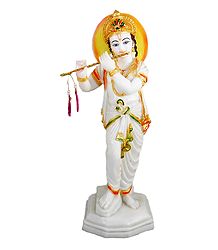
When Dhritharashtra returned their kingdom also and tried to console the Pandavas, the Kauravas were angry. They decided to play the dice again with Pandavas and whoever was defeated would have to give up the whole Kingdom and remain in the forest for twelve years, and then for another year live incognito (that is, without being recognized by others). If they were recognized by anybody during that period, then they had to repeat the twelve years' stay in the forests and spend a year incognito. This was the condition of the match. Yudhisthira was defeated again. The Pandavas gave up their royal robes and put on clothes made of bark of trees. Draupadi followed her husbands, giving up her life of luxury in palaces. So the forest life of the Pandavas began. Lord Krishna was the beloved God of Draupadi. He did not forget his devotees in the forest, but visited them now and again. Many sages also visited the Pandavas now and then and guided them. The Sun-God gave Yudhishthira an Akshaya Patra (magic vessel). This vessel would not become empty until Draupadi's meal was over. During the exile when Pandavas were in Kamyaka Forest, Duryodhan sent the short-tempered but highly knowledgable sage Durvasha and his thousand disciples to visit Yudhishtira. His intention was to get the Pandavas cursed by the sage Durvashsa. Yudhishtirs invited the sage and his disciples to dine, for he was sure that by the virtue of the Akshaya Patra, he had received from the Sun, they would be able to feed the sage and his disciples. Everybody at that time, even Draupadi and Kunti had taken their meal and the Akshaya Patra was empty. Sage Durvasha went to take a bath in the Ganges. Draupadi got worried and she again prayed to Krishna to save her and her husbands from the wrath of Durvasha when he would find out that the Pandavas had nothing to offer him and his disciples as a meal. Lord Krishna reached the hut of Draupadi and ate the single grain of rice in the Akshaya Patra. There at the river bank, sage Durbasha and his disciples felt as if they had a sumptuous meal with many delicacies. Durvasa rishi blessed the Pandavas and they decided to change their course silently.
Draupadi's troubles were not yet over. Jayadrath was the king of Sindhudesha and was married to Dusshala, the daughter of Dhritharashtra. He too had gone to Draupadi's Swayamvara but had lost the contest. He could not get her by valour. During the days of the banishment to jungle of the Pandavas, one day Draupadi was [ leaning against a kadamba tree, holding on to a branch with an upraised hand when Jayadratha seized her. She repulsed him so hard that he fell to the ground. Retaining full control of her faculties, she mounted his chariot on finding him bent on forcing her, calmly asked the family priest to report to her husbands. No Sita-like lamentation here, nor shrill outcries for succour! As her husbands closed up on Jayadratha, she taunted him with an elaborate description of the prowess of each and the inevitable trouncing that would follow. ][*]
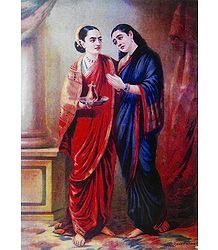
[ Draupadi was fully conscious of her beauty and its power, for she used it in getting her way with Bhima in Virata's kitchen. ][*] After the twelve years of exile in the forest was over, Pandavas had to spend a year incognito. How could five famous heroes, with a very beautiful wife, remain unknown for one full year anywhere? Would the Kauravas keep quiet? And it would be most difficult for Draupadi because she was a woman. Then they took a secret decision. Yudhishthira disguised himself as a pious Brhamin. He assumed the name of Kanka Bhatta and entered the place of Virata, the king of Matsya country. Bheema joined service in the kitchen of Virata, taking the name of Ballav, Arjuna, to be known as Brihannala (disguised as a eunuch) taught the art of dancing to the princesses at Virat's palace. Nakula joined the royal stables as a superviser taking the name Granthi and Sahadeva to be known as Tantri Pal began to look after the palace dairy. Draupadi as Sairindhri went to Queen Sudeshna and begged to be taken as one of her attendants. The queen was more than surprised at the great beauty of Draupadi. When Sudeshna asked about her she introduced herself as the wife of five Gandharvas who are divine musicians. Queen Sudeshna was pleased and engaged her. Draupadi, daughter of the powerful King Drupad, wife of Pandavas who could conquer the whole world, she who sat on the throne as an empress and was accepted by Lord Krishna himself as his sister, was now a servant to Queen Sudeshna. Yet she could at least see her husbands who were at the same palace; and this was consolation.
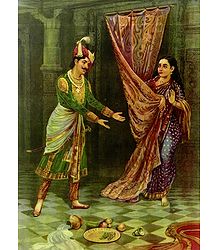
Keechak was queen Sudeshna's younger brother, and a very strong man. Once he saw Draupadi and was moved by her great beauty. Sudeshna could make out the evil thoughts of her brother and was afraid. Without the knowledge of the Queen, begged Draupadi to be his Queen. Draupadi warned him and ran away from him. But Keechaka followed her like an evil spirit. Once he actually chased her and Draupadi ran away with fear and entered the royal court where King Virata, Kanka Bhatta (Yudhisthira), and Ballav (Bhima) were present. Keechaka angrily pushed her and walked away. His eyes were burning. Ravaged by the insulting incident Draupadi accused the three of them of being mere onlookers while a woman was being insulted in front of them. The cook Ballav (Bhima), was hissing in anger. Yudhishthira stopped Bhima from precipitating a fight with Keechak. He also consoled Draupadi and sent her back. But Draupadi could not control her anger and agony. That night she went to Bhima and [ the manner in which Draupadi manipulated Bhima to destroy Keechaka is a fascinating lesson in the art and craft of sexual power. She does not turn to Arjuna, knowing him to be a true disciple of Yudhisthira as seen in the dice-game. Then Bhima alone had roared out his outrage. ][*] Draupadi enticed Keechak into a lonely place by making him follow her, while she carried a vessel of milk for him. At an opportune moment, Bheema pounced on Keechak while Draupadi watched. [ When Kichaka had been pounded to death by Bhima, instead of hiding in safety she recklessly flaunts the corpse before his kin, reveling in her revenge. They abduct her and she has again to be saved by Bhima from being burnt to death. ][*]
This fiery heroine Draupadi was not without kindness an affection. She was insulted, taunted and driven to the forest by the sons of Dhritarashtra and Gandhari. When, Dusshasana pulled at her saree, Dhritarashtra and Gandhari would not help her. But after the war of Mahabharata, Draupadi looked after Gandhari with respect and affection; she treated her in the same way as she treated Kunti. She had a resolve that would not cool off after thirteen long years of suffering, and also sympathy for Gandhari after all was over.
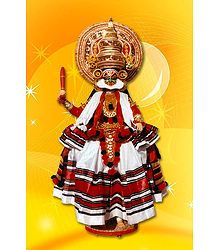
When Aswathama (son of Dronacharya) who killed the sons of Draupadi, inspite of her great grief at the loss of her children, came to Pandavas, she moved forward and touched his feet and paid him his due respect. Bhima was unable to bear such sorrow and because of this, he was in great emotions which drove him to the point of exhibiting his physical prowess to the world. In fact he was looking at this quality of forbearance of Draupadi as a laughing matter. Bhima was greatly surprised at the peaceful attitude of Draupadi. He thought that the suffering of having lost all her children had driven her to insanity, for, otherwise he was not able to understand how a true mother could show such forbearance when the person who had killed all her children was standing before her. Draupadi was a great woman with exemplary character. When the strong Bhima was preparing to kill Aswathama with his bare hands, would it be possible for a weakling like Draupadi to go and stop Bhima? It was only the purity of her thought that was her strength. Draupadi was such a great woman that in order to protect right conduct, she would even oppose her husbands. But even now, it was Bheema who tried to avenge the death of her sons by uprooting the Shiromani (divine diamond) off the forehead of Ashwathama and thus ending his powers of invincibility.
Draupadi maintained the reputation of her husbands, her parents and parents-in-law. She wanted her parents to be proud of her, she wanted her children to feel that they are the children of a great mother, she wanted her husbands to feel that they were married to a great woman and she wanted her parents-in-law to be proud of her and she wanted to please them. Draupadi herself was always behaving in a manner in which she maintained the reputation of her family and her kingdom.
[ Ultimately, the fact that Draupadi stands quite apart from her five husbands is brought tellingly home when not even Sahadeva of whom she took care with maternal solicitude, nor her favourite Arjuna - tarries by her side when she falls and lies dying husbanded yet unprotected, on the Himalayan slopes ][*] during their journey to heaven - the Mahaprasthana. It is said, however, in some analyses of the Mahabharata, that only Bheema, at such a juncture tried to save her from her fall from the cliffs by extending an unsuccessful hand to catch her. He failed and Draupadi fell to the ground below and was dying a painful death when Bheema came to her side, consoled her and remained by her side till she eventually died. During these last moments, it is said, Draupadi realized the futility of her undying love for Arjuna and felt the selfless and unconditional love and support that Bheema had provided her at each moment in her life and repented the fact that she could never reciprocate the love of Bheema in equal terms.
[ Draupadi appears from the flames with a divine announcement from the heavens that she would be the cause of destruction of evil-warriors. Draupadi, is always subjected to violence: her swayamvara ends in strife; a fivefold marriage is imposed upon her; she is outraged in the royal court twice over; Jayadratha and Keechaka attempted to rape her. Draupadi is also veritably a virgin goddess of war. ][*] The birth of Draupadi was unnatural without having a mother. [ If Draupadi had hoped to find her missing mother in her mother-in-law, she was tragically deceived as Kunti thrusts her into a polyandrous marriage that exposes her to a salacious gossip reaching a horrendous climax in Karna calling her a public woman whose being clothed or naked immaterial. No other woman has had to face this peculiar predicament of dealing with five husbands now as spouse, then as elder or younger brother-in-law (to be treated like a father or as a son respectively) in an unending cycle. ][*]
Draupadi is 'Krishna Sakhee'. 'Sakhee' means friend. She was a courageous queen with a dynamic personality. Even Duryodhan grudgingly admitted to her greatness. She was in a way, the revolving kingpin of the Mahabharata war. [ Draupadi does not rest till the revenge for which her father had invoked her manifestation is complete and the insult she suffered has been wiped out in blood. Through the thirteen years of exile, she never allowed her husbands and her sakha to forget how she was outraged and they were deceitfully deprived of their kingdom. When she finds all her husbands, except Sahadeva, in favor of suing for peace, she brings to bear all her feminine charm to turn the course of events inexorably towards war. Pouring out a litany of her injuries, she takes up her serpent-like thick glossy hair and with tearful eyes urges Lord Krishna to recall these tresses when He sues for peace. Sobbing, she declares that her five sons led by Abhimanyu and her old father and brothers will avenge her if her husbands will not. ][*]
Draupadi was used by everybody. [ Draupadi was used first by King Drupad to take revenge on Drona by securing the alliance of the Pandavas and then by Kunti and the Pandavas to win their kingdom thrice over (first through marriage, then in the first dice game when she wins them their freedom; finally as their incessant goal on the path to victory). Unknown to her, even sakha Krishna throws her in as the ultimate temptation in Karna's way when seeking to win him over to the Pandavas before the war, assuring that Draupadi will come to him in the sixth part of the day. Karna was also borne by Kunti's womb, albeit before her marriage to Pandu. These efforts of Krishna are followed by Kunti urging Karna to enjoy Yudhishthira's Shri (another name of Draupadi) which was acquired by Arjuna. There is an unmistakable harking back to her command to her sons to enjoy what they had brought together when Bhima and Arjuna had announced their arrival with Draupadi as alms. No wonder Draupadi laments that she has none to call her own, when even her sakha unhesitatingly uses her as bait! Draupadi, despite having husbands and chidren, remains alone to the last. ][*]
[ As far back as in 1887, the great Bengali litterateur Bankimchandra Chattopadhyay drew an illuminating distinction between Sita and Draupadi, noting that while the former is chiefly a wife in whom the softer feminine qualities are expressed, the latter is pre-eminently a tremendously forceful queen in whom woman's steel will, pride and brilliant intellect are most evident, a befitting consort indeed of mighty Bhima. He also pointed out that Draupadi represents woman's selfishness in performing all household duties flawlessly but detachedly. In her he sees exemplified the Gita's prescription for controlling the senses by the higher self. Since a wife is supposed to present her husband with a son, she gives one to each of the Pandavas, but no more, and in that exemplifies the conquest over the senses, as in the case of Kunti. Once this duty is over, there is no sexual relationship between her and the Pandavas. That is why, despite having five husbands, Draupadi is the acne of chastity. Akin to sakha Krishna, lotus-like she is fully of this world of senses, yet never immersed in it. The bloom of her unique personality spreads its fragrance far and wide, soaring above the worldly mire in which it is rooted.][*]
This remarkable "virgin" never asked anything for herself. Born unwanted, thrust abruptly into a polyandrous marriage, she seems to have had a profound awareness of being an instrument in bringing about the extinction of an effete epoch so that a new age could take birth. And being so aware, Draupadi offered her entire being as a flaming sacrifice in that holocaust of which Krishna was the presiding deity.
Draupadi is the most complex and controversial female character in Hindu literature. On one hand, she could be womanly, compassionate and generous and on the other, she could wreak havoc on those who did her wrong. She was never ready to compromise on either her rights as a daughter-in-law or even on the rights of the Pandavas and remained ever ready to fight back or avenge high-handedness and injustice meted out to her modesty. She secretly vowed that one day she would definitely seek vendetta on the injustice meted out to her. She did it by igniting the spark of revenge in the hearts of the Pandavas.
If the Mahabharata is an intricately woven saga of hatred and love, bloodshed and noble thoughts, courage and cowardice, beauty and gentleness, victory and defeat, then Draupadi is its shining jewel, casting the shadow of her towering personality over the epic poem and the all-destroying war it describes.
[*]Taken from Panchkanya by Pradip Bhattacharya ( visit http://www.indianest.com/hinduism/panchkanya/pk01.htm )
This article was written by:
Madhuri Guin