Please wait...

"The Ganga, especially, is the river of India, beloved of her people, round which are interwined her memories, her hopes and fears, her songs of triumph, her victories and her defeats. She has been a symbol of India's age long culture and civilization, ever changing , ever flowing, and yet ever the same Ganga."
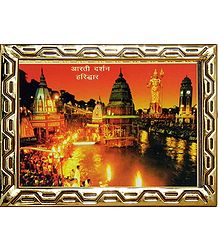
- Jawaharlal Nehru, First Prime Minister
of India
The eternal life-stream of Indian culture; the clock whose ticking denotes time to even Mahakaal (Lord Shiva), the great time-keeper; the chord which unites the four yugs (eons) - Ganga represents all of these and more - she integrates into herself the history, the beliefs and sometimes even the hopes of India and its people.
Ganga, or the Ganges, the holy river of the Hindus, has its source at Gangotri in the Himalayas from where it flows for a distance of 2,400 km. to fall into the Bay of Bengal. Ganga is a major river of the Indian subcontinent, associated in myth and reality with the land and people of India as well as neighboring countries like Bangladesh.
In the move to Aryanise the Ganga basin, when the Vedic people shifted focus from the Indus to the Ganga, a myth evolved that Ganga would take on all the sins of the world. Thereafter, people have religiously bathed in her waters to cleanse themselves of sin. Gangajal (water of Ganga) is widely used in religious ceremonies. The holy sight of Ganges gives knowledge, splendors, name, fame etc. The gravest of sins like Brahmahatya (killing of a Brahmin) and Gauhatya (killing of a cow) gets absolved by the mere touch of Ganga's holy water. Lord Vishnu himself has described the importance of river Ganges in the following way: he says to Garuda - the eagle God, his divine vahana (vehicle):
"thousands of man's sins get destroyed by the holy sight of the Ganges, and he becomes pure by the touch of the water of Ganges, by consuming it, or just by pronouncing 'Ganga - Ganga'"
For this reason Ganges is also called the savior of this world.
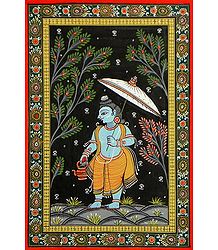
There are many versions of stories regarding the origin of Ganges. The river Ganga is said to have originated when Lord Brahma (one of the Supreme forms of divinity) washed the feet of Lord Vishnu in His incarnation as Vamana - the dwarf Brahmin. When He (Lord Vishnu, as Vamana) measured the world in three steps, the nails on His left foot caused a pore on the upper side of the universe from where Ganga fell down into heaven.
According to Valmiki's Ramayana, Ganges was the daughter of Himalaya and Menaka. The deities abducted her and took her to heaven. From that time onwards Ganga started living inside the Karmandala (a spout shaped vessel). According to Krittivas' Ramayana the deities had taken Ganga to Lord Shiva to get married with him. When Menaka did not find her in the house, she cursed Ganga to attain the form of water.
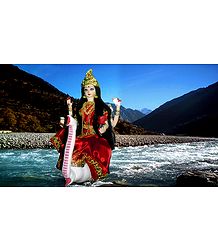
The Vishnu Purana describes the birth of Ganga in the following manner: she said to have issued forth from the big toe of Lord Vishnu's left foot. Dhruva, the pole star, received her in her descent and sustained her day and night on his head, while the seven Rishis (the Pleiades) performed their ablutions in her waters (because the Pleiades revolve around the Pole Star). Ganga then encompassed the orb of the Moon by her currents, which added to the luminary's brilliance. Thereafter, having issued from the Moon, she alit upon Mount Meru, and then flowed in four branches to the four corners of the Earth for the sake of its purification. The name of theses branches are Sita, Alakananda, Chaksu and Bhadra. The southern branch, Alakananda, was held affectionately by Lord Shiva on His head for one hundred divine years and then was released from His matted locks. Hence Lord Shiva is depicted in Indian iconography with a crescent Moon on his head, from where a shoot of water springs forth. Thereafter, the southern branch of Ganga journeyed through India and divided itself into seven rivers which flow into the southern ocean. Hence Alakananda is known as the most sacred river of the four branches.
According to another version, Goddess Ganga, once lived on Mount Kailash and flowed demurely for the sole pleasure of the Gods. Legend has that Sagar, King of Oudh, the 13th ancestor of Lord Rama, the descendent of Sun God (Suryavanshi), had performed the Ashwamedha Yagna, or the horse-sacrifice, 99 times. This ceremony consisted in sending a horse round the Indian world, with defiance to all the earth to arrest its progress. If the horse returned unopposed , it was understood to be acquiescence in the supremacy of the king, and the horse was then solemnly sacrificed to the gods. When King Sagar made preparations for the 100th sacrifice, Indra, King of Heaven, who had himself performed the ceremony a 100 times, jealous of being displaced by this new rival, stole the horse, and concealed it in a subterranean cell, where the sage Kapila, or Kapila Muni, was absorbed in meditation, dead to all occurrences of the external world.
The sixty thousand sons of Sagar traced the horse to its hiding place, and believing the sage to be the author of the theft assaulted him. The holy man being thus roused opened his eyes and cursed the assailants, who were immediately burnt to ashes and sentenced to hell. Sagar heard of this fate through Narada (devotee of Lord Narayana), the heavenly wonderer, and sent the grandson Ansuman to undo the harm. Ansuman descended to the underworld and met Kapila, who was much pleased with the youth's bearing and conversation. He granted that the souls of the sons of Sagar may be released by the waters of Ganga, then resident in heaven. Despite much austerity and prayer, neither Sagar nor Ansuman after him, nor his son Dilip could get Ganga to appear on earth.
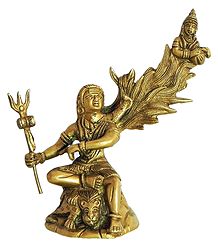
Finally it was Dilip's son Bhagiratha, who after severe austerities, propitiated the Goddess, and she agreed to come down to earth and then to the nether world to rescue the tormented souls of the sons of Sagar. However, the impact of her fall would be so severe, that it could be borne by none less than Lord Shiva himself. Therefore Bhagiratha went into meditation again and obtained Shiva's consent after many more austerities. Finally, the river came down and fell into Lord Shiva's matted hair, (this manifestation of Lord Shiva is known as Gangadhara), from where she separated into seven streams, of which three flowed to the west and three to the west. The seventh stream followed Bhagirath to earth and then to the nether worlds.
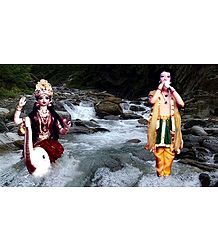
Bhagirath patiently led the river down to the sea from the Himalayas and for this reason the Ganges is also known as the Bhagirathi. However, being unable to locate the exact spot where the ashes lay, he requested Ganga to follow her own course. The Ganga, therefore in the region of Bengal, divided herself into a hundred mouths and formed the Ganges delta. One of these streams washed the ashes, and offered salvation to the souls of the departed. In this way the children of Sagar were saved and an ocean formed from the waters there. This is the Sagar Island of today, where the Ganges flows into the Bay of Bengal, where a bath at the confluence of the river and the sea is considered to be sacred on Makara Sankranti (mid January).
Thus on the tenth day of the bright half of Jyeshth (last week of May), Goddess Ganga began to flow from heaven to the matted hair of Lord Shiva, and from the hair of Lord Shiva she began to flow on earth. The first ten days of the month of Jyeshth (last week of May), known as Dashahara, are dedicated to honour the river Ganges, or Mother Ganges. The Ganges is believed to flow in the three worlds - heaven, earth and the nether world (patala - where the ashes of the sixty thousand sons of King Sagar lay): Thus the Ganga is known as "Three Path River". People believe that by bathing in the Ganga sins are washed away. The principle centers for the worship of the Ganga are Gangotri, the source of the river; Haridwar, where she comes down to the plains; Allahabad, where she joins the Yamuna; Varanasi, the holy city; and Sagara Island in her estuary where she finally flows into the Bay of Bengal.
The descent of Ganga from the heavens to Earth and finally to the nether world, escorted by Bhagirath, has an interesting interpretation on the metaphysical body plane, involving the Chakras and the Kundalini:
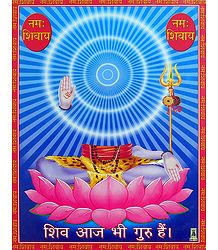
At the inner core of each individual spin seven wheel-like energy centers or chakras which together form a system. They are located within the body in front of the spinal column and are aligned vertically up and down the spine. The chakras are centers of activity which receive, assimilate and transmit life energies. As such, they are a kind of vortex or gathering point of organized life energy. Each chakra represents a dimension of our consciousness on seven basic levels corresponding to the major chakras. Together, they form a meta-physical vertical column called the sushumna, which is the central integrating channel for connecting the chakras, and their various dimensions of consciousness. The lowest chakra is called the Muladhara and is located at the tailbone base of the spine, while the topmost is called the Sehasara and is located at the top of the head. The Kundalini or the divine serpent energy of the Self is depicted as a coiled serpent, at the base of the spine and is a great reservoir of creative energy. It is said that self realization is the awakening of the Kundalini through the sushumna, piercing through the six chakras above the Muladhara and emerging at the Sehsara as a gentle "fountain" of coolness.
The journey of Goddess Ganga from heaven to the nether worlds symbolizes the origin of Kundalini and its descent through the various chakras of the body into the lowest chakra - the muladhara - which corresponds to the patala regions - the nether worlds - where it remains coiled like a serpent, till it ascends into the higher chakras during one's spiritual awakening. If the word Bhaghiratha (pronounced as Bhageerath, in Sanskrit) is interpreted as being formed from the words Bhaga and Rathi, it transalates into "He who rides the Bhaga (the reproductive organ)", which is where the Kundalini remains in a coiled state. The sons of Sagar, whose souls Bhagiratha redeemed, probably correspond to the various nerve centres in this region of the body.
Another possible interpretation is that Ganga represents a form of divine knowledge which, with its strength of purity and illumination has the powers to elevate all - dead and living - towards the heavens. This knowledge, available only to the Gods was brought to mankind by Bhagiratha through his devotion to Lord Shiva, who helped him receive this knowledge, to be passed on to mankind for its eventual salvation.
Another legend regarding Ganga has it that Ganga followed Bhagiratha and because of his tremendous speed, all the villages, forests etc. in the way were either getting submerged or drowned. Sage Jahnu who was doing a yagya in his hermitage got angry when his hermitage was submerged in the Ganga. He drank whole of the Ganga by his yogic power. At this the deities, and the men became restless and they requested Jahnu to release Ganga. Jahnu released Ganga from his thigh by cutting it and for this reason Ganga is also called "Jahnvi" or "Jahnusta".
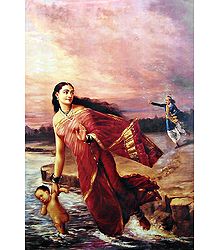
Yet another important story involving Ganga describes the following episode: Ganga saw Pratipa, a king of the Lunar Dynasty in the forest, doing tapasya, she fell in love with him and wishing to be taken by him for his wife, given the fact that she sat upon his right thigh. The king then explained that his right thigh was the place for his daughters-in-law and children to sit; the left thigh was for his wife. Since she sat upon his right thigh, he could not marry Ganga himself, but she could marry his son. This was arranged and the Goddess married Shantanu. When Prapita withdrew to the forest to spend all his time doing penance, he made Shantanu king and turned over his kingdom to his son. Shantanu was accepted by the Goddess on condition that he would not contradict her in anything. And he, being so enraptured by Ganga, agreed.
Meanwhile it happened that because of a curse cast upon them by the sage Vasishtha, the eight Astavasus were obliged to incarnate on Earth. Consequently they all took birth in the womb of Ganga. But, as each child was born, Ganga took it to the banks of the Ganges and cast it into the waters of the sacred river. Shantanu could say nothing to contradict her actions. So he watched as seven children were done away with this manner. Finally the eighth and last of the Astavasus took birth, whom Vasishtha had said was the only one that must stay upon earth for a longer period. When Ganga was about to cast him in the river, Shantanu could no longer contain himself and he pleaded with the Goddess to refrain from her act. Because of his intervention, the Goddess became enraged and disappeared from the palace, along with the child whom she named Devavrata. This child grew up to be Bhishma, one of the key protagonists of the epic of Mahabharata.
The Goddess Ganga is very rarely thought of, without reference to Lord Shiva. In common understanding, Ganga is understood to have emerged from Lord Shiva, as is symbolized by the stream of water gushing forth from the matted locks of Lord Shiva. Having originated from the mountains (the Himalayas), or Himavan, Ganga can also be thought of as the sister of Goddess Parvati, daughter of Himavan and eternal consort of Lord Shiva. The following tale will provide another interesting insight into the complex symbolization prevalant in Hindu mythology:
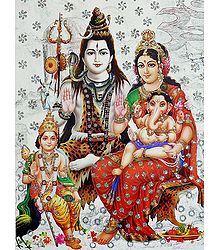
The Shiva Purana mentions that the son of Lord Shiva was destined to salvage Earth by leading the Devatas - the divine forces - to drive out the Asuras - the evil forces - who had taken possession of the planet. In order to hasten the birth of this divine son, the Gods decided to steal Lord Shiva's Bija (seed - his sperm) by interrupting his loveplay with his consort, Goddess Parvati, at the precise moment of emergence of the Bija from Lord Shiva. The interruption of the love making process led to the precious seed to fall on the ground. Agni - the Fire God, assumed the form of a white dove and picked up the Bija in its beak and flew away. Having emerged from Lord Shiva himself, the seed had immense power and fire stored within it - so much so that even Lord Agni found it difficult to keep holding it in his beak and he let go off it and dropped it in the Ganges. Ganga then carried the seed with her for long, and as instructed by Lord Brahma, deposited it in a sacred reed grove in the Saravana forest, situated on her shores, where the divine child was born after 10,000 years. Lord Shiva then proclaimed that this celestial child be known by six different names, to be known as the son of six different creators. He was to be known as Kartikeya as the son of the Kritikas or the six sacred Pleiades, whose wives had nourished him. As the son of Agni he was to be known as Mahasena. As the forest Saravena's son, he was to be known as Saravana. As Parvati's son he would be known as Skanda and as his own, as Guha. And finally, Lord Shiva proclaimed that the child would be known as Kumara, as the son of Ganga.
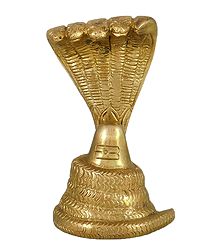
The above tale points us in the direction of viewing Ganga as being a consort of Lord Shiva, having carried his seed and borne his would-be son. This interpretation is further strengthened by the portrayal of Lord Shiva as always having Ganga near him. Thus we are also drawn to a possible interpretation of Goddess Parvati being the same as Goddess Ganga and Lord Shiva being the same as Himavan - the mountain God, being the common originator and consort of Goddess Parvati as well as Goddess Ganga. Goddess Ganga therefore, can also be looked at as Mahakali, consort of Mahakala (Lord Shiva - Time personified), and as the power of Time, she nourishes humankind with Lord Shiva's Bija - seed.
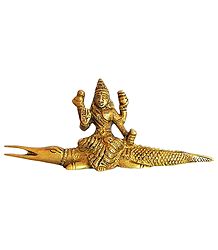
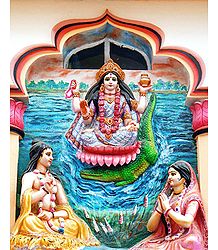
Hindu iconography depicts Goddess Ganga as sitting on a mythical creature, called the Makara - with the head of an elephant and the body of a fish. The Makara is the Goddess's vahana or vehicle. In astrology, the makara is often translated as a Water Horse, and corresponds to the western astrological sign of Capricorn, which is depicted as having the head of a goat and the body of a fish. Yet another depiction of the makara is in the form of a crocodile or alligator, which also is depicted as the vehicle of Lord Varuna - the God of winds.
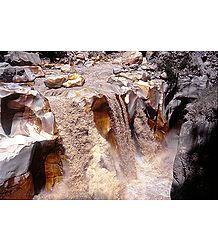
River Ganges is the longest river in India. The origin of river Ganges lies at the height of 14000 ft in the Gangotri glacier which is a vast expanse of ice, five miles by fifteen, at the foot hills of Himalayas in the Uttarakhand mountain ranges of the Himalayas in Tehri Garhwal, near Gangotri. The cave from which river Ganges originates is called Gaumukh and at its origin, Ganges is known as Bhagirathi.
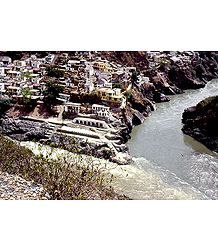
Many small and big rivers merge with the Ganges in the Himalayan region. From the point of her origin upto Badrinath in the eastern region the Ganges is known as Vishnu Ganga. In the western region it is the Dhauli Ganga of the Drona Giri. Dhauli Ganga merges with Vishnu Ganga near Joshimath and this combined stream is known as Alakananda. In Rudraprayag, Alakananda merges with Mandakini. Mandakini comes from Kedarnath, the abode of Lord Shiva. Bhagirathi joins Alakananda to form Ganga at the craggy canyon-carved town of Devprayag.
After Devprayag river Ganges enters Rishikesh and after that she turns towards Haridwar, which is situated to the south west of Rishikesh. At Allahabad, river Yamuna merges with river Ganges. In ancient times there was yet another river named Saraswati, which merged at Allahabad with river Ganges and Yamuna, but it has now become extinct. This union of three rivers at Allahabad is also known as Triveni Sangam, or Prayag.
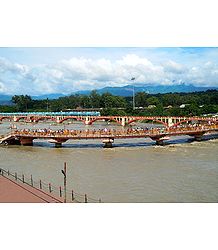
Hardwar and Allahabad, on the banks of the Ganges, assume a great importance in the Hindu religious context, since they are venues of the Kumbha Mela, one of the most important festivals of the Hindus. There are four such spots in India, the other two being Ujjain and Nasik, where the festival is held one by one at each of these spots, with a gap of three years between any two festivals. Each of these places therefore has the festival at a gap of 12 years each. The most important of these places however is Allahabad, which is said to be located on the central longitude (or the time measurement of the globe, latitude being known as the space measurement) on the map of the material and spiritual body of India (not to be confused with the geographical map of India). On the holy festival of the Kumbha Mela, millions of Hindus from India and abroad take a dip in the holy Ganges, hoping to redeem themselves off their sins.
After Allahabad the Ganges reaches Varanasi, having taken river Gomti into its folds. After that the Ganges enters the state of Bihar. Near Patna river Gandak coming from Nepal also merges into Ganges.
Thereafter, Ganges divides itself into two major streams, one of which is known as Hoogli which passes through the state of West Bengal and ultimately merges into the Bay of Bengal. The other major stream, still known as Ganga, flows into Bangladesh and merges with river Brahmaputra which originates in Tibet and flows through Assam to reach Bangladesh. Having merged with Brahmaputra, Ganges takes on the name of River Padma and merges into the Bay of Bengal.
The importance, which the Bhagawad Gita has in the field of spirituality, the same prominence and importance has been given to the holy river Ganges in the field of religion and religious activities. No other river has been as much mentioned in the Purana as the holy Ganges. According to the Puranas the Ganges is the holiest of all the shrines on this earth. Not only man, but even the tiniest of insects get liberated and achieve salvation. And thus river Ganges is given the apt title of Patita Pavani - the liberator of the greatest of sinners.
This article was written by:
Madhuri Guin