Please wait...

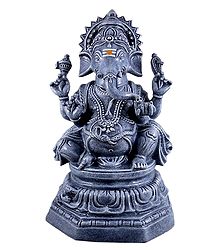
Ganesha, the Hindu deity in a human form but with the head of an elephant - represents the power of the Supreme Being that removes obstacles and ensures success in human endeavors. Hindu religious texts recommend the worshipping of Ganesha before the beginning of any religious, spiritual or worldly activity.
Pranamya shirasaa devam gaurii putram vinaayakam
Bhaktaa vaasam smarenha nityam aayuh kaama artha siddhaye
This stotra is from Narada Purana, and is recited to remove all troubles and get liberation. The meaning of this stotra (religious hymn) is that one should bow one's head and offer obeisance before the son of Gauri, Vinayaka (or Lord Ganesha), whose abode is the devotees, and remember Him always for the purpose of obtaining longevity, desired powers and prosperity.
Ganah in Sanskrit means 'multitude', 'Isa means 'Lord'. Lord Ganesha therefore literally means the 'lord of all beings'. Lord Ganesha is the first son of lord Shiva. Shiva represents the supreme Reality. The son of Shiva symbolizes one who has realized the Reality. One who has discovered the godhood in him. Such a man is said to be the Lord of all beings.
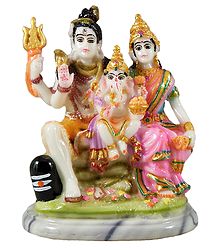
In mythology, the birth of Ganesha is celebrated as a divine twist of fate. The most popular tale brings alive the story about the elephant head. As the legend goes, Parvati (consort of Lord Shiva) was rather disappointed that none of the guards she appointed out of Lord Shiva's army failed to stop him from barging into her private chambers. She decided to have someone who would be entirely her own and place no one above her. According to Shiva Purana, Ganesha was born of the scurf from Parvati's body. Once, when Shiva was away, Parvati wanted someone to guard the door while she bathed. From the scurf of her body and water from the Ganges she created a boy who is Lord Ganesha. This makes Parvati and Ganga his mothers and he sometimes also known as Dwimatri. Having created the figure, Parvati infused life into him and told him to ensure that nobody entered her room while she bathed. Lord Shiva soon came in and was stopped by Lotd Ganesha. This enraged Shiva and He beheaded the boy. Parvati was peeved to such an extent that she asked Goddess Durga and Goddess Kali to destroy everything and everyone. She demanded that Ganesha be brought back to life and Shiva sought to assuage her, by promising to bring the boy to life but his head could not be found in the battlefield. Lord Shiva sent his hordes to collect the head of first living being, who was sleeping with head facing north. The north was associated with wisdom, and was also the direction from which the Aryans had invaded.
Airavat, Indra's white elephant paid the price for Shiva's blunder. While Airavat slept facing the north, Shiva's hordes beheaded him. His elephant head was carried away for the dead body. Lord Brahma brought the boy back to life and they took him to Parvati. Parvati still had a few conditions to be fulfilled by the Gods for her son before she agreed to cease the havoc created by the Shaktis. She asked that he should be invincible, the giver of victory and God of wisdom. The person who worships him should gain success and property. She also wanted that nobody should be permitted to heaven before pleasing him and it should be compulsory to first invoke him before any other deity. These were all granted to Lord Ganesha, by the triumvirate of Gods, Lord Brahma, Lord Vishnu and Lord Shiva.
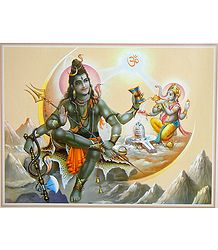
Lord Shiva eventually appointed Lord Ganesha as the leader of his Gana (public) and called him Ganapati, literally meaning, leader of people. Ganapati represents all the qualities that a leader should have.
The Brahma Vaivarta Purana narrates a different story regarding the origin of Ganapati. Shiva instructed Parvati, who wanted to have a son, to observe the Punayaka vrata (a special type of holy fasting) for a year to propitiate Vishnu. On completion of the vrata by Parvati, it was announced that Krishna would incarnate Himself as Her son in every kalpa. Accordingly, Krishna was born as a charming infant, delighting Parvati who celebrated the event with great enthusiasm.
All the Gods arrived to have a look at the baby. But Shani, the son of Surya, did not look at him and stared at the ground instead. Upon Parvati's questioning regarding his behaviour, Shani said that his look would harm the baby. Parvati, however insisted that he should look at the baby. In difference to Her wish Shani cast his eyes on the baby. Due to his malevolent glance, the baby's head was severed and flew to Goloka, the abode of Krishna. Parvati and all the Gods assembled there, including Shiva, were grief-stricken. Thereupon, Vishnu mounted Gaduda and rushed to the banks of the Pushpa-Bhadra river and brought back the head of a young elephant. The head of the elephant was joined with the headless body of Parvati's son, reviving him. All the Gods blessed Ganesha and wished Him power and prosperity.
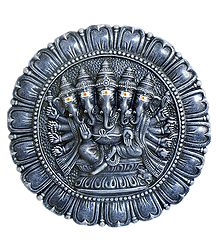
Another tale is that once Lord Shiva slew Aditya, the son of a sage. However, Shiva later restored life to the dead boy. At this outrage, Kashyap, one of the seven great Rishis, doomed Shiva's son to lose his head. When he did lose it, the head of Indra's elephant was used to replace it. Still another version states that on one occasion after Parvati had bathed, the water was thrown into the Ganges and was drunk by the elephant-headed Goddess Malini, who gave birth to a baby with four arms and live elephant heads. The river Goddess Ganga claimed him, but Shiva declared him to be Parvati's son, reduced his five heads to one and enthroned him as the "Controller of obstacles" (Vigneshwara).
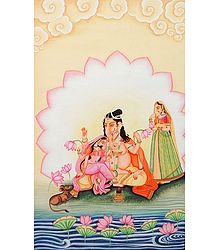
In some regions of India, Ganesha is considered to be a bachelor while in most he is believed to have two wives, Riddhi and Siddhi. It implies that all the Riddhi and Siddhi (knowledge and perfections) of the world kiss those who adopt all the virtues of Lord Ganesha in their life. Riddhi and Siddhi are the two beautiful daughters of Vishwabrahma. It is also said in some Hindu tales that Lord Ganesha had two sons, Kshema and Labha.
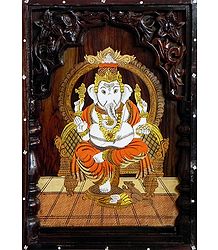
All rituals begin with the worship of Ganesha. His image invokes the universe, his head signifies wisdom and his body is globular, Vishwaroopa. Ganesha represents the majesty of the animal kingdom with his head and his vehicle, the mouse, shows subjugation of pestilent rats. In Hindu mythological literature, Lord Ganesa is described as having a human form with an elephant's head. One of the tusks in his head is broken. He has a conspicuously large stomach. He sits with one leg folded in. At his feet a variety of food is spread. A rat sits near the food and looks up at him as if it were asking him for sanction to eat the food. This mystical form of Lord Ganesha represents not only the supreme state of human perfection but the practical path to reach that state. The details of his description suggest deep philosophical significance, which can guide you to reach that ultimate state.
Lord Ganesha is known for his intellect and wisdom. A legend explains why Ganesha is worshipped before any other deity or prior to any important event. It happened that Lord Shiva asked Kartikeya and Ganesha - his two sons - to circle the world and return. Kartikeya hurried off on his peacock, but Ganesha walked around Shiva and Parvati. He explained that for him, his parents constituted the world. Pleased, Shiva granted him a boon, saying that before undertaking any important task, people would pray to Ganesha. According to the Narasimha Purana, if he is not worshipped at the beginning of a ceremony, he creates obstacles for the performers. Therefore, no matter what the occasion or ceremony be, Ganesha is worshipped before all other deities.
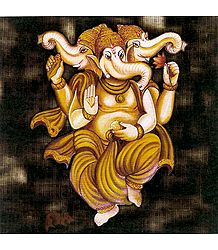
Ganesha is also known as Ekdanta, or the one with one tooth, because one of his tusks is broken. The reason for this, according to Padma Purana, is that one day when Lord Shiva was sleeping, sage Parashurama came to visit him. However, Ganesha would not allow Parashurama in, for his father's sleep would be disturbed. When Parashurama insisted he be permitted entry, a fight broke out. In the course of their struggle, Parashurama threw his axe at Ganesha. This axe had been given to Parashurama by Lord Shiva. Recognizing the axe and out of reverence for his father, Ganesha refused to intercept the weapon. He bowed and took its impact on one of his tusks, which broke. This broken tusk was used by him to write the epic, Mahabharata. Ganesha, the embodiment of wisdom, is also depicted as a scribe to whom sage Vyasa dictated the Mahabharata. He is accepted as the god of learning and the patron of letters.
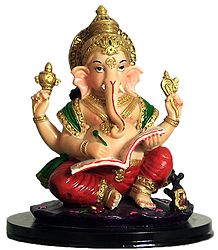
There is an interesting tale connected with the composition of Mahabharata. Sage Vyasa, the author of Mahabharata, wanted to dictate the verses of Mahabharata to someone who was capable of writing extremely fast, and without mistakes. Lord Brahma decided that Lord Ganesa was the only person equal to this great task. When Lord Ganesha came to Vyasa, Vyasa told him that he would dictate the poem very fast and that Ganesha must take down all the verses without mistakes. Ganesha threw a challenge in return that he would write as fast as Vyasa dictates and that too correctly, but when dictating, Vyasa should not stop till he complete the entire Mahabharata. Vyasa accepted the challenge and Ganesha used his broken tusk as the divine quill to record the Mahabharata - each word of the verses recited by Vyasa - for Gods and men alike.
Another legend about the broken tusk of Ganesha is as follows. Ganesha Chaturthi is celebrated as the birthday of Ganesha. During one of his birthdays, his mother, Goddess Parvati cooked twenty-one types of delicious dishes and a lot of sweet porridge. Ganesha ate so much that even his big belly found it difficult to accommodate all the food. Mounting his little mouse, he embarked on his nightly rounds. His mouse suddenly stumbled upon spotting a huge snake. To adjust his belly, Ganesha put the snake on as a belt around his belly. All of a sudden, he heard laughter emanating from the skies. He looked up and saw the moon mocking him. Ganesha was infuriated and broke off one of his tusks and hurled it at the moon. The moon hid himself behind the clouds and immediately Ganesha pronounced a curse on him and banished him from the night skies. The curse shattered the moon's pride. He realized his mistake, and felt apologetic. Standing devotedly with folded hands in front of Ganesha, he prayed to him to forgive him and his ignorance and requested Ganesha to take back his curse and save him from humiliation. This calmed down the kind Ganesha. He consoled the unhappy moon and said, "Moon, you have realized your fault. What is important is the destruction of your pride. Anyhow, my curse cannot be in vain. But those who are subjected to false accusations will be saved and will regain their good name if they see you on the second night of the bright fortnight or listen to the story of the Syamantaka jewel."
The story of the Syamantaka jewel may be found in the Puranas such as the Bhagavata Purana and the Vishnu Purana. Satrajit, who secured a jewel Syamantaka from Surya - the Sun God, did not part with it even when Lord Krishna asked for it, saying it would be safe with him. Prasena, the brother of Satrajit went out hunting wearing the jewel but was killed by a lion. Jambavan - one of the monkey Gods from Ramayana and great devotee of Lord Rama, killed the lion and gave the jewel to his son to play with. When Prasena did not return, Satrajit falsely accused Krishna of killing Prasensa for the sake of the jewel. Krishna, in order to remove the stain on his reputation, set out in search of the jewel and found it in Jambavan's cave, with Jambavan's child. Jambavan attacked Krishna thinking him to be an intruder who had come to take away the jewel. They fought each other for 28 fays, when Jambavan, his whole body terribly weakened from the hammering of Krishna's fists, finally recognized him as Rama. As repentence for his having fought Krishna, Jambavan gave Krishna the jewel and also his daughter Jambavati in marriage. Krishna returned to Dwaraka with Jambavati and the jewel, and returned it to Satrajit, who in turn repented for his false accusation. He promptly offered to give Krishna the jewel and his daughter Satyabhama in marriage. Krishna accepted Satyabhama as His wife but did not accept the jewel.
The depiction of Ganesha as a pot-bellied God with an elephant head having a trunk and two tusks with one of them broken, and with a snake tied around its waist and having a mouse for a vehicle, has specific symbolisms attached to it.
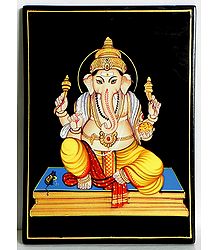
The huge size of Ganapati represents the universe (cosmos). Parvati is the primordial energy. The seven lokas (various planes of spiritual human existence) above, seven lokas below and the seven divine oceans, are inside the cosmic belly of Ganesha, held together by the cosmic energy of Kundalini symbolized as a huge snake which Ganesha ties around him.
Lord Ganesha is the presiding deity of the Mooladhara Chakra, which is the foundation of the evolutionary, creative or primeval energy called the Kundalini Shakti. It is coiled up like a snake when dormant and is depicted by the snake around Lord Ganesha's belly. When activated, this energy is said to result in an expansion of consciousness and the enlightenment of man. The snake around Lord Ganesha's belly reminds us that we have to awaken this energy to reach the state of expanded consciousness. The snake around the belly also shows that everything in nature (the pot-belly) is supported by energy.
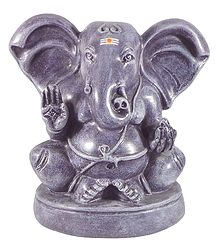
Lord Ganesha's large belly is meant to convey that a man of perfection can consume and digest whatever experiences he undergoes. He maintains an unaffected grace in and through all these fluctuations of the world. In Hindu mythology, Kubera, the god of wealth offered a dinner to Lord Ganesha in his palace. Lord Ganesha ate all his food that was prepared for the entire gathering of guests. Thereafter still dissatisfied, he started eating the festive decorations that were used for the occasion. At this juncture, his father Lord Shiva approached him and offered him a handful of roasted rice. Lord Ganesha consumed the roasted rice and his hunger was satisfied immediately. This story is a directive to mankind that man can never be satisfied with the joys provided by the world of objects represented by Kubera's feast. The consumption of roasted rice indicates the destruction of desires in us. Thereafter, we remain in a state of absolute peace & bliss.
The large head of an elephant symbolizes wisdom, understanding, and a discriminating intellect that one must possess to attain perfection in life. The wide mouth represents the natural human desire to enjoy life in the world. The large ears signify that a perfect person is the one who possesses a great capacity to listen to others and assimilate ideas.
Ganesha's trunk is depicted as being curled and takes the form of the holy Hindu symbol, OM. The trunk is a unique instrument, which springs from his head, and represents the intellect, the faculty of discrimination, which necessarily arises out of wisdom. Intellect is the discriminating faculty, the discerning ability or the judging capacity in man. The trunk of an elephant has the unique capacity of performing both gross and subtle activities.
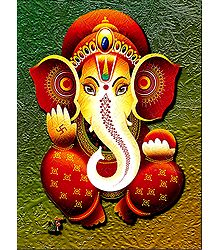
A trunk can uproot a tree. It can pick up a needle from the ground. Likewise, the human mind must be strong enough to face the ups and downs of the external world and yet delicate enough to explore the subtle realms of the inner world. The trunk hangs between the two tusks signifying discrimination between the worldly and spirituality. Ganesha, beyond all dualities, is attached to neither.
The trunk should be curved to the left for normal idols. If it is curved to the right, it is called Siddhi Vinayaka and needs special worship. One should be very careful in worshipping such idols. The left-turning trunk has easy rules and one can worship however one wants to, with respect, but the right-turning trunk will burn the self, if rules are violated.
The two tusks denote the two aspects of the human personality, wisdom and emotion. The right tusk represents wisdom and the left tusk represents emotion. Ganesha's right tusk is broken. This broken tusk is symbolic of knowledge, as it is with this tusk that he wrote the Hindu epic, Mahabharata. The depiction of a broken tusk is interpreted by some as indicative of the fact that we should not be trapped between pairs of opposites like pleasures and pains but that we should make conscious efforts to break its grip on us. Ganesha uses the broken tusk as a writing instrument. This shows that one who transcends the pair of opposites becomes creative. Our right side represents Shiva (spiritual) and the left is Shakti (material). The broken right tusk indicates that one must break-off the ego for spiritual fulfillment. In worldly life, however, we need the ego as otherwise we cannot live. But the ego is worldly and life must be controlled by divine wisdom.
All animals can see in the right perspective. The elephant is the only animal that lacks this capacity: it can't see things in right perspective. It sees all things as being bigger than itself. Thus the elephant-eyes of Ganesha symbolize the idea that even if an individual gets "bigger and bigger" in wealth and wisdom, he should perceive others to be bigger than himself; that is, surrender one's pride and attain humility. All this also implies that one should never take one's opponents for granted and that one should regard everyone as being bigger and better and more virtuous than oneself. One should always view the goings-on of the world with a microscopic sight, reflecting over them seriously. Thus one will be able to anticipate the crises that may befall.
Lord Ganesha has four arms. The four arms represent the four inner equipment of the subtle body, namely mind (manas), intellect (buddhi), ego (ahankar) and conditioned consciousness (chitta). Lord Ganesha represents the pure consciousness - the Atman - which enables these four equipment to function in us. In one hand he holds an axe. The axe symbolizes the destruction of all desires and attachments & their consequent agitations & sorrows. The other hand is shown in a blessing pose, which signifies that Ganesha always blesses his devotees. In the third hand he holds a rice ball (modaka). Modaka represents the joyous rewards of spiritual seeking. A seeker gains joy of satisfaction and contentment as he progresses on the path of spiritual evolution. Modakam is a sweet cake. The modakam consists of an outer flour portion and an inner sweet portion. The inner sweet portion represents the supreme. The message is that man must dive within himself and transcend the outer, in order to find the inner treasure. In the fourth hand he holds a lotus. The lotus represents the supreme goal of human evolution. By holding the lotus in his hand, he draws the attention of all seekers to that supreme state that each one of them can aspire for and reach through proper spiritual practices.
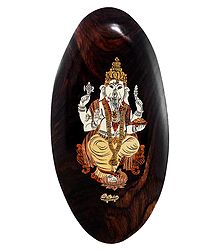
Lord Ganesha sits with one leg folded up and the other leg resting on the ground. This suggests that while we live in this world, we must tread the middle path and not to go to extremes. Moderation should be our guide. Ganesa's posture indicates that one of his tasks is to deal with the world while the other is ever-rooted in single pointed concentration upon the Supreme Reality.
The large ears of Ganesha signify that a perfect person is the one who possesses a great capacity to listen to others and assimilate ideas. The large ears of Ganesha teaches us to talk less and listen more. Ears are used to gain knowledge. The large ears indicate that when God is known, all knowledge is known. Lord Ganesha has a wide mouth, which represents the natural human desire to enjoy life in the world. Lord Ganesha has a human body and possesses a human heart, which is a symbol of kindness and compassion towards all.
Ganesha is usually portrayed wearing red and yellow clothes. Yellow symbolizes purity, peace and truthfulness. Red symbolizes the activity in the world. These are the qualities of a perfect person who performs all the duties in the world, with purity, peace and truthfulness.
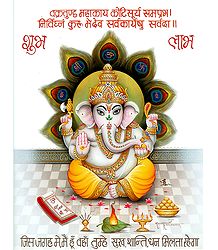
At the feet of the Lord is spread abundance of food. Food represents material wealth, power and prosperity. Beside the food is a tiny rat loking up towards the Lord Ganesha. All the gods have two appearances - tangible and intangible. They stay in the physical world in their intangible form whereas in the divine abode, they stay in their tangible form. In the tangible form, all the gods have their own vehicle. A vehicle in fact reflects the god's own radiance. Lord Ganesha himself is gigantic in appearance, whereas his vehicle, the mouse, is extremely small. The symbolization of the mouse - Mooshikam - with Lord Ganesha has a number of interpretations, some of which are contradictory to each other.
The mouse is said to symbolize the equal importance of the biggest and smallest of creatures, in the eyes of the infinity of creation. Vrihadaarnyak Upanishad says that Ganesha's vehicle is in fact a symbol of all pervasive omniscient Brahma. Like the omnipresent Brahma, a mouse stays in every household. But it is not visible all the time. Members of a household come to know about it only when its action begins to manifest.
The mouse is also interpreted as our ego. One who has controlled the ego has Ganesha consciousness or God-consciousness. According to other interpretations, the rat represents desire. A rat has a small mouth & tiny sharp teeth. But it is the greediest of all animals. Its greed & acquisitiveness are so great that it steals more than it can eat and hoards more than it can remember, often abandoning burrows full of hoarded grains through forgetfulness.
Lord Ganesha is the lord of knowledge & intelligence. Likewise, His vehicle, mouse, is also the symbol of wisdom, talent and intelligence. It symbolizes minute investigation of a cryptic subject.
A mantra of Rigveda narrates a tale. According to it, a sage was feeling tormented by a mice which were biting his genitals. The sage was hence praying the gods to get him rid of his tormentors. This tale clearly points that a mouse also symbolizes sexual feeling, sexual urge & sexual behaviour. A sex-dominated behaviour is not divine; it is an animal instinct. A conscience that is overridden by sex cannot house divinity. In order to attain proximity with gods, one must overcome his sexual urges and develop a pious attitude.
A mouse leads a clandestine life below the ground. Thus it is also a symbol of ignorance that is dominant in darkness & fears light and knowledge. As the vehicle of Lord Ganesha, a mouse teaches us to remain always on alert and illuminate our inner-self with the light of knowledge.
Lord Ganesha is given prime importance among the five gods, according to Indian Hindu tradition. The other four are Vishnu, Shiva, Devi and Surya (Sun God). Lord Ganesha is respected with the first honour of worship, before undertaking any auspicious occasion, or celebration. For the successful completion of any auspicious undertaking, the twelve names of Lord Ganesha are pronounced and praised. One who utters these twelve names of Ganesha while beginning one's studies, at the time of marriage, while entering a newly constructed house, before setting off for a journey, before setting off for war, or in times of crises, does not come across any obstacles.
The twelve names of Ganesha are as follows : (1) Sumukh, (2) Ekdanta (with one tooth), (3) Kapil, (4) Gajakarna, (5) Lambodar, (6) Vikat, (7) Vighna-Nashan, (8) Vinayak, (9) Dhumraketu, (10) Ganadhyaksha, (11) Bhalchandra, (12) Gajanan. The inner-meanings of each other twelve names are drastically different from each other:
Ganesha is said to be possessing all the qualities of Moon, who is also called the God of beauty, and is hence also known as Sumukh.
Ganesha is also known as Ekdanta, or the one
with one tooth, because one of his tusks is broken. The name
Ekdanta is probably derived from a tale associated with the Asura
(demon), Mada-Asura, who is also associated with Pride. After
having surrendered to Ganesa, the Asura describes Ganesha as
the one who is the embodiment (eka) of the supreme truth (danta)
and hence the name Ekadanta.
The philosophical interpretation of this name however is this: Lord Ganesha,
through his single tusk propagates Adwaitavad - or the Hindu doctrine of singularity,
which in simple terms says that all existence - animate and non-animate - is
but a part of a single whole. The other belief in Hinduism is that of Dwaitavad
or the principle of duality, where Man is seen as being separate from God.
Kapila was also the name given to a celestial grey cow. Just as a cow contributes in keeping Man healthy through its milk, Ganesha too does the same for the human mind by passing on knowledge and wisdom. This nature of kind giving to Man is assimilated in the name, Kapila.
Gajakarna indicates the possession of the ears of an elephant. Ganesha's ears, which also appear like large winnowing baskets, have philosophical significance. Just as one uses a winnowing basket to separate grains from dirt, one must use discriminition (viveka) to separate the real (Brahman) from the unreal (Maya) in life. Here the grains stand for Brahman and the dirt signifies Maya. In other words, Ganesha's ears indicate that such discrimination between Brahman and Maya is to be gained by taking recourse to Sravana (hearing). Listening to words of wisdom from those who are already enlightened will lead to proper discrimination and Brahman realization and this is the message that is sought to be passed on through the depiction of Lord Ganesha with elephant ears.
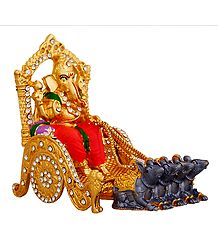
Lord Ganesha learnt the art of music from the tinkling sound of nupur (anklets) tied around the ankles of his mother, Goddess Parvati. He studied the Vedas from the sound of the Damaru (a small percussion instrument) of Lord Shiva. Thus with the accumulation and storage of vast knowledge, his tummy became large.
This name, which means ferocious or dreadful, is suggestive of Lord Ganesha taking on those forms to defeat all evils. It is said that one needs to take on one's opponents in the same manner as they behave so as to defeat them. This is the message conveyed by the name Vikat.
Lord Ganesha is a destroyer of all evils and calamities. It is said that Lord Shiva told Parvati that their son Ganesha would create numerous obstacles for those who do not follow the path of dharma (righteousness) but that he would remove all the obstacles to those who revere knowledge and wisdom.
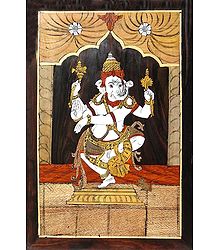
To the king Abhijit and queen Gunavati was born a beautiful son named Gana. He was very bright and strong. In addition, he had great devotion to Lord Shiva. Lord Shiva, pleased with Gana's devotion, granted him some boons. However, this inflated Gana's ego and he fell to bad company. One day he visited sage Kapila's ashram (hermitage). Kapila had a precious gem called Chintamani which was could fulfill the wishes of its owner and could provide food for thousands. When Gana spotted this gem, he wanted to possess it but Kapila did not want to give it to him. Gana forcibly took it away from him. Kapila prayed to Lord Ganesha and Ganesha appeared in the dream of Gana and cut off his head. Gana on waking up, did not repent but rather took his army to kill Kapila. Gana's father Abhijit pleaded with Gana to give Kapila back his gem, but Gana did not heed the advice. However, on reaching Kapila's ashram he found that Ganesha had assembled an army to fight him. In the fight that ensued, Gana was slayed by Ganesha and Ganesha restored the Chintamani gem to Kapila. Kapila, however, gave it back to Ganesha saying that even a small gem like that is the cause of all troubles and wealth is the root of many troubles of the world. Kapila, however, requested Ganesha to stay in that place. This place is now called Chintamani Vinayaka and is at Theur near Pune, Maharashtra, in India. In the word Vinayak, the syllable "Vi" stands for Vighna (obstacle or calamity) and Nayak means controller or leader.
This name indicates the shaping of smoke into a specific form - suggestive of Ganesha's role in helping Man in the formation of specific ideas from foggy thoughts. It also means Agni (fire) and is indicative of the power that Ganesha has in burning all evils and calamities.
Lord Ganesha is seen as the leader of the Ganas (masses), Nar (Man), Asura (Demon) and Nag (Snake) and hence this name.
By placing the moon near his head, Lord Ganesha creates an atmosphere of pleasure and peace. It is indicative of the fact that the more a person feels peaceful using his wisdom, the more effectively and efficiently will he be able to shoulder his responsibilities. A quite mind is the stepping-stone to success. Balachandra also indicates the moon being a king of Brahmins - those who are enlightened or those who are perfect in knowing Brahma. Thus by depicting the Brahmin king on Ganesha's head, it is sought to indicate that Ganapati has stored the entire knowledge of Brahma in his mind.
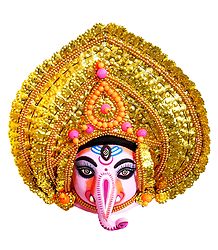
The symbolism of Ganesha having his head as
that of an elephant and the various meanings attached to it have
been described at length earlier.
History tells as that during Dravidian times, Lord Ganesha was worshipped as
an elephant signifying the wisdom and majesty of the universe. The invading
Aryans, adopted the Dravidian godling and affirmed their belief in Ganesha.
Ganesha made a ceremonial entrance as an Aryan God. 'The auspicious god', he
would be worshipped at the beginning of all rites, an unbroken tradition that
continues to this day.
The symbol of Lord Ganesha is the Swastika. The Swastika is a basic Hindu symbol, reflecting the primary principle of Creation, personalized by Lord Ganesha. The in-depth interpretation of the direction of the swastika proves, that the ancient Oriental mind gives positive answers to the existential problem of the unity of the profane and sacred in human life.
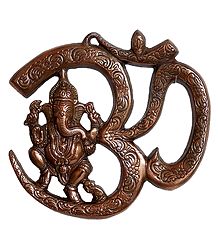
Another symbol associated with Lord Ganesha is the OM. The sign Om is the primary sound of the creation, the holy breath of God, the primary word or the primary verb. Lord Ganesha's form is shaped like and represents Om, which is the primeval, creative energy. When the elephant cries it produces a sound akin to the Om. The Om is the sound symbol of Brahmam, Sivam, the Eternal, the Unchanging, the substratum of all existence.
Lord Ganesha represents unity. He has a revered place in all Hindu temples including the Shiva temple and the Krishna temple. Lord Ganesha has a place in the Buddhist temple and among the Jains as well. The Chinese too worship Ganesha but with a different name. Ganesha like deities are found in Indonesia, Japan, Afghanistan, Mexico, Brazil, Burma, Thailand, Cambodia, Tibet, Mongolia and Polynesia among other places.
Ganesha is the beginning of our world. He was created first and he gave shapes, the qualities, the elements, the modes of time, the Gods, the people. Ganesha is the symbol of the personality, which surpasses the human ego and superego. Ganesha is the innocence, living in constant worship of the Spirit. In other words, Ganesha is the unrealized, potential innocence in everything. Lord Ganesha is source of the illusive energy "Maya", hiding Atma (soul) from the mind in the same way as an illusion makes one mistake the rope for a snake.
Ganesha is also the Lord of Categories. All that can be counted or comprehended is a category (gana, hence the lord of gana, Gana-pati). The principle of all classifications through which the relations between different orders of things, between the macrocosm and the microcosm, can be understood is called the lord-of-categories.
"I bow to you, lord of categories. You alone are the visible form of the principle. You alone are the creator, you alone are the sustainer, you alone are the destroyer, you alone are unmistakably the Principle-of-All (Brahma), the true Self."
This article was written by:
Madhuri Guin