Please wait...

Dolls are the representative of a nation and are the confluence of its different ages, time and culture. The rich cultural heritage through the ages can be vividly depicted through these dolls. Religion, nature and human interaction have been the three basic inspiring forces for artists down the ages, although the medium of expression has diffused from stone and canvas to cloth and celluloid.
From ancient times, dolls of various types fascinated men, women and children all over the world. Children in particular have found great fun and delight in dolls, which also help them to develop their intellect and imagination.
The history of India from ancient times to modern is recounted in a series of dolls. The simple folk of India find a place in dolls that project rural life. The vividly colorful Indian dances - be it Kathakali, with its complex grammar, or Bhangra, with its vigour and exuberance are also well depicted through dolls. Dolls act as cultural ambassadors reflecting 5,000 years of Indian civilization.
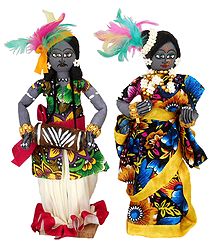
The Indian people have a very special affection for dolls. They are part of a tradition Indians have grown up with. At one time dolls were given away as wedding presents to the child bride. Today, dolls not only provide a diversion but also a colorful canvas for depicting Indian life in its plethora of cultural beauties.
Each region is known for its typical dolls and toys. Assam and West Bengal fashion toys out of pith. In the eastern terracotta belt, the theme of "mother and child" models, are popular. Varanasi, Lucknow, Mathura and Vrindavan are reputed for their brightly painted wooden dolls and toys, Tirupati for its dampati (man-woman) dolls. Rajasthan makes dolls of unbaked clay. In Madhubani, dolls are made of sikki, a grass. Kondapalli in Andhra Pradesh makes some of the traditional dolls and toys out of a mixture of cowdung, sawdust and clay and covers them with lustrous pigments.
From early times, various materials have been used to make toys and dolls. The oldest toys date back to 5,000 years ago, from the sites of the Indus valley civilization. Harappan art goes back to 3 millennia B.C and shows a high degree of proficiency, which suggests much earlier development. The perfect modeling of human and animal figures at Mahenjodaro and Harappa are testimony to the technical skills of craftsmen who could cast images in metal using the (now rare) wax process. They could cast in clay and chisel in stone with ease, creating an art, worthy of these great centers of civilization.
Copper and bronze were the earliest non-ferrous metals which man shaped into tools. References to the casting of bronze images were found in ancient texts like the Matsya Puarana. China has the oldest continuous civilization in the world. Bronze working was perfected during 1700-1122 B.C. and kaolin (pure white clay) was discovered by Chinese potters. Gujarat and Uttar Pradesh in the north India, and Tamil Nadu and Andhra Pradesh in south India, are known for their bronze and copper items. In solid casting of icons, the mould is made by giving several clay coatings on prepared wax models, but with a different clay each time. These convey the contours of the model to the cast-image and are therefore important. The molten alloy is then poured in a thin and even stream into the mould made red-hot. When the mould is broken, care is taken to see that the head of the icon is brought out first, as a good omen.
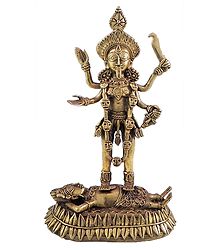
The Dokra work, using the lost wax-method from the region now divided into the states of Orissa, West Bengal and Bihar, is well known. Dokra is a tribal art and derives its name from the semi-tribal nomadic blacksmith craftsmen who use the technique known as Dokra kamars. These artists produce a large variety of articles of outstanding artistic value, especially images of Hindu Gods and Goddesses.
Workmanship on wood has flourished in India over the centuries. Dolls made from wood are very popular. Sikkim is known for its carved objects and dolls. Traditional designs are carved on wood and then painted over giving the whole object a rich effect. In Tripura tribal figures and masks form part of the repertoire in wood. The Konyak tribe of Nagaland is known for its wooden figure carvings. Craftsmen from Orissa use Gambhari wood to sculpt exquisite mythological pieces. Orissa offers choicest varieties of wooden dolls blended both in folk and classical forms, which provide an aesthetic appeal with a freshness and charm of their own. Wood carving is a traditional craft of Orissa to be found in Puri, Cuttack, Bargarh, Sambalpur and Khandapara. But Puri is the principal center of this craft, whose history is stretched over centuries. Kashmir produces a number of articles from walnut wood. Dolls made from walnut wood come from three parts of the tree - the branches, the trunk and the root. The branches have the palest colour of wood and the trunk the darkest. Branches have no veins, trunks have the strongest marked veins. As walnut is a soft wood, it takes carving very well. Tribal traditions have been kept alive in wood carvings of the Bastar district (Jagdalpur) of Madhya Pradesh. Gujarat is rich in structural wood carving. Madurai in Tamil Nadu is known for its rosewood carvings. Tirupati is noted for its rakta chandan (blood-coloured sandalwood) figurines. Karnataka craftsmen specialize in carvings on sandalwood. Dolls and other items made of sandalwood, rosewood, walnutwood and ivory are of artistic excellence.
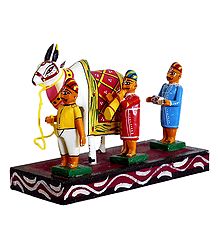
Makers of clay doll in India usually follow two separate schools - one called the Terracotta school, in which the figurines after being prepared, are burnt to make them last longer. The second school does not involve the burning process for the figurines, and is more prevalant in Kumartulli and Krishnanagar in West Bengal.
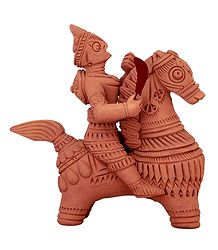
Terracotta is the most ancient and original form of expression of clay-art. Terracotta figurines in India, ranging over a period of 3,000 years, belong to times both before and after the use of stone in sculpture. Though it is fragile and disintegrates quickly, a continuous stream of art throughout the different stages of civilization can still be found. Some of the famous terracotta temples are found in the Birbhum and Bishnupur districts in West Bengal.
Pottery in India has deep religious significance. Figurines of Gods and Goddesses are made of clay during festivals like Durga Puja in Bengal and Ganesh Chaturthi in Maharashtra. Also popular are the gram devtas (village deities) regularly created by local craftsmen. Delhi is known for its blue pottery which is almost translucent. The Jaipur blue pottery is even more unique with its arabesque. Alwar, in Rajasthan, makes paper thin kagzi pottery. Pokhran, in Rajasthan, has pottery in different shapes with red and white etchings. Khurja in Uttar Pradesh to this day has pottery as its main activity. Natural white wares are the speciality of Vidi, a small village in Kutch. Saurashtra has a clay called gopichand because it resembles chandan (sandalwood). Kashmir gives its pottery a glazed surface. Kangra in Himachal Pradesh has mainly black and red wares. Goa has figurines of earthen ware with a velvety finish. The black and red pottery of Vellore of Tamil Nadu are painted over with yellow substance.
Orissa was traditionally known as "Utkal", land of excellence of art, because of the vast commmunities of painters, potters, weavers and other artists who were attached to the major temple complexes. In a land where the finest of the country's temples have been sculptured, some of the best handicrafts are based on stone sculpture. Human figures in pink, pitted sandstone are highlights of the crafts of this region. Though heavy, these are excellent and bring to bear the skills of the forbearers of the traditions of their art. Dolls made of stone bear testimony to the magnificent craftsmanship of the east. In fact the art of stone carving in Orissa dates back to the Kalinga (previous name of Orissa) period. Stone carving is carried out on sandstone, Nilgiri stone, soft stone (Kochilla) and serpentine stone. Popular themes include the images of Hindu gods and goddesses, and dancers. Makrana in Rajastan produces fabulous marble dolls and figurines.
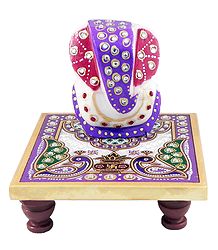
Papier Mache is a comparatively new craft in India, which has caught on very well in many parts of the country, since the raw material is easily available and inexpensive. The craft of making objects from papier mache is an ancient one. Soon after the Chinese discovered how to make paper, about 2,000 yeas ago, they began to experiment with ways of molding it by tearing it into pieces, mixing it with glue, and shaping it into useful and attractive objects. The interest in this craft declined for hundreds of years until the French revived it in the 18th century. They called it papier mache, literally meaning, 'chewed up paper'. Uses for papier mache were far more limited then they are today, since the invention of epoxy resin which makes the papier mache object much stronger and more durable than traditional water-soluble glues and pastes. Epoxy resin can also be used as a surface finish. To make papier mache dolls, paper is soaked in water till it disintegrates. It is then pounded, mixed with an adhesive solution, shaped over moulds, and allowed to dry and set before being painted and varnished. Paper that has been pounded to pulp has the smoothest finish in the final product. When the pounding has not been so thorough, the finish is less smooth. The design painted on objects of papier mache are brightly colored. Gold is used on most objects, either as the only color, or as a highlight for certain motifs. Varnish, which is applied to the finished product, imparts a high gloss and smoothness, which increases with every coat. Kashmir is famous for papier mache craft. Kashmir produces some of the most beautifully handcrafted papier mache items. Gwalior in Madhya Pradesh makes papier mache toys, while in Ujjain figures of popular deities are made of this material. Jaipur (Rajasthan) and Chennai are also famous for their papier mache crafts.
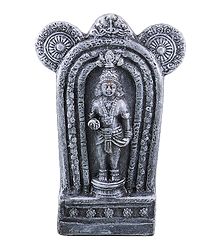
Figurines of Shola pith are another popular form of handicraft in certain parts of India. Shola pith is a herbaceous plant growing wild in marshy and water-logged areas. This material is used in West Bengal for making figurines, artistic decorations and headgears for deities during festivals. Craftsmen of Tiruchirapalli in Tamil Nadu make remarkable reproductions of well known temples in pith.
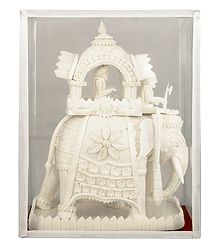
It was the Mughals who discovered the decorative potential of glass - the fact that when it is cut, it has the opalescence and the glitter of a myriad diamonds. Glass engravings from India, exported to Europe till the 16th century, are said to have influenced the Venetians. Today this art has declined but glass items are still part of the everyday scene. Saharanpur of Uttar Pradesh makes glass dolls and toys filled with coloured liquid called panchkora.
The cloth doll has been in existence for almost as long as cloth itself. Dolls were made of cloth in ancient Egypt and cloth-dolls have been made ever since. They have been more popular in some periods of history than others, but they have never been forgotten. The main reason for this is that cloth is the easiest of all materials for a woman to find. A mother could always use at least an old rag to fashion a doll for her child. Aside from the fact that it is always available, cloth is easy to work with and requires practically no tools. These two reasons were the basis for the selection of cloth as the material for costume dolls. Another reason was that even though it is simple to make a doll from cloth it is not simple to make a realistic one. Cloth dolls have a basic simplicity and charm, which sets them apart from other dolls, which are usually made to be realistic in appearance. From a child's point of view, no doll feels as good as a cloth doll.
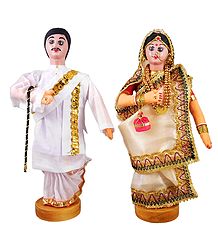
Even though most cloth dolls over the world lack sophistication and realism, cloth dolls, made by the award-winning artist, Madhuri Guin, used to portray human life as realistically as dolls made of other materials. These dolls are no longer made owing to the ill-health of the doll-maker. The cloth body parts used to be stitched and stuffed with synthetic cotton, with a metal frame providing the body structure. The faces also were made of cloth with synthetic cotton stuffing. Facial features were painstakingly painted by hand. All limbs, fingers, and toes were stitched separately, to provide for more realistic depiction of gestures. Clothing and accessories were also stitched or prepared by hand.
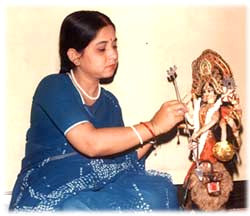
These cloth dolls were paragons of beauty. Somewhere you could see a harmony of solo rhythm and somewhere a collective wild rhythmic movement. One could feel as if a stone sculpture from an Indian temple has come to life. The combat between Bhima and Duhshasana (mythological characters from Mahabharata, the great Indian epic) in Kathakali style (a classical dance form of India) will take you to the age of the Mahabharata. Radha-Krishna (Krishna is a Hindu God and Radha his consort) in Manipuri dance style (another Indian classical dance form) brings rhythm from the Geetgovindam (scriptures in praise of Lord Krishna).
Through our current collection of dolls, you can acquaint yourself with the art and culture of each state of India through the bridal dresses, dresses of rural India and common folks.
This article was written by:
Ansusekhar Guin