Please wait...

O Kali, my mother full of
bliss! Enchantress of the almighty Shiva!
In Thy delirious joy Thou dancest, clapping Thy hands together!
Thou art the Mover of all that move, and we are but Thy helpless toys.
-- Ramakrishna Paramhans
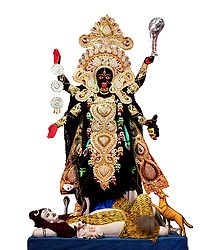
Kali is one of the most well known and worshipped Hindu Goddesses. The name Kali is derived from the Hindu word that means "time", and that also means "black". Kali in Hinduism, is a manifestation of the Divine Mother, which represents the female principle. Frequently, those not comprehending her many roles in life call Kali the goddess of destruction. She destroys only to recreate, and what she destroys is sin, ignorance and decay. She is equated with the eternal night, is the transcendent power of time, and is the consort of the god Shiva. It is believed that its Shiva who destroys the world, and Kali is the power or energy with which Shiva acts. Therefore, Kali is Shiva's shakti, without which Shiva could not act. Kali receives her name because she devours kala (Time) and then resumes her own dark formlessness. This transformative effect can be metaphorically illustrated in the West as a black hole in space. Kali as such is pure and primary reality (the "enfolded order" in modern physics); formless void yet full of potential.
The Matsyapurana states that Kali began as a tribal Goddess of the high mountain region of Mount Kalanjara, which is in north-central India and east of the Indus Valley. However, because of the relatively recent origin of the Matsyapurana we cannot be certain when or where the worship of Kali actually began. We do know however, that she was mentioned in the Upanishads, which were written a thousand years before the Matsyapurana. In the Vedas the name is associated with fire god Agni, the god of fire, who had seven flickering tongues of flame, of which Kali was the black, horrible tongue.
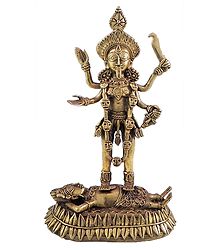
Kali is usually depicted as naked, blood-thirsty, and wild-haired. Records of Kali's worship date back less than 2,000 years and it is widely assumed by scholars that she represents a survival of a Dravidian (pre-Aryan) goddess and is thought of as the great creatrix of the ancient Indian pantheon as she is well over 2000 years old. Kali is thought to be a pre-Aryan goddess, belonging to the civilization of the Indus Valley, because there is no evidence that Aryan people ever raised a female deity to the rank that she held in the Indus and currently maintains in Hinduism. Her dark skin evidences the fact that she predated the lighter-skinned Aryan invasion of the darker-skinned inhabitants of the Indian sub-continent. This conflict became the subject of many myths handed down about Kali's fierce passion in defending her people against the invaders. Kali's passion and fierceness are due both to her ties to the pre-Aryan Great Mother Goddess, as well as her place at Shiva's side as his consort, which gives her the power of the Shakti, or female energy. However the Aryan Invasion Theory of India's origins is currently in dispute amongst historians.
The Aryan invaders introduced into India's culture the patriarchal gods that they had brought with them, but various matriarchal tribes, such as the Shabara of Orissa , continues worshipping Kali. She was probably an aboriginal deity of vegetation and agriculture; but evidence that animal and human sacrifices were offered to her suggests that Kali became a fertility deity. Animal sacrifices are still made to her, notably in temples such as the one at Kalighat in Calcutta, where a goat is immolated in her honor every day. On her feast in the fall, goats and buffalos are the usual victims, along with certain types of vegetation. Although human sacrifices have been banned, there are occasional reports of alleged sacrifices to authorities from remote areas.
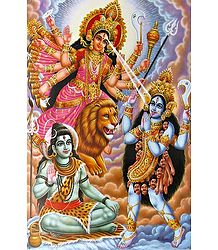
Kali was first manifested when the Goddess Parvati knitted her brows in fury when the demon, Daruka, threatened the Gods. It was then that the three-eyed Kali first sprang forth from Parvati, fully armed, and immediately putting an end to Daruka. It is for this reason that Kali is considered an aspect of Parvati.
Other stories tell of how Kali fought and killed two demons. It was then, celebrating Her victory, that She drained the blood from their bodies and, drunk from the slaughter, She began to dance. Kali became overjoyed with the feel of their dead flesh under Her feet, and She continued to keep dancing, more and more wildly, until She finally realized that Her husband, Shiva, was underneath Her, and that She was dancing him to death.
Realizing this, Kali's wildness did slow down, but only for a short while; it is believed that She will eventually continue Her dance and that when she does, it will bring an end to the world. Yet, her followers still believe that once faced and understood, Kali has the ability to free Her worshippers from all their fears. Once this occurs, then Kali metamorphasizes into another aspect, that of a loving and comforting Mother.
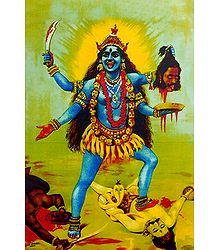
There is yet another version of Kali's manifestation. The Gods were not able to kill the demon, Raktabija. Each drop of his blood that touched the ground turned into another Raktabija. Thus, every time he was struck, millions of his duplicates appeared all over the battlefield.
At this point the Gods were totally desperate, and they then turned to Shiva for help. Shiva, though, was so deep in meditation that he could not be reached. The Gods then turned to Shiva's consort Parvati for help. The Goddess Parvati immediately set out to do battle with the demon, and it was then that She took the form of Kali.
Kali then appeared, with Her red eyes, dark complexion, gaunt features, hair unbound, and Her teeth as sharp as fangs. She rode into the midst of the battle on a lion, and it was only then that the demon Raktabija first began to experience fear.
Kali then ordered the Gods to attack Raktabija, while She spread Her tongue over the battlefield, covering it completely, and preventing even one drop of the demon's blood from falling. In doing this, Kali prevented Raktabija from reproducing himself again, and the Gods were then victorious.
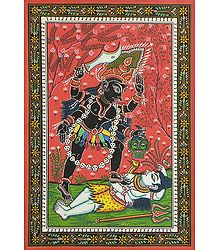
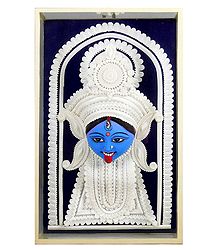
Kali is the ferocious aspect of Devi Durga perfectly personified. According to the Purana, this image of Durga as Kali, so widely worshipped in eastern parts of India, owes its origin to the battle of Durga with Shumbha and Nishumbha. She after her victory over these demons was so overjoyed that she started the dance of death. In her great ecstasy Kali continued the destruction. As the prayers of all gods could not calm her, Lord Shiva had to intervene. Seeing no other way of dissuading her, the God threw himself amongst the bodies of slain demons. When Kali saw that she was dancing over the body of her husband, she put her tongue out of her mouth in sorrow and surprise. She remained stunned in this posture and this is how Kali is shown in images with the red tongue protruding from her mouth.
The manifestation of the goddess as Kali is the most shocking appearance. She is depicted standing on the prostrate body of Shiva, who is lying on a lotus bed. She has absorbed the inexorability of Rudra and Shiva as Bhairava. Yet there is both life and death in this form of the Divine Mother.
The name Kali comes from the word "kala," or time. She is the power of time which devours all. She has a power that destroys and should be depicted in awe-inspiring terror. Kali is found in the cremation ground amid dead bodies. She is standing in a challenging posture on the prostrate body of her husband Shiva. Kali cannot exist without him, and Shiva can't reveal himself without her. She is the manifestation of Shiva's power and energy. While Shiva's complexion is pure white, Kali is the color of the darkest night-a deep bluish black. As the limitless Void, Kali has swallowed up everything without a trace. Hence, she is black.
Kali's luxuriant hair is disheveled and, thereby, symbolizes Kali's boundless freedom. Another interpretation says that each hair is a jiva (individual soul), and all souls have their roots in Kali. Kali has three eyes; the third one stands for wisdom. Kali's tongue is protruding, a gesture of coyness-because she unwittingly stepped on the body of her husband Shiva. A more philosophical interpretation of Kali's tongue is that it symbolizes Rajas (the color red, activity) and that it is held by her teeth, symbolizing sattva (the color white, spirituality).
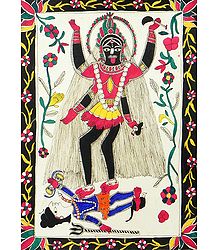
Kali has four arms. The posture of her right arms promises fearlessness and boons while her left arms hold a bloody sword and a freshly severed human head. Looking at Kali's right, we see good, and looking at her left, we see bad. Kali is portrayed as naked except for a girdle of human arms cut off at the elbow and a garland of fifty skulls. The arms represent the capacity for work, and Kali wears all work (action), potential work, and the results thereof around her waist. The fifty skulls represent the fifty letters of the Hindu alphabet, the manifest state of sound from which all creation evolved.
Kali's nudity has a similar meaning. In many instances she is described as garbed in space or sky clad. In her absolute, primordial nakedness she is free from all covering of illusion. She is Nature (Prakriti in Sanskrit), stripped of 'clothes'. It symbolizes that she is completely beyond name and form, completely beyond the effects of maya (illusion). Her nudity is said to represent totally illumined consciousness, unaffected by maya. Kali is the bright fire of truth, which cannot be hidden by the clothes of ignorance. Such truth simply burns them away.
Despite Kali's origins in battle, she evolved to a full-fledged symbol of Mother Nature in her creative, nurturing and devouring aspects. Some groups of people, unfamiliar with the precepts of Hinduism, see Kali as a satanic demon probably because of tales of her being worshipped by dacoits and other such people indulging evil acts.
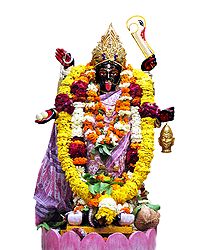
The Goddess Kali is represented as black in color. Black in the ancient Hindu language of Sanskrit is kaala. The feminine form is kali. So she is Kali, the black one. Black is a symbol of The Infinite and the seed stage of all colors. The Goddess Kali remains in a state of inconceivable darkness that transcends words and mind. Within her blackness is the dazzling brilliance of illumination. Kali's blackness symbolizes her all-embracing, comprehensive nature, because black is the color in which all the colors merge; black absorbs and dissolves them.
"Just as all colours disappear in black, so all names and forms disappear in her"
-- Mahanirvana Tantra
On the other hand, black is said to represent the total absence of color, again signifying the nature of Kali as ultimate reality. This in Sanskrit, the color black is named as nirguna (beyond all quality and form). Either way, kali's black colour symbolizes her transcendence of all form.
"Is Kali, my Divine Mother, of a black
complexion?
She appears black because She is viewed from a distance
But when intimately known She is no longer so
The sky appears blue at a distance, but look at it close by
And you will find that it has no colour
The water of the ocean looks blue at a distance
But when you go near and take it on your hand, you find that it is colourless".
-- Ramakrishna Paramhansa (1836-86)
Kali is a great and powerful black earth Mother Goddess capable of terrible destruction and represents the most powerful form of the female forces in the Universe. Worship of the Goddess Kali is largely an attempt to appease her and avert her wrath. The Goddess Kali constantly drinks blood. She has an insatiable thirst for blood. As mistress of blood, she presides over the mysteries of both life and death. Kali intends her bloody deeds for the protection of the good. She may get carried away by her gruesome acts but she is not evil. Kali's destructive energies on the highest level are seen as a vehicle of salvation and ultimate transformation.
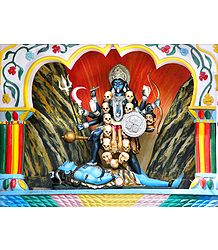
Kali is the central deity of Time. She created the world and destroys it. She is beyond time and space. After the destruction of the Universe, at the end of the great cycle, she collects the seeds of the next creation. She destroys the finite to reveal the Infinite. This Black Goddess is death, but to the wise she is also the death of death. This can only be revealed through the worship of Kali, and meditation on her mysteries.
To her worshippers in both Hinduism and Tantra she represents a multi-faceted Great Goddess responsible for all of life from conception to death. Her worship, therefore, consists of fertility festivals as well as sacrifices (animal and human); and her initiations expand one's consciousness by many means, including fear, ritual sexuality and intoxication with a variety of drugs.
Her three forms are manifested in many ways: in the three divisions of the year, the three phases of the moon, the three sections of the cosmos (heaven, earth, and the underworld), the three stages of life, the three trimesters of pregnancy, and so on. Women represent her spirit in mortal flesh.
"The Divine Mother first appears in and as her worshipper's earthly mother, then as his wife; thirdly as Kalika, she reveals herself in old age, disease and death."
Three kinds of priestesses tend her shrines: Yoginis or Shaktis, the "Maidens"; Matri, the "Mothers"; and Dakinis, the "Skywalkers". These priestesses attend the dying, govern funerary rites and act as angels of death. All have their counterparts in the spirit world. To this day, Tantric Buddhism relates the three mortal forms of woman to the divine female trinity called Three Most Precious Ones.
Kali's three forms appear in the sacred colors known as "Gunas": white for the Virgin, red for the Mother, black for the Crone, the three together symbolizing birth, life, death. Black is Kali's fundamental color as the Destroyer, for it means the formless condition she assumes between creations, when all the elements are dissolved in her primordial substance.
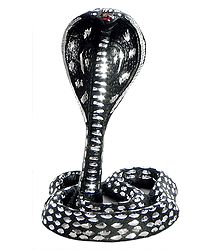
As Kundalini the Female Serpent, she resembles the archaic Egyptian serpent-mother said to have created the world. It was said of Kundalini that at the beginning of the universe, she starts to uncoil in "a spiral line movement, which is the movement of creation." This spiral line was vitally important in late Paleolithic and Neolithic religious symbolism, representing death and rebirth as movement into the disappearing-point of formlessness, and out of it again, to a new world of form. Spirals therefore appeared on tombs, as one of the world's first mystical symbols.
Kali is considered to be the most fully realized of all the Dark Goddesses, but even though Kali was originally worshipped as a warrior goddess, and her followers gave her offerings of blood and flesh, her followers still found her greatest strength to be that of a protector.
Kali is not always thought of as a Dark Goddess; rather, she is also referred to as a great and loving primordial Mother Goddess in the Hindu tantric tradition. In this aspect, as Mother Goddess, she is referred to as Kali Ma, meaning Kali Mother, and millions of Hindus revere her as such.
Kali is also associated with intense sexuality. Myths tell of the Yoni (vagina) of Kali (when she existed as Sati - wife of Lord Shiva) falling down to the Earth on the sacred hill near Gauhati in Assam (India), the same place where the Temple of Kamakhya is now located. The temple's outer walls are highly decorated with carvings showing Kali as a Triple Goddess: squatting, and exposing her Yoni (vagina); as a mother suckling Her child; and as a warrior woman drawing back Her bow. While these carvings show Kali as a sexual being, they also show her as a protective and motherly woman, full of compassion.

Known as the "Dark Mother," the Hindu Triple Goddess of creation, protection, and destruction, now most commonly known in her Destroyer aspect, is very often depicted as squatting over her dead consort Shiva and devouring his entrails, while her yoni sexually devours his lingam. Kali is:
"The hungry earth, which devours its own children and fattens on their corpses ... It is in India that the experience of the Terrible Mother has been given its most grandiose form as Kali. But all this and it should not be forgotten an image not only of the Feminine but particularly and specifically of the Maternal. For in a profound way life and birth are always bound up with death and destruction."
-- Erich Neumann from "The Great Mother: An Analysis of the Archetype"
Kali's paramount place of worship is in the cremation ground, preferably at the dead of night, on a suitable day of the waning Moon. Here, her nature becomes clear and apparent. For an adept in the worship, the whole world is a cremation ground, and She, the true form of time, who by herself creates and destroys all, is personified as the pyre. There, after life, all mortals and their wishes, dreams and reflections come to their fruition, a pile of worthless ashes.
Kali's dwelling place, the cremation ground denotes a place where the pancha mahabhuta (five elements) are dissolved. Kali dwells where this dissolution takes place. In terms of devotion and worship, this denotes the dissolving of attachments, anger, lust and other binding emotions, feelings and ideas. The heart of devotee is where this burning takes place, and it is in the heart that Kali dwells. The devotee makes her image in his heart and under her influence burns away all limitations and ignorance in the cremation fires. This inner cremation fire in the heart is the gyanagni (fire of knowledge), which kali bestows.
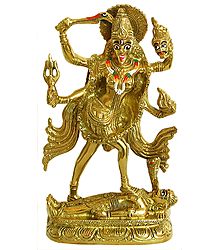
Kali is the universal mother. It is believed that she goes into the darkness with us, and for us, to swallow our sins, worries and concerns. She can show us how to radically transform our lives by embracing our own darkness, rather than fearing and fleeing from that which haunts us. She can spiritually hack away at the handcuffs that keep us shackled to the hungry ghosts of the past. There comes a point in the process when you must surrender fully to her healing powers, and let her bring you back cleansed, transformed, whole.
Kali is the powerful Hindu Goddess who is in charge of darkness, death and regeneration. Many people fear her because she is so awesome looking, but Hindus love and adore her as their great goddess and they see her as a manifestation of power that is fierce and potent. She is shakti (female energy) incarnate and the manifestation of primordial power. While she is the consort of the great Lord Shiva, she is also seen dancing wildly, with his form beneath her feet. They are partners in darkness, and in dancing the dance of death and regeneration. She brings life and death. She is regeneration and rebirth. In many ways she is the consummate representation of the classic power of the Divine Female - the power to give birth, to bring death to the old and to regenerate. Her haunts are the cremation grounds, where she takes life, and then recycles it into new life. Her symbol for cutting away at evil and darkness is to behead humans, but what that image really represents is the cutting away of the human ego and all the problems it causes. She eats pain, and swallows despair, and the secret shadows of our lives.
Kali is a goddess who acts in violent, gruesome, fearsome ways, killing as her main function, yet she is not evil. She is a representation of negative forces in the universe. Yet even then, she is a manifest form of godhead, a part of the divine whole. Kali in one aspect is still the mother of all. According to devotional literature she is revered as a terrible fearsome goddess, but also as one who must be accepted and loved. Kali represents in a way the kinks in the Hindu system of dharma. A system that is based upon structure and purity, that ritualizes and prepares for the occurrences of death and other disorder. Yet there are things that are unexpected, impure and chaotic. Kali is the representation of what is outside the order.
The Hindu goddess Kali deals with the horrible aspects of life that most people will not think about. Embodying horror, rage, unkempt fury and chaos, Kali is worshiped as a goddess and not mistaken for a demon. Chaos must exist in compliment to order in the creation and maintenance of balance in the universe. The dark side of the divine exists in contrast to the bright and the beautiful. In Hinduism, the polarity of good and evil are blurred. The demons may perform austerities to be granted boons, just as the gods may go awry and threaten the stability of the cosmos. No female deity embodies the duality of light and dark in a complimentary existence as well as Kali.
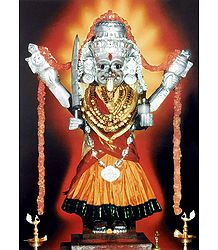
Kali is the full picture of the Universal Power. She is Mother, the Benign; and Mother, the Terrible. She creates and nourishes and she skills and destroys. By Her magic we see good and bad, but in reality there is neither. The whole world and all we see is the play of Maya, the veiling power of the Divine Mother. God is neither good nor bad, nor both. God is beyond the pair of opposites that constitute this relative existence.
The Tantras mention over thirty forms of Kali. Sri Ramakrishna often spoke about the different forms of Kali. The Divine Mother is known as Kali-Ma, Maha Kali, Nitya Kali, Shamshana Kali, Raksha Kali, Shyama Kali, Kalikamata, and Kalaratri. Among the Tamils she is known as Kottavei. Maha Kali and Nitya Kali are mentioned in the Tantra Philosophy.
When there were neither the creation, nor the sun, the moon, the planets, and the earth, when the darkness was enveloped in darkness, then the Mother, the Formless One, Maha Kali, the Power, was one with the Maha Kala, the Absolute. As Mahakali she is the timeless, immortal, formless power indistinguishable from the transcendent one or Absolute Power.
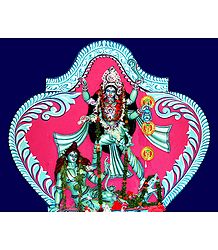
Shyama Kali has a somewhat tender aspect and is worshipped in Hindu households. She is the dispenser of boons and the dispeller of fear. People worship Raksha Kali, the Protectress, in times of epidemic, famine, earthquake, drought, and flood. Shamshan Kali is the embodiment of the power of destruction. She resides in the cremation ground, surrounded by corpses, jackals and terrible female spirits. From her mouth flows a stream of blood, from her neck hangs a garland of human heads, and around her waist is a girdle made of human arms.
Tantrics worship Siddha Kali to attain perfection. Phalaharini Kali to destroy the results of their actions; Nitya Kali, the eternal Kali, to take away their disease, grief, and suffering and to give them perfection and illumination.
Robbers and thieves have their own kali. Not so many years ago, robbers lived in Indian woods and had the habit of worshipping Dakait Kali before they want to rob people on highways and in villages. Some of these old Kali images have survived time and are still being worshipped, though for reasons other than originally intended.
In Kolkata she is worshipped as Bhavtarini, the redeemer of all creation, the most beautiful one. The beauty of the Dakshineswar Kali Temple in Kolkata is far removed from the dreary sight of an active cremation ground. And, although the Goddess in this temple is the same Ma Kali as the feared one in the cremation ground, she is regarded as benign-a protrectress rather than a destroyer.
While someone unfamiliar with the Shakti worship may perceive Kali's images as equally terrible without making the slightest distinction between them, the Hindu distinguishes a benign Kali (dakshina) from a fearful Kali (shamshan) by the position of her feet. If Kali steps out with her right foot and holds the sword in her left hand, she is a Dakshina Kali. If she steps out with her left foot and holds the sword in her right hand, she is the terrible of the Mother, the Shamshan Kali of the cremation ground.
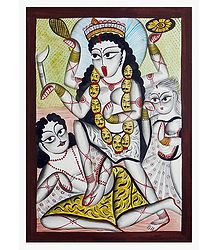
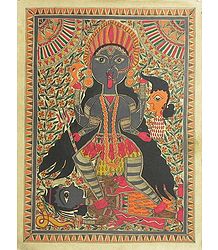
Of the many other aspects of Kali, the two best known are Mahakali and Bhairavi.
In the aspect of Bhairavi, Kali is the counterpart to Shiva, taking pleasure in destruction, and the ultimate dissolution of the universe.
Kali is also thought to be an aspect of the Devi or Mahadevi or Mahakali, who was the most powerful and complex of all the great Goddesses. When She is in the aspect of Mahakali, Kali uses Her very appearance to terrify the various entities, demons, and devils who represent the sinister forces.
It is in this aspect, as Mahadevi, that Kali is depicted with black skin and a hideous tusked face and claws; Her forehead bearing a third eye like Shiva's. Here, Kali is shown with four arms, the upper two holding a bloody sword and severed head, while Her two lower hands are held out in welcome, as She grants favors to Her devout followers.
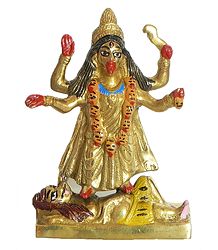
Western scholars erroneously viewed the various manifestations and incarnations of Kali as many different Goddesses, particularly isolating those primitve mother-goddesses ("matrikadevis") grouped together as "Dravidian she-ogres." Yet Kali's worshippers plainly stated that she had hundreds of different names, but they were all the same Goddess.
Some of Kali's older names found their way into the Bible. As Tara, the earth, she became Terah, mother of the Hebrew ancestral spirits called "teraphim". The same Tara became the Celts' Tara, Gauls' Turan, and the Latin Terra, meaning "Mother Earth," said to be interchangeable with Venus.
The name of Eve, may have originated with Kali's Ieva or Jiva, the primordial female principle of manifestation; she gave birth to her "first manifested form" and called him Idam (Adam). She also bore the same title given to Eve in the Old Testament: Mother of All Living (Jaganmata).
Variations of Kali's basic name occurred throughout the ancient world. The Greeks had a word Kalli, meaning "beautiful," but applied the name to things that were not particularly beautiful such as the demonic centaurs called kallikantzari, relatives of Kali's Asvins. Their city of Kallipolis, the modern-day Gallipoli, was centered in Amazon country formerly ruled by Artemis Kalliste. The annual birth festival at Eleusis was Kalligeneia, translateable as "coming forth from the Beautiful One," or "coming forth from Kali." The temple of the Great Mother of the Gods at Pergamum stood on Mount Mamurt-Kaleh, easily transposed into Mount Mother-Kali.
Lunar priests of Sinai, formerly priestesses of the Moon-goddess, called themselves kalu. Similar priestesses of prehistoric Ireland were kelles, origin of the name Kelly, which meant a hierophantic clan devoted to "the Goddess Kele". This was cognate with the Saxon Kale, or Gale, whose lunar calendar or kalends included the spring month of Sproutkale, when Mother Earth (Kale) put forth new shoots. In antiquity the Phoenicians referred to the strait of Gibraltar as Calpe, because it was considered the passage to the western paradise of the Mother.
The Black Goddess was known in Finland as Kalma (Kali Ma), a haunter of tombs and an eater of the dead. European "witches" worshipped her in the same funereal places, for the same reasons, that Tantric yogis and dakinis worshipped her in cremation grounds, as Smashana-Kali, Lady of the Dead." Their ceremonies were held in the places of ghosts where ordinary folk feared to go. So were the ceremonies of western "witches" - that is, pagans. They adored the Black Mother Earth in cemeteries, where Roman tombstones invoked her with the phrase Mater genuit, Mater recepit - "the Mother bore me, the Mother took me back". Kurukulla is a fierce Nepalese and Tibetan goddess much like Kali.
Kali's title Devi (Goddess) was similarly widespread in Indo-European languages. She was the Latin diva (Goddess) and Minoan diwi or Diwija, the Goddess associated with Zeus at Knossos. Dia, Dea, and Diana were alternate forms of the same title.
Though called "the One," Kali was always a trinity: the same Virgin-Mother-Crone triad established perhaps nine or ten millenia ago, giving the Celts their triple Morrigan; the Greeks their triple Moerae and all other manifestations of the Threefold Goddess; the Norsemen their triple Norns; the Romans their triple Fates and triadic Uni (Juno); the Egyptians their triple Mut; the Arabs their triple Moon-goddess - she was the same everywhere. Even Christians modeled their threefold God on her archetypal trinity.
Indo-European languages branched from the root of Sanskrit, said to be Kali's invention. She created the magic letters of the Sanskrit alphabet and inscribed them on the rosary of skulls around her neck.
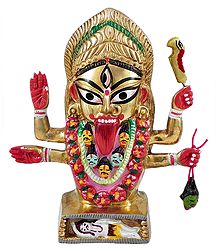
Although Kali is worshipped throughout India and Nepal, and even in Indonesia, she is most popular in the state West Bengal in India, where one also finds Kalighat, her most famous temple just outside Kolkata (capital of West Bengal). Considering that Calcutta is simply an Anglicized form of kaligata, the city received its very name from the goddess.
Each district, town and village in Bengal seems to have its very own Kali famous for a particular miracle or incident. The Hindus of Bengal have always taken a fancy towards the Goddess Kali and have worshipped her both as a mother and as a daughter. The concept of Kali as being both mother and daughter is enhanced by the various hymns composed by the great Begali devotees, Sri Ramakrishna Paramhansa and Ramaprasad.
Kali is "the divine Shakti representing both the creative and destructive aspects of nature", and as such she is a goddess who both gives life and brings death. Clothed only with the veil of space, her blue-black nakedness symbolizes the eternal night of non-existence, a night that is free of any illusion and distinction. Kali as such is pure and primary reality, the enfolded order, formless void yet full of potential.
Kali represents the entire physical plane. She is the drama, tragedy, humor, and sorrow of life. She is the brother, father, sister, mother, lover, and friend. She is the fiend, monster, beast, and brute. She is the sun and the ocean. She is the grass and the dew. She is our sense of accomplishment and our sense of doing worthwhile. Our thrill of discovery is a pendant on her bracelet. Our gratification is a spot of color on her cheek. Our sense of importance is the bell on her ankle. The full and seductive, terrible and wonderful earth mother always has something to offer.
One shouldn't jump to the conclusion that Kali represents only the destructive aspect of God's power. What exists when time is transcended, the eternal night of limitless peace and joy, is also called Kali (Maharatri). And it is she who prods Shiva Mahadeva into the next cycle of creation. In short, she is the power of God in all His aspects. A very apt and poetic description of the Great Mother Kali has been given by Pirsig, who wrote, "Kali, the Divine Mother, is the symbol for the infinite diversity of experience."
Knowest not, Mind, to farm? In the untilled
field
Would golden harvest wave, so thou hadst sown.
Make of her name a fence, that so the yield
Be not destroyed. Not Death himself, O Mind,
Dare come nigh Kali of the tresses free.
When forfeiture will come is all unknown -
To-day, or after many a century.
Lo, to thy hand the present time, O Mind
Haste thou, and harvest. What they gave to thee,
The seed thy teachers gave, scatter it now;
With water of love it sprinkle. If alone,
O Mind, thou canst not this accomplish, thou
Alone, take Ramprasad to be with thee.
-- Ramprasad
This article was written by:
Madhuri Guin