Please wait...

O Mother!
Thee, who is present everywhere,
thee who is the embodiment of power and Energy!
I Bow to Thee! I Bow to Thee! I Bow to Thee!
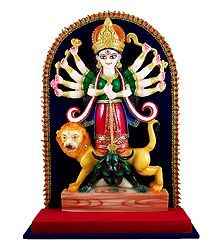
Durga - the goddess of power and strength, is perhaps the most important goddess of the Hindus. She is a multi-dimensional Goddess, with many names, many personas, and many facets. As Mahishasuramardini or Shakti, she is the destroyer of evil - with her ten mighty arms carrying lethal weapons she triumphantly slays the demon Mahishasura. As Sati, beloved daughter of King Daksha and Queen Menaka she gives up a kingdom and earns her father's wrath. As Kali, she turns black as the night and omnipotent, terrible in rage and fury, with just a string of skulls as her garland and her only garb. As Parvati, she is serene, the pretty consort of Lord Shiva by his side in the snowy peaks of the Kailash mountain. She is Bhawani, symbol of life. She is Sati, the object of death. She is Basanti, the heralder of springtime. She is also Amba, Jagadhatri, Tara, Ambika, Annapurna.
Durga, through all her forms, encompasses the essence of salvation and sacrifice. She is the mother of bounty and wealth, as also of beauty and knowledge, for her daughters are Lakshmi and Saraswati (Hindu goddesses of wealth and knowledge, respectively).
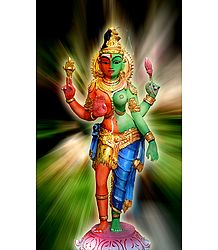
She is the embodiement of purity, knowledge, truth and self-realization. The highest form of truth present in any being or Jiva is known as "Aatman" or supreme consciousness. This supreme consciousness or the absolute soul is infinite, birthless, deathless, beyond time and space, and beyond the law of causation. Goddess Durga is the inherent dynamic energy through which this supreme consciousness manifests itself.
Goddess Durga represents the power of the Supreme Being that preserves moral order and righteousness in the universe. She is the energy aspect of the Lord. Without Durga, Lord Shiva has no expression and without Shiva, Durga has no existence. Lord Shiva is only the silent witness. He is motionless, absolutely changeless. He is not affected by the cosmic play. Shiva has no direct connection with the tangible elements in the universe and is obliged to emanate a manifestation, an emission of energy, shakti, through the goddess. It is Durga who is the doer of all actions. Shiva and Durga are regarded as the twofold personalization of Brahman, the primeval substance.
The Sanskrit word Durga means a fort, or a place that is protected and thus difficult to reach. Durga, also called Divine Mother, protects mankind from evil and misery by destroying evil forces such as selfishness, jealousy, prejudice, hatred, anger, and ego.
The projection of the stronger and fiercer side of womanhood is but obvious in the tales surrounding goddess Durga. According to certain mythological tales, Durga is thought to be the skin of Parvati, which slips off and fights the demon brothers - Shumbha and Nishumbha. Sometimes Durga is supposed to have created helpers to fight for her, Kali being the most famous. In other versions she is supposed to have created the Saptamatrikas, the Seven Mothers, who were originally Yaksha gods.
The absence of any male influence as well as of any male assistance, in Durga's fierce battles with male demons, is worth noting. The most interesting facet of the tales of her origin is not that she is presented as Shakti - the divine power - but rather, that she assumes the powers of the male gods to save the universe.
Hindu mythology tells an interesting tale of the fierce battle of Durga with Mahishasura, a demon who earned the favour of Lord Shiva after long and hard penance. Lord Shiva, pleased with the devotion of the demon, blessed him with a boon that no man or deity would be able to kill him. Empowered with the boon, Mahishasura started his reign of terror over the Universe and people were killed mercilessly. He even attacked the abode of the gods. The war between gods and demons lasted a hundred years, in which Mahishasura was the leader of the Asuras or demons and Indra was the chief of the gods. In this contest the army of the gods was defeated by the more powerful demons. When Mahishasura conquered the gods, he became their leader.
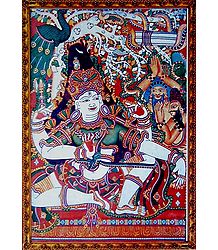
The gods, utterly defeated, took refuge under Lord Brahma, who took them to Lord Shiva and Lord Vishnu. Having heard of the misdeeds of the demons, pure energy blazed forth from Brahma, Vishnu and Shiva - the trinity forming the pure energy of Godhood. As the gods witnessed this fiery crest of energy pervading all the directions and blazing forth like a mountain peak aflame with the sun, this matchless energy that sprang from the bodies of all the gods, its light illuminating the three worlds, became concentrated in one spot and took form of the Goddess. Her face was from the light of Shiva. Her ten arms were from Lord Vishnu. Her feet were from Lord Brahma. The tresses were formed from the light of Yama (god of death) and the two breasts were formed from the light of Somanath (Moon God), the waist from the light of Indra (the king of gods), the legs and thighs from the light of Varun (god of oceans), and hips from the light of Bhoodev (Earth), the toes from the light of Surya (Sun God), fingers of the hand from the light of the Vasus (the children of Goddess river Ganga) and nose from the light of Kuber (the keeper of wealth for the Gods). The teeth were formed from the light of Prajapati (the lord of creatures), the Triad of her eyes was born from the light of Agni (Fire God), the eyebrows from the two Sandhyas (sunrise and sunset), the ears from the light of Vayu (god of Wind). Thus from the energy of these gods, as well as from many other gods, was formed the goddess Durga.
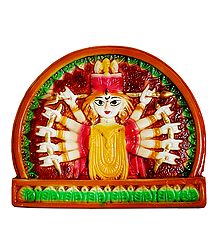
The gods then gifted the goddess with their weapons and other divine objects to help her in her battle with the demon, Mahishasura. Lord Shiva gave her a trident while Lord Vishnu gave her a disc. Varuna, gave her a conch and noose, and Agni gave her a spear. From Vayu, she received arrows. Indra, gave her a thunderbolt, and the gift of his white-skinned elephant Airavata was a bell. From Yama, she received a sword and shield and from Vishwakarma (god of Architecture), an axe and armor. The god of mountains, Himavat gifted her with jewels and a lion to ride on. Durga was also given many other precious and magical gifts, new clothing, and a garland of immortal lotuses for her head and breasts.
The beautiful Durga, bedecked in jewels and golden armor and equipped with the fearsome weaponry of the gods, was ready to engage in battle with the fierce and cruel Mahishasura. Her lion's thunderous roars shook the three worlds. Oceans boiled and surf poured overland. Continents were torn at their granite foundations as whole new chains of mountains rose, while older ranges crumbled, cracked, and gave way to dust in a thousand landslides. Mahishasura and his demon allies found their attention drawn from heaven to Earth, as Durga's power moved its way towards heaven. Though confident of their power and control in heaven, the demons could not help being awestruck.
As Mahishasura's armies were struck down effortlessly by Durga, it became obvious to him that he was not as secure in heaven as he had thought. No demon could fight her and win. Her breath would replenish her armies - bringing back to life all of her soldiers who fell. From Airavata's gift, the bell, came a confusing clamor. The demons were in chaos and were easily defeated and captured. The ground was left littered with the broken limbs and body parts of the defeated demon army.
Mahishasura was shocked and enraged by the disastrous events on the battlefield. He took on the form of a demonic buffalo, and charged at the divine soldiers of Durga, goring and killing many and lashing out with his whip-like tail. Durga's lion pounced on the demon-buffalo and engaged him in a battle. While he was thus engaged, Durga threw her noose around his neck.
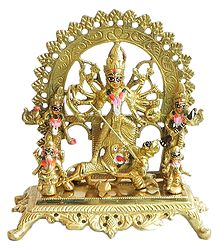
Mahishasura then assumed the form of a lion and when Durga beheaded the lion, Mahishasura escaped in the form of a man who was immediately face to face with a volley of arrows from Durga. The demon escaped yet again and then having assumed the form of a huge elephant, battered Durga's lion with a tusk. With her sword Durga hacked the tusk into pieces.
The demon reverted once more to the form of the wild buffalo. He hid himself in the mountains from where he hurled boulders at Durga with his horns. Durga drank the divine nectar, the gift of Kuber. She then pounced on Mahishasura, pushing him to the ground with her left leg. She grasped his head in one hand, pierced him with her sharp trident held in another, and with yet another of her ten hands she wielded her bright sword, beheading him. At last he fell dead, and the scattered surviving remnants of his once invincible army fled in terror.
The Gods bowed to the goddess and showered their praises on the goddess following her victory:
"Mother, you have created this universe. You are the strength of all. Devatas (Gods), Rishis (sages), Yakshas (demi-gods), Kinnaras (heavenly musicians with human bodies and heads of horses) all bow to you. Even Brahma, Vishnu and Maheshwar (Lord Shiva) do not know you fully. For the Dharmik (righteous) you are Lakshmi (Goddess of wealth), for the adharmiks (evil) you are Alakshmi (she who brings misfortune). You are buddhi (knowledge), you are lajja (modesty), you are shraddha (respect). You were there always and will be there forever. You are the adhar (source) for all, You are Prakriti (nature). You save the earth by killing the numerous asuras (demons)."
The tale of Durga continues beyond Mahishasura, through the tale of goddess Kaushiki, another form of goddess Durga. After Mahishasura, two more demon brothers, Shumbha and Nishumbha forcibly drove the gods out of heaven. The gods then started praying to Mahamaya - the mother Goddess - to help them. At that moment, Goddess Parvati - wife of Lord Shiva - was going to take a bath in the river. After Parvati heard their tale of woe, a beautiful woman emerged from Parvati's body. She was named Kaushiki. Upon the emergence of Kaushiki, Parvati's body turned black and she then became known as Kalika.
Kaushiki was spotted by Chanda and Munda, the two trusted assistants of Shumbha and Nishumbha. They reported to their masters, that they had spotted a beautiful woman. Shumbha then sent a messenger to Kaushiki. The messenger, Sugriva, went to Kaushiki and informed her of the desire of their masters, Shumbha and Nishumbha, who were also the rulers of the heavens, that Kaushiki marry either of the two demon brothers. Kaushiki, feigning innocence replied that she was very foolish and that she had pledged that she would marry only that person who would defeat her in warfare. She asked Sugriva to convey to his masters that whoever could defeat her in battle could win her. On hearing this, Shumbha sent Dhumralochana to capture the goddess. Initially the asura (demon) tried to persuade the Devi to accompany him, but when she refused, he rushed to capture her. The goddess uttered a mantra and the asura was reduced to ashes. On hearing this, Shumbha sent Chanda and Munda to capture the Devi. On seeing Chanda and Munda coming, Kaushiki wriggled her eyebrows. From the eyebrows emerged a ferocious looking goddess with a sword and a noose in her hands. She wore a tiger skin around her body. Her big eyes were red and from her tongue saliva dribbled. She was goddess Kali. Kali jumped among the asuras (demons) and started killing them. She killed Chanda and Munda and dragged their bodies to Kaushiki. This gave Kali the name of Chamunda.
The asuras, after the death of Chanda and Munda, attacked the goddesses Kaushiki and Kali from all sides. At that moment, from the bodies of the various gods, women forces began emerging. These goddesses started fighting along with Kaushiki. Kali then approached Shiva and requested Lord Shiva to ask Shumbha and Nishumbha to surrender. This act of Kali requesting Lord Shiva to be her messenger earned her the name Shivaduti - (she whose messenger is Shiva). Hearing Shiva's message, the asuras became even more ferocious. Among the asuras there was one named Raktabija. If a drop of his blood, dropped on the ground, another asura would spring forth from that drop of blood. Unknowingly, the goddesses attacked Raktabeeja and from his flowing blood numerous Raktabeejas emerged. Following this, Kali swallowed up Raktabeeja and the asuras which emerged from his blood.
Upon Raktabeeja's death, Nishumbha was killed by Kaushiki after he attacked her. After Shumbha too was defeated, he asked if so many goddesses fighting against a solitary demon was fair. In response, all the goddesses merged into Kaushiki and thereafter she killed the evil Nishumbha.
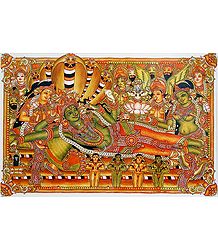
Durga is also equated with Mahamaya - the supreme creator of illusions and attachment - the one whose spell even the gods cannot elude. There is an interesting tale related to Mahamaya. Before the creation of the universe, water pervaded all space. In that water, Lord Vishnu rested in Yoga Nidra (deep slumber), which was a result of a divine spell cast by Mahamaya on Lord Vishnu. From the navel of Lord Vishnu appeared Lord Brahma, the creator, seated on a lotus. From the wax in Lord Vishnu's ear were formed two demons, Madhu and Kaitabha. Madhu and Kaitabha were supposed to be companions of Brahma but being demons they indulged in naughty acts, which disturbed Lord Vishnu's slumber and he ordered them to limit their fun and frolic in the depths of the ocean so that his cosmic slumber wouldn't be disturbed. Though the demons went away they pledged vengeance on Lord Vishnu. They propitiated the Mahamaya and appeased her into giving them a boon of choice of their own death, which she granted them. The demons then decided to come back to where Brahma and Vishnu resided and started scaring Brahma. Seeing this Lord Vishnu decided to kill the two demons but he could do little since they were protected by Mahamaya's boon. Brahma and Vishnu then propitiated Mahamaya. Mahamaya used her powers of illusion and cast spells on the two demons, which made them grant a boon to Lord Vishnu. They granted Lord Vishnu the boon of being able to kill them, on the condition that he did so only where there be no earth or water, no air or ether, neither mind nor intelligence and not even false ego. Taking this opportunity, Lord Vishnu squashed the two demons on his thigh, which was neither of earth, water, air, ether, fire, mind, intelligence or false ego, since Lord Vishnu's was a transcendental body. Thus the Mahamaya using her skills at illusions brought the evil demons to their own end.
Durga is also equated with two other popular Indian goddesses - Sati and Parvati - both consorts of Lord Shiva, though at different points in time. Though all three are worshipped separately, they are seen to be the form of the same goddess Durga.
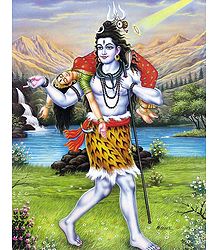
Sati was the first-born daughter of king Daksha, one of the progenitors of mankind. Sati, right from her childhood, started worshipping Lord Shiva as her would-be husband. Shiva, being pleased with the worship of Sati, came to marry her. Daksha did not like this tiger-skin clad groom with ash and dirt over all of his body. Sati however got married to Shiva against her father's wishes. King Daksha, later on, arranged for a yagna (Hindu form of penance where offerings are made to a holy pyre which represents the fire god) where everyone except Shiva was invited. Sati, despite Shiva's objections went to attend the yagna and was subsequently subjected to insulting remarks made by her father. Not being able to bear this insult, Sati immolated herself in sacrificial fire. Hearing this news Shiva flew in a rage and reached there with his blazing trident and along with his followers of demi-gods, destroyed the sacrificial altar and beheaded king Daksha. Then, lifting up Sati's body, he started his violent dance, Tandava -the dance of destruction. As the entire creation looked on with fear as the earth shook and winds roared and the oceans heaved, Lord Vishnu used his Sudarshan Chakra (divine disc) to cut off Sati's body into pieces while Shiva held on to it and kept dancing. As the last of her pieces fell from Shiva's shoulder, he was finally pacified. Shiva then restored life to Daksha using a goat's head as a replacement for Daksha's own. The spots where the pieces of Sati's body fell are now known as Shaktipeeths and are spread over 51 places in the Indian subcontinent.
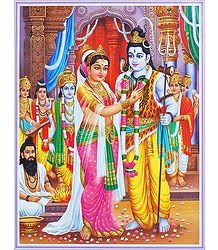
In her next life, Sati appeared as Parvati, the daughter of Himalaya. After the loss of Sati, Lord Shiva had lost interest in worldly matters and marriage did not interest him anymore. Parvati, however, being Sati reincarnate, wanted to marry Lord Shiva, and identical to Sati, Parvati too practiced severe austerities for a thousand years to appease Lord Shiva, who eventually agreed to marry Parvati. The wedding of Shiva and Parvati is described in a very colorful manner in ancient Hindu Puranic literature, describing the merry-making procession of the followers of Lord Shiva - mendicants, wanderers and the lot - following him to Parvati's home for his wedding.
There is an interesting tale about how Parvati came to be called Durga. On one occasion the sage Agastya asked Lord Kartikeya why Parvati, his mother, was called Durga. Kartikeya replied that once there was a demon, named Durga, the son of Ruru. He with his austerities pleased Lord Brahma and with his blessings, became very powerful. He conquered the three worlds and even dethroned Indra, the king of Gods. He abolished all religious ceremonies. Brahmins were terrified and stopped reading Vedas. All the gods assembled and prayed to Lord Shiva to protect them from the tyranny of this demon. Shiva took pity on them and asked goddess Parvati to go and destroy the evil demon. She calmed the Gods and agreed to slay the evil Durga. There was long and fierce battle. As soon as the demon came near with his evil followers, Parvati assumed thousand arms and also brought out a number of weapons out of her body. Just as in the legend of Durga and Mahishasura, here too, Goddess Parvati, with her trident, killed the evil Durga, who had assumed the form of a buffalo. The Gods, pleased with the goddess, honored her by naming her Goddess Durga.
Traces of origin of Durga as a deity have been found in wild regions such as the Vindhya Mountains and with old tribes such as the Sabaras and Pulindas. Probably these roots associate her with the non-Aryan habits of drinking alcohol and non-vegeterianism. Durga is first mentioned in the Mahabharata as a virgin delighting in wine, flesh, and animal sacrifice. Durga's association with agriculture, especially in her major festival, the Durga Puja, may arise from her early origins. She is thought to be the power inherent in the growth of crops and in all vegetation.
The origin of goddess Durga can be, very strangely, traced back to the Mesopotamian culture. The depictions and form of goddess Ishtar, worshipped in Mesopotamia, hold a striking resemblance to those of goddess Durga in Hindu religious texts. Mesopotamia of ancient times is an area, which is mostly covered by present day Iraq. The goddess Ishtar was worshipped by the Sumerians, Assyrians, Babylonians, and even Romans and Egyptians, since about 2000 B.C. and probably even before that, since an epic called the descent of Ishtar was already traced to an old tale of that time. Ishtar is described as an independent goddess who roamed the forests and deserts at will and was a constant seeker of battle. She was depicted as riding a lion and had multiple arms holding many weapons. She was thought to have had many lovers from all sorts of backgrounds and probably this was seen as a probable cause of her immense popularity with the common man of those days since he preferred her raw energy to pretensions and pomposity often associated with most other gods. This feeling of her transcending class division was emphasized by the wide-ranging profile of lovers from all social classes.
{{image -9}}Possibly through trade routes and ancient cross-cultural contacts, goddess Ishtar found her way into ancient Hinduism. However, the nature of promiscuity of Ishtar did not probably find favor with the ancient Hindus and hence those characteristics of hers, which alluded to promiscuity, were discarded and thus goddess Durga took form in ancient Hindu religion. Other forms of Durga have been found in other regions, cultures and religions too - with evidence of similar deities in Japanese-Buddhist art forms.

Widespread worship of goddess Durga is found in texts of the 4th and 7th centuries A.D., with the resurgence of goddess worship during those times. She is the only female deity after whom an entire Upanisad is named. At the close of the Vedic era there were apparently several goddesses acknowledged as wives of Shiva while other goddesses were worshiped by different castes throughout India. These diverse deities eventually coalesced into the one great goddess, Mahadevi, whose ultimate origin may have been the Mother Goddess of the Indus valley civilization. In the ancient Indus Valley civilization it is obvious that the worship of female deities had a very prominent place in society. The many seals and figurines found provide evidence for the apparently highly important place of female deities in the religion of the time. There is evidence of a Mother or Earth goddess cult being in existence in the period.
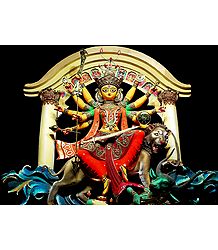
The post-Vedic period saw the rise of several goddesses hardly mentioned in the epic period (Mahabharata and Ramayana and Vedas) rising to a dominant position in worship. Durga and Kali were such goddesses and each gathered a following of devotees who held them as the supreme divinity. Durga and Kali were essentially independent but they were still often linked to powerful gods but in a drastically different role than the subservient, model partners played by the goddesses of the epics.
Durga came to be seen as the supreme deity by her devotees and in many aspects was supposed to have a similar role to the highest held male deities. She took on the role of leader of the gods in their struggle against the demons and also, as does Vishnu, comes down to earth to defeat evil. Durga was thought to be particularly pleased with blood offerings. Though associated to Lord Shiva, Durga is still essentially seen as independent.
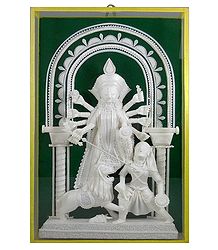
In the early Medieval period appeared the Great Goddess or Mahadevi. She was to her devotees indisputably the highest manifestation of the divine. The emergence of Mahadevi is evidence of the acceptance by a large section of the population of the highest manifestation of the divine being feminine. Portrayals of Mahadevi can be found in the Devi Mahatmya, Saundaryalahari and the Devi-bhagavata Purana. The Devi Mahatmya is perhaps the most significant, illustrating the emergence and establishment of Devi as the ultimate reality of the universe within the Sanskritized Hindu tradition. As has been mentioned earlier, goddess Durga is essentially equated with the Mahadevi.
Around the fourth century A.D., images of Durga killing a buffalo become common throughout India. After the sixth century and into the medieval period, Durga was well-known and popularly worshipped. In the classical texts, the Puranas, dating from the third to the fifteenth centuries, her mythological exploits are recounted. An entire Purana, the Devibhagavatam, is dedicated to Durga. The most important text is the section of the Markandeya Purana called the Devi Mahatmya, of possibly the seventh century, which is also known as the Durgasaptasati or Chandi Mahatmya. This text is so venerated that every verse is considered a mantra (sacred utterance) of the Goddess.
Goddess Durga is propitiated as various forms, as have been mentioned in various holy Hindu texts. Some of these sets of forms overlap partially. All of these forms however mark an independent Goddess who is intricately involved in the protection of nature and cosmic order and in destruction of evil forces who try to overturn this balance.
The Markandeya Purana places the ten forms of Durga in the following order:
Durga: The Goddess who first received and showed her beautiful face to entice the demons.
Dashabhooja: In this fierce ten-armed form of hers, she destroyed a part of the army of demons.
Singha-Vahini: In this form atop a lion, she fought with Raktabeeja, the general of Shumbha and Nishumbha whose drops of blood created thousands of demons.
Mahisha-Mardini: In this form she slew Shumbha, the demon, who had taken the form of a buffalo.
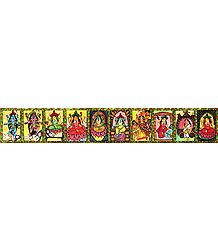
Jagadhatri: In this form she overcame the army of demons.
Kali: In this form she destroyed Raktabeeja by drinking his drops of blood and not allowing them to fall on the ground thus disallowing the further creation of demons from his blood.
Muktakeshi: In this form with flowing hair she overcame another army of demons.
Tara: In this form she killed Sambhu.
Chinnamastika: In this form she killed Nishumbha.
Jagadguree: In this form she was worshipped by all the gods on their salvation from the demons.
Goddess Durga is also intricately associated with three distinct aspects of the cosmos as seen in the Hindu thought process. Durga is said to be associated with Shakti, Maya and Prakriti.
Shakti, the Basis, is the underlying power of the divine, the aspects of the divine that permits and provokes creative activity, a creative force, personified as goddess.
Goddess as Shakti: the male gods contribute their strength and vigor to the goddess, who epitomizes power, action and strength in the battle with demons. Durga is action and power personified and as such is a fitting representation of the idea of Shakti.
Maya, the Delusion, is the power that deludes an individual into thinking oneself to be the center of the world, the power that prevents an individual from experiencing the ultimate truth. It impels individuals into self-centered, egotistical actions and thus hides the underlying unity of reality and masks one's essential identity with Brahman. Maya can be as either a positive or a negative energy.
Goddess as Maya : In the battle with Madhu and Kaitabha, she deludes the demons so that Vishnu can slay them. In the battle with Mahishasura, she enters into the battle more of leela (divine play), fighting with the demons because it pleases her, not out of sense of compulsion.
Prakriti is the physical world as well as the inherent rhythms within this world that impel nature to gratify and provide itself in its manifold species. She is both primordial matter, from which all material things come, and the living instincts and patterns, that imbue the material world with its proclivities to sustain and recreate itself in individual beings.
Goddess as Prakriti: In Devi Mahatmaya - a Hindu text on goddess Durga - it is stated that Durga is the world, and as the earth itself, she conveys cosmic stability. She is Sakambhari (she who provides the world with food from her own body). She is the foundation of all creatures and that, which nourishes all creatures. In her role as the cosmic queen, warrior goddess and demon slayer, Durga in effect protects herself in her aspect as the earth itself.
Hindu religious texts also talk about the existence of the Ten Great Feminine Cosmic Powers (Dasha Mahavidyas) which basically can be thought to be the ten fundamental aspects of the Supreme Cosmic Mother's personality. Nevertheless, each Goddess has a specific cosmic function in the universal harmony. The traditional sequence of the ten Goddesses is:
Kali : The Power of Time and The Night of Eternity
Tara : The Power of Void and The Night of Anger
Tripura Sundari : The Power of Absolute Splendor
Bhuvaneshwari : The Power of Space and The Night of Perfect Realization
Tripura Bhairavi : The Power of Death and The Night of Destiny
Chhinnamasta : The Power of Sacrifice and The Night of Courage
Dhumavati : The Power of Deprivation and The Night of Frustration
Bagalamukhi : The Power of Instantaneous Stopping
Matangi : The Power of Domination and The Night of Illusion
Kamalatmika : The Power of Perfect Happiness and The Night of Paradise
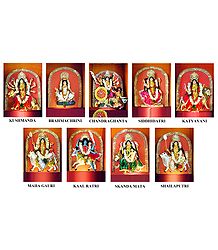
Another such classification of the mother Goddess based on the various functions in protecting the cosmos and keeping the divine cosmic cycle running is the basis of the Nava Durga or the Nine Durgas. These nine goddesses, who actually are forms of Goddess Durga are propitiated on each day of a popular Hindu festival called the Navaratri.
Shailputri: As daughter (putri) of the Himalaya mountains (Shail), Parvati or Hemvati represents the first of the nine Durgas. She is depicted as holding a trident and a lotus in each of her two hands and is shown mounted on a bull.
Brahmacharini: The name indicates the phase of Parvati's life when she was indulging in severe austerities to appease Lord Shiva into marrying her. She had pledged that she would remain unmarried (Brahmacharini) till Lord Shiva gives his consent to marrying Parvati. She is shown as holding a water pot (Kumbha) in one hand and a rosary in the other. She is considered as a holder of knowledge and wisdom. Rudrakhsa (rosary beads) form her favorite ornamentation.
Chandraghanta: As Chadraghanta, the goddess is depicted as having golden skin and with a moon-crescent near her forehead. She is shown as having three eyes and ten hands, eight of which carry weapons and two of which form gestures of giving boons and stopping harms. She is shown as sitting on a tiger. She is usually associated with the giver of knowledge, bliss and serenity.
Kushmanda: The fourth Durga is known as Kushmanda. She is depicted as emanating a cosmic aura and is depicted as having eight hands, seven of which carry weapons while the eighth carries a rosary.
Skanda Mata: Skanda Mata literally means the mother of Skanda. Skanda was the son of Lord Shiva and Parvati and was the leader of the army of gods.The goddess is shown as having four hands, two of which carry lotuses while two are in defending and granting gestures. She is shown sitting on a lion with her son Skanda in her lap.
Katyayani: Katyaynai is so named because of her stay at the hermitage of sage Katyayan for the purpose of penance. She is sometimes also said to be the daughter of sage Katyayan. She also is shown astride a lion and has three eyes and four arms. In one hand she holds a lotus and in another a weapon. The third and fourth hands show defending and granting gestures.
Kaalratri: The seventh Durga, Kaalratri, is depicted as having black skin with bountiful hair, four arms and astride a donkey. In one hand she holds a cleaver and in another a burning torch. With the other two hands she forms gestures of granting and defending. She represents the enemy of darkness and ignorance.
Maha Gauri: Maha Gauri is depicted as the fairest of the nine Durgas and is often dressed in white or green. She emanates peace and compassion and is shown with three eyes and as riding a bull. She also has four arms, one of which carries a tambourine and another a trident. The other two form defending and granting gestures. It is said that when Parvati, consort of Lord Shiva, became dirty while observing penance, Lord Shiva bathed her with the holy waters of river Ganga. Parvati's body turned lightning bright and thus she came to be known as Maha Gauri (Gauri means fair).
Siddhidatri: Siddhidatri means the giver of siddhis (magical or spiritual powers for the control of self, others and the forces of nature). It is said in Devipuran that the Supreme God, Lord Shiva received all of these powers by propitiating the Maha Shakti. The Goddess is sometimes shown atop a lion and sometimes atop a lotus. She is shown as having four arms, which hold a club, a conch shell and a lotus. The fourth hand forms a gesture of granting. Siddhidatri is considered to be the most powerful of all the nine forms of Durga.
Durga is said to be extraordinarily beautiful; she does not use her beauty for seduction, but rather entrapment. She entices her victims and then defeats them. She rides a lion, and it appears whenever her strengths are needed. Her role is not that of creator, but rather that of a maintainer: she maintains cosmic order by defeating demons that plague the universe.
Durga is not only a powerful force for cosmic order but also a protector of her devotees. She listens to her devotees and attends to their needs. The Devi Mahatmya describes her as a personal savior who will save her devotees from forest fires, wild animals, robbers, imprisonment, execution, and battle.
Goddess Durga keeps up the play of the divine universal God through the three attributes of Nature, namely, Satva (equilibrium and serenity), Rajas (dynamism and kinesis) and Tamas (ignorance and inertia). Knowledge, peace, lust, anger, greed, egoism and pride, all are Her forms. Maha Saraswati is Her Sattviki Shakti or power of equilibrium. Maha Lakshmi is Her Rajasik Shakti or power of activity. And Maha Kali is Her Tamsik Shakti the power of destruction. All these are feminine forms.
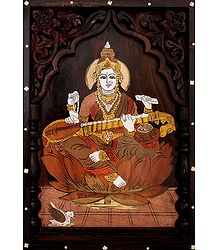
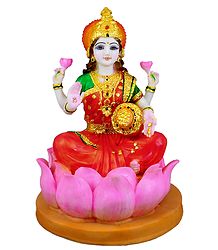
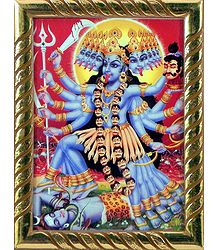
Shiva's power is Shakti, the dynamic creative mother aspect of the Godhead. It is she who creates and at the time of dissolution, it is she who swallows her own creation. Shakti cannot exist without Shiva and Shiva cannot personify without Shakti.
Therefore Hinduism proclaims the highest personification of God, the supreme energy, to be feminine. Hinduism is the only religion in the world, which conceptualizes the supreme form of Divinity to be a woman. This demonstrates the elevated status of women in Hinduism as a religion.
An important festival of the Hindus associated with goddess Durga is that of Durga Puja, which has been celebrated for ages by Hindus. In the Hindu epics Mahabharata and Ramayana there are various references to goddess Durga. When the Pandavas entered the capital of Virata for their period of one year in disguise they propitiated Durga who appeared before them and granted them boons. Again, at the commencement of the great war of Kurukshetra, Lord Krishna advised Arjuna to worship Goddess Durga to ensure victory in battle.
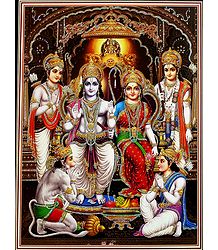
The festival of Durga Puja is popularly attributed to a tale from the Hindu epic, Ramayana. Lord Rama went to Lanka, the kingdom of Ravana - the demon king, to rescue his abducted wife, Sita. Before starting for his battle with Ravana, Rama wanted the blessings of goddess Durga. He came to know that the goddess would be pleased only if she is worshipped with one hundred eight 'Neel Kamal' or blue lotuses. Rama, after travelling the whole world, could gather only one hundred seven of them. He finally decided to offer one of his eyes, which resembled a blue lotus. Durga, being pleased with the devotion of Rama, appeared before him and blessed him. The battle with Ravana started on the 'Saptami' (the seventh day after the new moon night just prior to the Autumn festival of Durga Puja) and Ravana was finally killed on the 'Sandhikshan' i.e. the crossover period between Ashtami (the eighth day after new moon) and Navami (the ninth day after new moon). Ravana was cremated on Dashami (the tenth day after new moon). Since the period of this worship was different from the conventional period of worship of Durga (during the spring - 'Basanta'), this puja is also known as 'Akal-Bodhan' or worship (Bodhan) at an unconventional time.
Durga Puja is a Hindu festival observed in Ashwin Navaratri (month of October) and is celebrated all over India with great joy especially in West Bengal. The festival is also popular by other names like Dusshera and Navaratri. The ten days of festivity are dedicated to the supreme mother goddess Durga.
{{image-19}}
Worship of goddess Durga signifies the process by which the divine potential within every being removes its layers of ignorance and achieves the state of self-realization. Hindus celebrate this occasion at an auspicious time every year to constantly remind themselves of the significance of this very process. They contemplate the progress made on their spiritual journey and celebrate with great joy the victory of the supreme consciousness over the demons of ignorance. The festival is also a reminder that evil can never triumph over the power of truth.
Durga Puja is the greatest Hindu festival in which God is adored as Mother. Hinduism is the only religion in the world, which has emphasized to such an extent the motherhood of God. Perhaps the greatest testament to the power of Durga Puja is that even today the Mother is worshipped by billions of Hindus world wide in exactly the same manner as she was thousands of years ago.
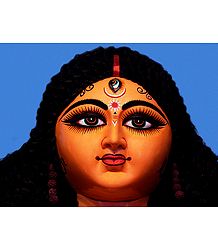
Images of Durga usually have an extra divine eye in the middle of the forehead. There can be four, eight, ten, eighteen, or twenty arms. The most common objects held in the hands are a conch, discus, trident, bow, arrow, sword, dagger, shield, rosary, wine cup, and bell. Her hair is in Karandamukuta, a crown style of hairdo. She wears gorgeous red clothes and several ornaments, and stands on a lotus or the head of a buffalo or rides a lion. There are endless aspects of Durga described in the Puranas and Agamas (ancient Hindu texts) and the iconography is consequently varied.
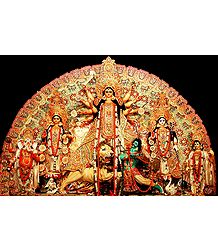
The most important form of Durga is as Mahishasuramardini or the slayer of Mahishasura (the demon king). The image is of the Goddess cutting off the head of the buffalo-demon. This image usually most commonly is shown with eight or ten arms, and the hands hold weapons and a lotus. Mahishasura, the demon, may be shown half emerging in his human form from the carcass of his former buffalo form.
At the Durga Puja, the most important festival of Durga, she is shown with four other deities - usually smaller in size than that of goddess Durga. Two deities are placed on each side of the main idol of goddess Durga. These deities are Kartikeya, Ganesha, Saraswati, and Lakshmi, who are commonly identified as her children. The festival of Durga Puja usually involves beautiful and larger than life clay idols of Durga and her accompanying deities.
In eastern India Durga Puja is celebrated with enormous vigor. Enormous tents spring up in practically every locality and an amazing array of idols of Durga, crafted from the special clay of river Ganga, are installed. These idols are crafted by skilful idol makers using a wide array of alternative materials, the range limited only by imaginative creativity. The most common of these of course is clay. However, other innovative media like shola pith, coconut husk, cloth, and flowers, amongst others are popularly used. Legend has it that the idol of the goddess is incomplete without a pinch of clay from a prostitute's courtyard. This probably was society's attempt to include and accord status to its most alienated beings.
The four days (beginning with the sixth day after the last new moon before the festival) of the festival is actually representative of the home-coming of goddess Durga along with Kartik, Ganesha, Saraswati and Lakshmi. These four days are marked by celebration and merry-making. The deities are presented with offerings throughout the festivities. On Vijayadasami, the "Victorious Tenth Day," the idols are taken in a parade to a river or tank and immersed as a representation of bidding a tearful goodbye to the deities. This is usually a very emotional time for devout Hindus who accompany the idols to the immersion spot.
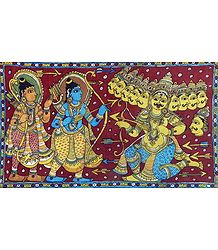
The same day sees millions of Hindus also celebrate the festival of Dusshera which marks the end of evil, as depicted by the burning of huge effigies of Ravana, Kumbhakarna and Meghnad - the three demon brothers, Ravana being the king of demons. All three were defeated by Lord Rama on this day.
Other forms of festivities during the period preceding Dussehra or Vijayadashami also exist, the most popular being that of the Navaratri festival, which involves the propitiation of Goddess Durga in nine different forms called the Nava-Durga (explained in an earlier section), over the nine days preceding Dussehra and starting on the first day after the last new moon preceding Dusshera. During Navaratri, one of each of these nine forms of goddess Durga is worshipped on a particular night for the destruction of evil and for the preservation of Dharma (religion).
The Devi Mahatmya indicated that Durga, in the form of Mahamaya or Mahashakti, pervades the universe in both its forms as material and thought. She creates, maintains, and periodically destroys it. When the balance of the universe is disturbed, Durga assumes various forms to restore order and balance. She is thus also, the guardian of dharma or cosmic order. This nature of hers makes her akin to a female form of Lord Vishnu since the concept of a deity assuming a separate form for maintaining the cosmic order is central to Vaishnavism - the Hindu sect which follows Lord Vishnu as the sole universal power.
The Devi Mahatmya talks about three such cosmic interventions by Durga on behalf of the gods: the battle with Madhu and Kaitabha, the battle with Mahishasura - the buffalo-demon, and the battle with Shumbha and Nisumbha.
The Devimahatmya states that Durga is the universe. "As immanent in the world Durga is equated with the earth. As transcendent, she is the heavenly queen who descends from time to time to maintain harmony on earth." (Kinsley 1986, 105)
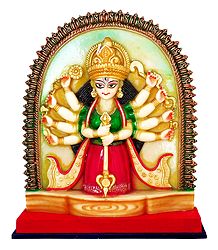
The Divine Mother is beyond all material attributes, eternal and ever omniscient. She is beyond any change, immutable and unattainable but by yoga. She is the refuge of the universe and her nature is of pure consciousness.
Durga, the Mother Goddess is the symbol of all the auspicious and true qualities which define the Supreme Being. Of all her forms, Devi Durga is the ultimate representation of infinite power, purity and strength of purpose, which resides within the divine essence of every being.
Om. She Who Conquers Over All,
All-Auspicious, the remover of Darkness,
the Excellent One Beyond Time,
the bearer of the Skulls of Impure thought,
the reliever of difficulties, loving, forgiving,
supporter of the Universe,
accept the oblations of the devotee who is one with you,
accept the oblations of ancestral praise,
We bow to you.
This article was written by:
Madhuri Guin